TFTC – Truth for the Commoner
Bitcoin Brief
|
|
Sup, freaks.
Yesterday we covered the Kelp DAO exploit that drained $13 billion from DeFi in 48 hours. Overnight, the story got worse. Arbitrum's Security Council unilaterally froze $90 million in stolen ETH, proving what Bitcoiners have been saying for over a decade: the entire DeFi complex is decentralized in name only. They erode UX and build complexity to feign decentralization so they can push affinity scams and Ponzi schemes on the public. Meanwhile, BlackRock just locked the exits on a $26 billion private credit fund. Bitcoin is the only truly decentralized cryptocurrency, and it trades 24/7 with no gates, no lockups, and no committee deciding when you can access your own money. Everything else is a LARP.
|
|
LEAD STORY
|
Arbitrum Freezes $90M in Stolen ETH, Proving DeFi Is Decentralization Theater
As we covered in yesterday's Brief, a bridge exploit in the Kelp DAO ecosystem wiped $13 billion from DeFi in two days. Overnight, the response made things worse. The Arbitrum Security Council took emergency action to freeze 30,766 ETH (roughly $90 million) held in an address connected to the KelpDAO exploit. A multisig of insiders unilaterally reversed a transaction on what claims to be a "decentralized" Layer 2 network. They acted "with input from law enforcement" on the exploiter's identity. The funds were moved to "an intermediary frozen wallet" and can only be moved by "further action by Arbitrum governance."
This is functionally identical to what a bank does when it freezes a suspicious account. The difference is that banks don't pretend to be decentralized.
Zach Rynes laid out the absurd complexity that made this exploit possible: people staked ETH on Ethereum to earn yield, except they didn't want their capital locked, so they staked through Lido (stETH). Then they restaked via Eigenlayer, except through KelpDAO (rsETH). Then they leveraged looped in Aave, borrowing ETH against rsETH collateral and restaking the ETH into more rsETH. Except rsETH used a cross-chain bridge called LayerZero that got hacked by North Koreans, causing rsETH to become undercollateralized. Now the looping positions are stuck, everyone is pointing fingers, and "also DeFi is a very serious industry."
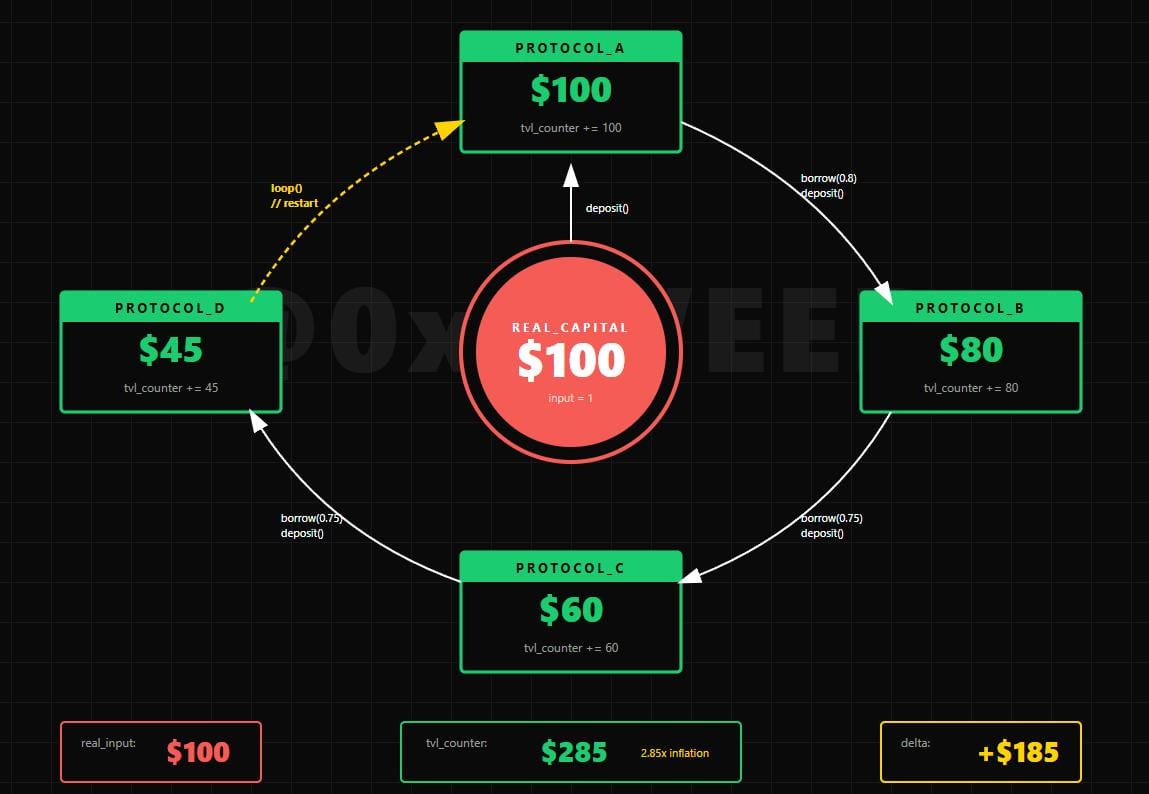
As @0xSweep explained, DeFi was never a financial system. It was a loop designed to manufacture synthetic valuations from minimal capital. You deposit $100 into a protocol, that's $100 TVL. You borrow $80 against it and deposit somewhere else, now there's $180 counted. You borrow $60 against that and deploy again, now $240. Loop it one more time and you have $285+ across protocols from the same $100. "TVL became FDV in a different format." Strip out token-denominated TVL, emission-based yield, recycled collateral, and wash volume, and what's left is a small set of protocols actually moving capital. "DeFi didn't fail. It worked exactly as designed."
Francis Pouliot of Bull Bitcoin put it bluntly: "The shitcoin ecosystem is facing an existential crisis. The only 2 real use-cases for web3 ended up being stablecoins and crypto lending. Both of these can be implemented with Bitcoin-native systems without unsecure rube-goldberg machines, ponzi tokens, ICOs and blockchains interconnected with 'smart contracts' that depend on dubious 'tokenomic engineering' for their security models."
Predictably, defenders of Ethereum and the Arbitrum ecosystem are already arguing that this wasn't a "decentralization violation" but a "validity violation." The Security Council, they claim, was simply enforcing the rules of the protocol as designed. This is semantic nonsense. If 12 people can get in a room, freeze a supposedly self-custodial wallet, and move funds out of it with input from law enforcement, your system is not decentralized. Full stop. It does not matter what you call it. The outcome is identical to a centralized entity seizing assets. Dressing it up in governance theater and protocol jargon doesn't change what happened.
Bitcoin doesn't need a Security Council to freeze funds because Bitcoin doesn't have single points of failure. No multisig committee can rewrite the ledger. No "governance vote" can reverse a transaction. That's not a limitation. That's the whole point. You only need blockchains for distributed sound money in the digital age. Everything else adds complexity to extract value from greater fools. The reckoning is here.
|
|
|
SIGNAL
|
Commander of US Pacific Fleet Endorses Bitcoin for National Security
Why it matters: A four-star admiral running the largest fleet command on the planet just called Bitcoin a national security asset.
Admiral Samuel Paparo, Commander of US Indo-Pacific Command, said that "Bitcoin shows incredible potential for national security" and that "proof of work imposes more cost than just the algorithmic securing of networks." The Pentagon is framing Bitcoin as a cybersecurity tool and a form of power projection. This is a profound shift. The commander responsible for deterring China in the Pacific is publicly endorsing Bitcoin's security model. Not "blockchain." Not "crypto." Bitcoin, specifically, and proof of work, specifically. When the military starts talking about proof of work as a strategic asset, the Overton window has moved.
|
|
Scammers Demand Bitcoin for Safe Passage Through Hormuz
Why it matters: Crypto is now a weapon in the fog of war at the world's most important chokepoint.
Fraudulent messages demanding Bitcoin or USDT for "safe passage" through the Strait of Hormuz have been sent to shipping companies with vessels stranded in the Gulf, according to Greek maritime risk firm MARISKS. Unknown actors impersonating Iranian authorities are requesting crypto payments for "clearance" through the strait. MARISKS warned that at least one vessel fired on by Iranian boats last Saturday had paid the fraudulent fee. Hundreds of ships and roughly 20,000 seafarers remain stranded. Iran itself had previously proposed crypto-based tolls for transit because, as they put it, the fees "can't be traced or confiscated due to sanctions." Whether the official tolling system ever operated at scale remains disputed. TRM Labs says they've found no on-chain evidence of crypto being used for Hormuz transit fees. Either way, scammers have found a new attack surface in the chaos.
|
|
Warsh Tells Senate: "The Fed Must Stay in Its Lane"
Why it matters: Trump's pick for Fed Chair faces senators today with a message about limiting the central bank's scope.
Kevin Warsh released prepared remarks for his Senate Banking Committee confirmation hearing today. He says he's "committed to ensuring that the conduct of monetary policy remains strictly independent" but also criticized the Fed for overstepping its boundaries on multiple occasions. Polymarket has the April 28-29 FOMC meeting at 99.4% no change, keeping rates at 3.5%-3.75%. The real question: once confirmed, does Warsh open the door to cuts later this year?
|
|
Stanford AI Index 2026: Open-Source AI Models Now Match Proprietary
Why it matters: The performance gap between open and closed AI models has essentially closed.
Stanford's annual AI Index dropped last week. Key findings: Anthropic, xAI, Google, OpenAI, Alibaba, and DeepSeek all occupy the top tier of Arena Elo ratings, meaning open-source models from DeepSeek and Alibaba are now competing head to head with closed models from OpenAI and Anthropic. The biggest category gains came from agentic AI, specifically autonomous coding (SWE-Bench) and autonomous computer use (OSWorld). AI training now competes directly with other industries for energy and semiconductor capacity. Bullish for energy-dense assets, bullish for Bitcoin miners who can provide demand response flexibility to strained grids.
|
|
Amazon Acquires Globalstar for $11.6 Billion: Space Is the Next Race After AI
Why it matters: After AI, space is shaping up to be the next great corporate arms race, and this deal proves it.
Amazon is buying Globalstar for $90/share ($11.57 billion) to add direct-to-device satellite services to its Project Kuiper constellation. Apple had a 20% stake in Globalstar. Amazon, SpaceX (Starlink), and Apple are now all making massive bets on satellite infrastructure that bypasses terrestrial networks entirely. The pattern is clear: after the AI buildout comes the space buildout. Direct-to-device satellite connectivity means any phone becomes a node on a global network that no single government controls. For Bitcoiners, every new satellite constellation is another layer of censorship resistance. The more redundant the global communications infrastructure, the harder it becomes to shut down Bitcoin transactions anywhere on Earth.
|
|
Iran Ceasefire Expires, Hormuz at Standstill, Peace Odds at 12%
Why it matters: The geopolitical backdrop that pushed oil to $100+ is not resolved.
The two-week US-Iran ceasefire expired today with no permanent deal. The situation has been wild: Iran declared Hormuz "fully open" last week, then reclosed it the next day. The US Navy seized an Iranian cargo ship. CENTCOM says 27 ships have been turned back since the blockade began, with 20+ vessels attacked in recent weeks. Oil is up roughly 6% on the week. Polymarket gives just 12.5% odds of a permanent peace deal by April 22. JD Vance may travel to Islamabad for second-round talks. Bitcoin reclaimed $75,000 as markets price in continued uncertainty.
|
|
|
PRESENTED BY
|
Unchained
Unchained is the most secure way to hold your bitcoin. Their collaborative custody vaults put you in control of two of three keys while Unchained holds one for recovery support. No single point of failure. Your keys, your bitcoin, with a partner who has your back if something goes wrong. Over 10,000 clients trust Unchained with their bitcoin security.
Secure Your Bitcoin
Sponsor
|
|
|
DATA SNAPSHOT
|
| Bitcoin Price | $75,939 |
| Sats per Dollar | 1,317 |
| Block Height | 946,055 |
| Network Hashrate | 876.3 EH/s |
| Priority Fee | 4 sat/vB |
|
| On-Chain Metrics |
| MVRV Ratio | 1.40 Fair value range |
| SOPR | 0.992 Coins moving near breakeven |
| STH Realized Price | $80,647 Short-term holders underwater |
| NUPL | 0.287 Optimism zone |
| Realized Cap | $1.08T Aggregate cost basis of all coins |
|
|
|
|
|
|
If this landed, forward it to someone who could use more signal and less noise. Marty's Bent is free, always will be.
See you tomorrow,
Marty Bent
|
|
|
Follow: @MartyBent · @TFTC21
Nostr: primal.net/marty
YouTube: TFTC · Podcast: tftc.io/podcast
|