Finland Halts Google's €13B AI Data Centers Over Missing Environmental Reviews
Finland's Licensing and Supervision Agency issued stop-work orders against Google's subsidiary Tuike Finland Oy on October 6, halting site preparation at two data centers central to the company's €13 billion AI infrastructure push in northern Finland.
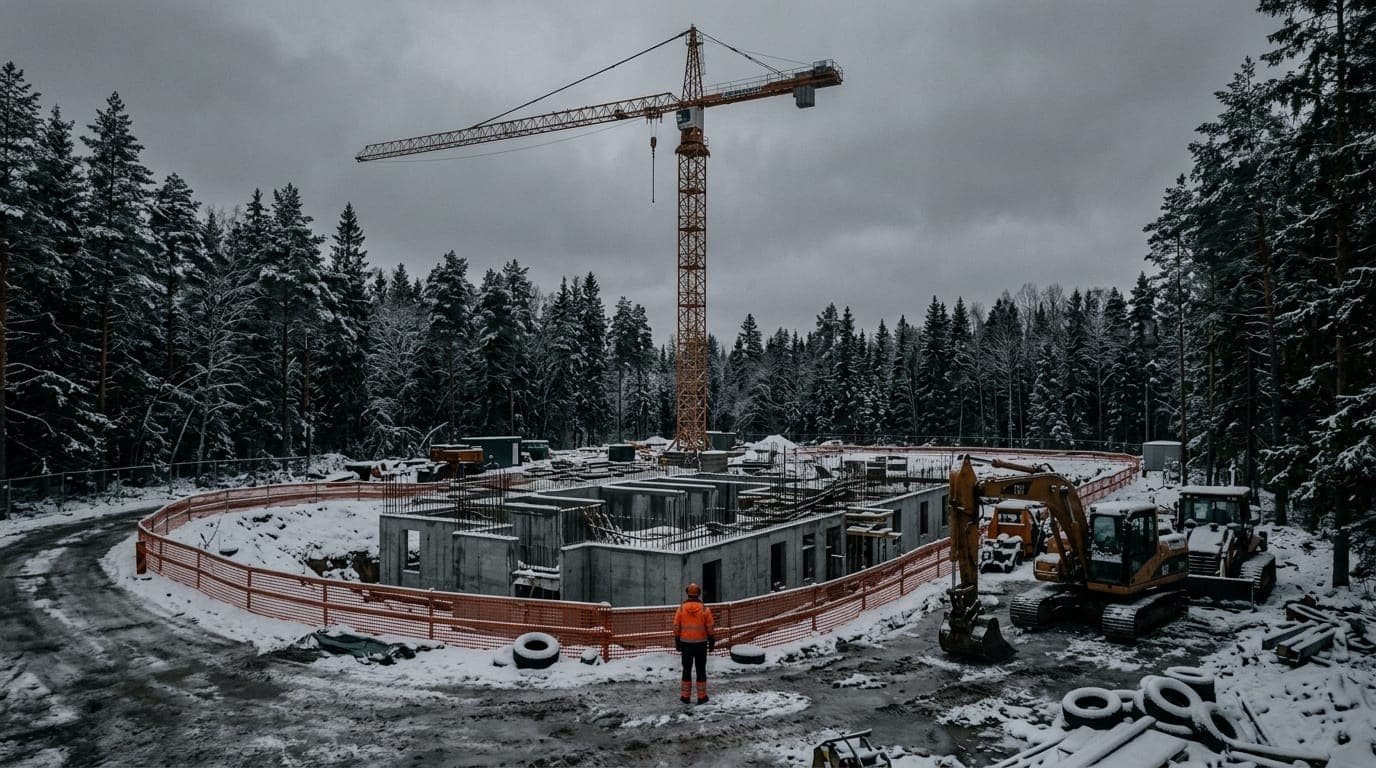
Finland's regulator stopped construction at two of Google's most strategically important European data center sites. The reason: trees cleared and ground broken before the law said it was legal to do so.
Key takeaways
- Finland's Licensing and Supervision Agency (LVV) issued stop-work orders on October 6 against Tuike Finland Oy, Google's local subsidiary, covering data center sites at Muhos and Kajaani; all heavy construction must cease by October 23.
- Google cleared hundreds of hectares of forest and altered terrain at both sites before completing legally required Environmental Impact Assessments, drawing orders that could escalate to conditional fines if ignored.
- The halt exposes a constraint the AI capex narrative consistently underweights: grid access and capital are not the binding limits on hyperscaler buildout, physical land law and national sovereignty are.
Finland's Licensing and Supervision Agency (LVV) issued two stop-work orders on October 6, 2026, against Tuike Finland Oy, the Google subsidiary responsible for the company's northern Finland data center buildout, per an LVV statement (diary numbers LVV-U/37128/2026 for Muhos, LVV-U/22159/2026 for Kajaani, available via lupavalvonta.fi). Tuike Finland must submit a written explanation by October 14 and halt all heavy site work by October 23 or face enforcement proceedings, including a conditional fine.
The two sites sit at the center of Google's €13 billion investment in Finland, announced in September 2026 and described by the company as its single largest investment in Europe. The problem: site preparation including tree clearing, topsoil removal, excavation, road construction, and drainage alteration proceeded at both locations before mandatory Environmental Impact Assessments were completed.
What the LVV Found
The agency's Environmental Department head, Tommi Muilu, put the violation plainly in the LVV press release: "Our assessment is that these measures change the environment and cause impacts whose identification and assessment are among the central objectives of the environmental impact assessment procedure."
Finnish and EU law require EIAs to be completed before irreversible site changes occur, precisely because those changes are the thing regulators are there to evaluate. Google had partnered with Finnish grid operator Fingrid to identify locations with grid-friendly connections in northern Finland, where Fingrid had indicated significant grid capacity was available, per Google's September 2026 investment announcement. The capital was committed. The problem was that the land alteration happened first and the legal process came second.
Google acknowledged the sequence publicly. A spokesperson told CNBC: "We understand the concerns and have fallen short of our own high standards in this instance." Sondre Ronander, Google's Head of Communications for Finland and Norway, told Finnish broadcaster Yle: "We are examining the observations by the Finnish authorities carefully and will act in line with the instructions by Finnish authorities."
Finnish Minister of Climate and the Environment Sari Multala left no diplomatic ambiguity in a statement to Helsingin Sanomat: "This is a serious matter: all companies operating in Finland must comply with the law. In this case, that has not happened."
The Constraint the Capex Story Ignores
PwC projects $31.6 trillion in AI data center capex through 2050. The Texas grid authority is already auditing 1,800 stalled projects. Oracle invoked force majeure on a major buildout. The Finland case adds a different category of friction: not grid math, not chip supply, not financing. Environmental law applied to irreversible physical alteration of land.
The TFTC read: the Finland halt is evidence that the AI infrastructure buildout is running into constraints that a balance sheet cannot solve on a data center timeline. Google had grid capacity available in northern Finland, the capital, and the political backing of a significant bilateral economic relationship. It still got stopped, because hundreds of hectares of Finnish forest were cleared before a regulator signed off.
That asymmetry matters for anyone tracking the AI energy management picture. Large, centralized, politically visible hyperscaler projects carry EIA exposure at the scale they must operate. Bitcoin mining's modular footprint, tolerance for stranded and curtailed power, and ability to co-locate with existing industrial infrastructure typically fall well below the land-conversion thresholds that triggered this order.
The falsifiable version: if Google and other hyperscalers complete their pending EIAs before year-end 2026 as currently projected, resume construction without meaningful schedule impact, and no other European jurisdiction issues comparable orders in the next 90 days, this is a speed bump. If EIA timelines slip, if Vaala or Hamina face similar scrutiny, or if Sweden, Norway, or Ireland follow with analogous actions, the structural constraint thesis holds.
What to Watch
LVV says EIA procedures for both Muhos and Kajaani are underway and expected to conclude during 2026, but the agency has not committed to a hard date. Tuike Finland's written response is due October 14.
The two other Finnish municipalities in Google's buildout plan, Vaala and Hamina, are not under current orders. Whether they stay that way depends on whether Google's site preparation practices were consistent across all four locations. Watch the October 14 submission and the EIA completion announcements.
Sources
- LVV (Licensing and Supervision Agency of Finland), stop-work orders LVV-U/37128/2026 (Muhos) and LVV-U/22159/2026 (Kajaani), October 6, 2026; first widely reported via AFP, October 7, 2026
Frequently Asked Questions
Will this stop Google's entire €13 billion Finland investment?
No. The stop-work orders cover Muhos and Kajaani only and suspend heavy site preparation, not the overall investment commitment. Two other planned locations, Vaala and Hamina, are not subject to this order. EIA procedures for the affected sites are expected to conclude during 2026, after which construction could resume.
What is an EIA and why does it apply here?
An Environmental Impact Assessment is a statutory process under Finnish and EU law requiring regulators to evaluate significant environmental effects before irreversible site changes occur. The LVV determined that tree clearing, excavation, and drainage alteration at both sites constituted exactly the kind of irreversible change the EIA process exists to assess in advance.
Does this kind of regulatory halt affect Bitcoin miners?
EIA thresholds in Finland and across the EU are triggered by the scale and permanence of land alteration. Bitcoin mining operations are typically smaller, modular, and co-located with existing industrial or energy infrastructure, keeping them well below the land-conversion thresholds that triggered these orders. The regulatory exposure is asymmetric: it scales with footprint and visibility.