DOE Awards Prometheus Project $60M to Use AI to Halve Nuclear Costs
The DOE's largest Genesis Mission grant goes to a 32-partner consortium betting AI can cut nuclear deployment costs in half and compress build timelines by 2x. Energy is the binding constraint on AI scaling, and the federal government just put $60 million behind that thesis.
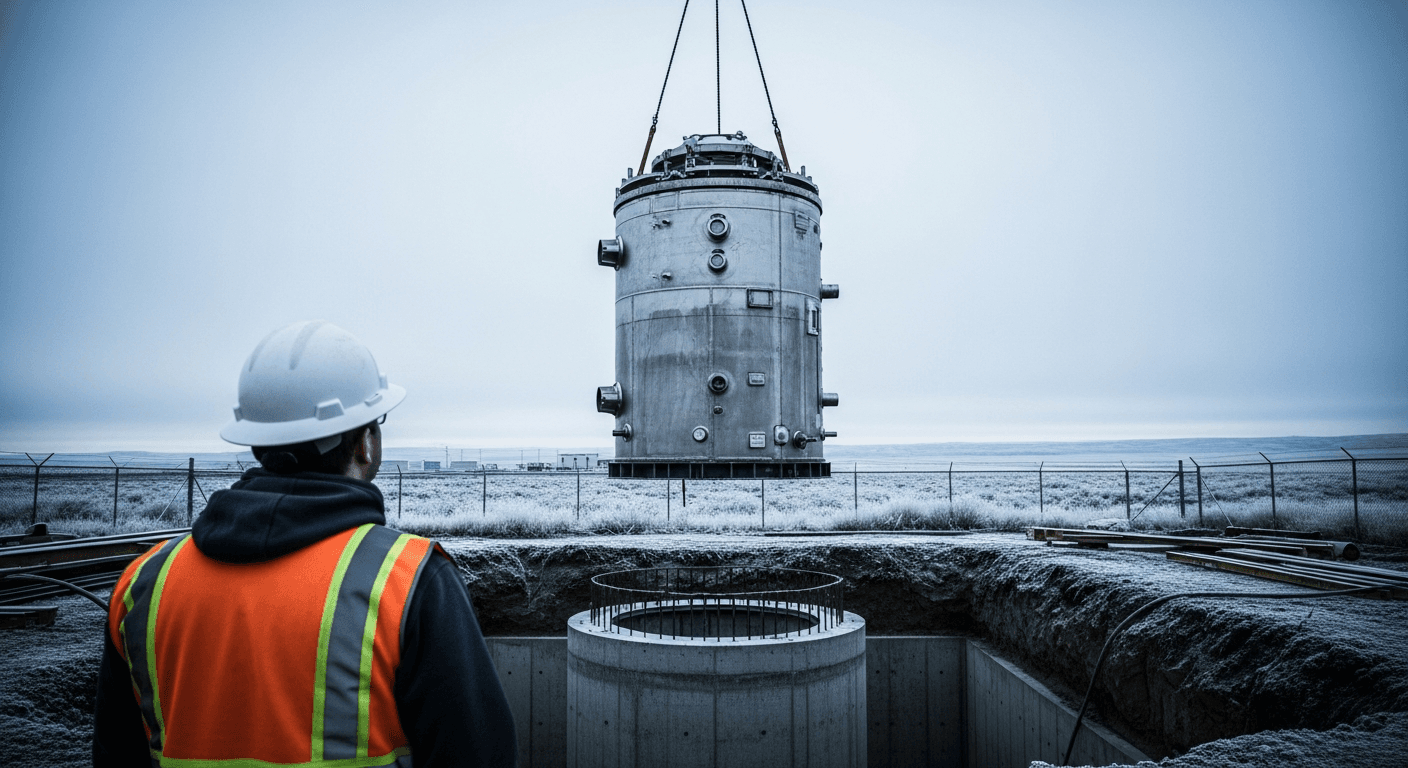
The federal government's biggest Genesis Mission grant backs INL, Nvidia, AWS, and X-energy in a three-year push to make advanced nuclear economically inevitable.
Key takeaways
- The DOE awarded Project Prometheus a $60 million Phase II grant on July 22, making it the largest individual Genesis Mission award across 278 selected projects and the only Phase II project announced so far.
- The consortium, led by Idaho National Laboratory with Nvidia, AWS, and X-energy as core partners, is targeting at least a 2x schedule compression and greater than 50% cost reduction in nuclear reactor deployment using AI.
- For anyone building long-duration physical infrastructure, including Bitcoin miners, the message is clear: whoever controls dispatchable baseload power wins the next decade of compute. The federal government just put $60 million behind that thesis.
The Department of Energy awarded Project Prometheus a $60 million Phase II Genesis Mission grant on July 22, selecting Idaho National Laboratory's 32-partner consortium as the single largest recipient across all 278 Genesis Mission projects. The award is subject to appropriations. Partners include Nvidia, Amazon Web Services, X-energy (Nasdaq: XE), Oak Ridge National Laboratory, Argonne National Laboratory, and Sandia National Laboratories.
The objective: deploy AI across every stage of the nuclear lifecycle, from reactor design and licensing to fuel fabrication and operations, with human-in-the-loop workflows throughout. The stated targets are aggressive: cut operational costs by more than 50% and compress deployment timelines by at least 2x compared to current baselines.
What the $60M Is Actually Buying
Prometheus is not a research curiosity. The INL release describes AI applications spanning legacy nuclear document management, advanced fuel fabrication, and real-time reactor operations. X-energy's Xe-100 pebble-bed, high-temperature gas-cooled SMR and its TRISO-X fuel serve as the core technical platform.
X-energy confirmed its Tier 1 partner status on July 22. The company carries an 11-gigawatt commercial pipeline across the U.S. and U.K., and Amazon holds an option to deploy more than 5 GW of X-energy nuclear capacity by 2039. That option, not a binding contract, is now the commercial pressure test Prometheus is designed to make viable.
The consortium raised more than $200 million in industry cost share alongside the $60 million federal grant. DOE Secretary Chris Wright put it plainly at the Genesis Mission Summit in Washington: "America has no shortage of bold ideas or talented scientists, and the response to the Genesis Mission proves that."
Sandia Associate Labs Director Toby Townsend framed the national stakes: "At a national scale, Prometheus will help us meet surging electricity demand while supporting the nation's strategic technological leadership."
Genesis Mission itself was launched by executive order in November 2025 with the goal of doubling U.S. scientific productivity within a decade through AI. DOE received more than 5,000 applications; 278 projects were selected across Phase I and Phase II. Prometheus is the only Phase II award announced July 22. Additional Phase II selections are expected in fall 2026.
Energy Is the Binding Constraint, Not Silicon
The $60 million number is not the story. The story is what it signals about where the AI infrastructure race is actually being fought.
AI efficiency gains don't reduce power demand, they expand the frontier of what gets computed. Hyperscalers have absorbed that lesson and are now moving capital from the GPU column into the energy column.
AWS has an existing agreement with INL on AI models and GPU infrastructure dating to July 2025. Nvidia and AWS signed DOE partnership agreements in December 2025, months before the Prometheus Phase II award. The federal government is now explicitly co-investing in the energy infrastructure that makes always-on AI compute viable.
That shift has direct implications for anyone competing for baseload megawatts. As covered previously, AMD and Anthropic announced a deal to deploy up to 2 gigawatts of compute with up to $5 billion in investment, and AI capex is now weaponizing eminent domain to accelerate transmission buildout. Prometheus adds a third vector: federal capital directly subsidizing the nuclear supply that hyperscalers need.
Bitcoin miners are watching the same dynamic from the other side. The DOE's $3.26 billion Texas grid loan is already rewriting the power interconnection queue. Prometheus accelerates the timeline for new nuclear supply, which expands total grid capacity in the long run, but in the near term, miners without locked-in long-term power agreements are getting squeezed from both ends.
The energy-monetizer thesis is validated by this, not threatened. Miners who operate as flexible, dispatchable loads, absorbing surplus power when AI demand is low and stepping back when it spikes, are exactly the grid partners that advanced nuclear operators need. The Genesis Mission's own "Dispatchable Data Centers" challenge targets precisely that load-shaping behavior. The infrastructure logic maps cleanly to what the best sovereign mining operations already do.
The falsifiable version of this thesis: if AI workloads shift toward intermittent, inference-only architectures that can tolerate interruptible cheap power (wind and solar plus batteries), the premium on always-on nuclear baseload shrinks and the energy-moat argument weakens. Watch the ratio of AI training compute to inference compute over the next two years.
Training demands firm, continuous power. Inference can tolerate variance. If inference dominates the growth curve, the Prometheus thesis gets harder to sustain.
What to Watch Next
The $60 million award is subject to congressional appropriations. If Prometheus gets caught in a budget deal or a continuing resolution standoff, the structural commitment is paper. Watch the fall 2026 Phase II announcements for whether DOE follows through on the remaining awards, and watch X-energy's commercial pipeline for the first signed contracts that convert that 11-gigawatt figure into steel in the ground.
Update, September 9, 2026
The DOE's public financing push for nuclear infrastructure extended well beyond Prometheus this week. DOE's Office of Energy Dominance Financing closed a loan of up to $1.9 billion to NextEra Energy to help finance the restart of the Duane Arnold Energy Center in Linn County, Iowa.
The plant ceased operations in 2020, and NextEra is targeting a 2029 restart. The loan was confirmed via the DOE's official announcement.
The AI-energy link here is explicit, not implied. The restart is underpinned by a 25-year agreement for Google to buy power from the plant to feed its expanding cloud and AI infrastructure in Iowa. DOE said its loan program has now financed three nuclear plant restarts and completed four concurrent conditional commitments and financial closings under the Trump administration.
For Bitcoin miners, the competitive picture keeps sharpening. Pending required NRC licensing approvals, the plant's restart will return reliable nuclear power to the grid and help meet growing electricity demand across Iowa and the Midwest. Google locking up 615 MW of dispatchable baseload under a 25-year PPA is exactly the kind of offtake structure that prices out less-capitalized buyers of firm power. Every gigawatt contracted to a hyperscaler is one fewer gigawatt available to miners at favorable rates.
Sources
Frequently Asked Questions
What is the DOE Genesis Mission and how does Project Prometheus fit into it?
The Genesis Mission was launched by executive order in November 2025 with the stated goal of doubling U.S. scientific productivity within a decade using AI. DOE received more than 5,000 project applications and selected 278 across Phase I and Phase II. Prometheus is the only Phase II project announced on July 22, 2026, and the largest individual grant at $60 million, with the remainder of Phase II selections expected in fall 2026.
How is X-energy connected to Amazon, and what is the 5 GW nuclear option?
Amazon, through AWS, holds an option (not a binding contract) to deploy more than 5 GW of X-energy nuclear capacity by 2039 to support grid reliability and AWS data center power needs. X-energy's Xe-100 SMR is the platform underpinning both that commercial arrangement and the Prometheus research initiative. X-energy joined Prometheus as a Tier 1 industry partner on July 22.
Does accelerated nuclear buildout help or hurt Bitcoin miners competing for power?
Both, depending on the timeline. Near-term, hyperscaler capex backed by federal grants intensifies competition for tight baseload supply. Longer-term, faster nuclear deployment expands total grid capacity. Miners who operate as flexible, dispatchable loads (absorbing surplus power rather than demanding firm allocation) become more attractive grid partners as variable AI demand grows, not less.