Britain's Grid Paid £1.4M/Hour for Gas as Wind Failed the Grid
Britain's grid operator issued an emergency margin notice and paid gas plants the equivalent of £1.4 million per hour as wind output fell for a third consecutive day. This is not an anomaly, it is what the net-zero grid looks like under stress.
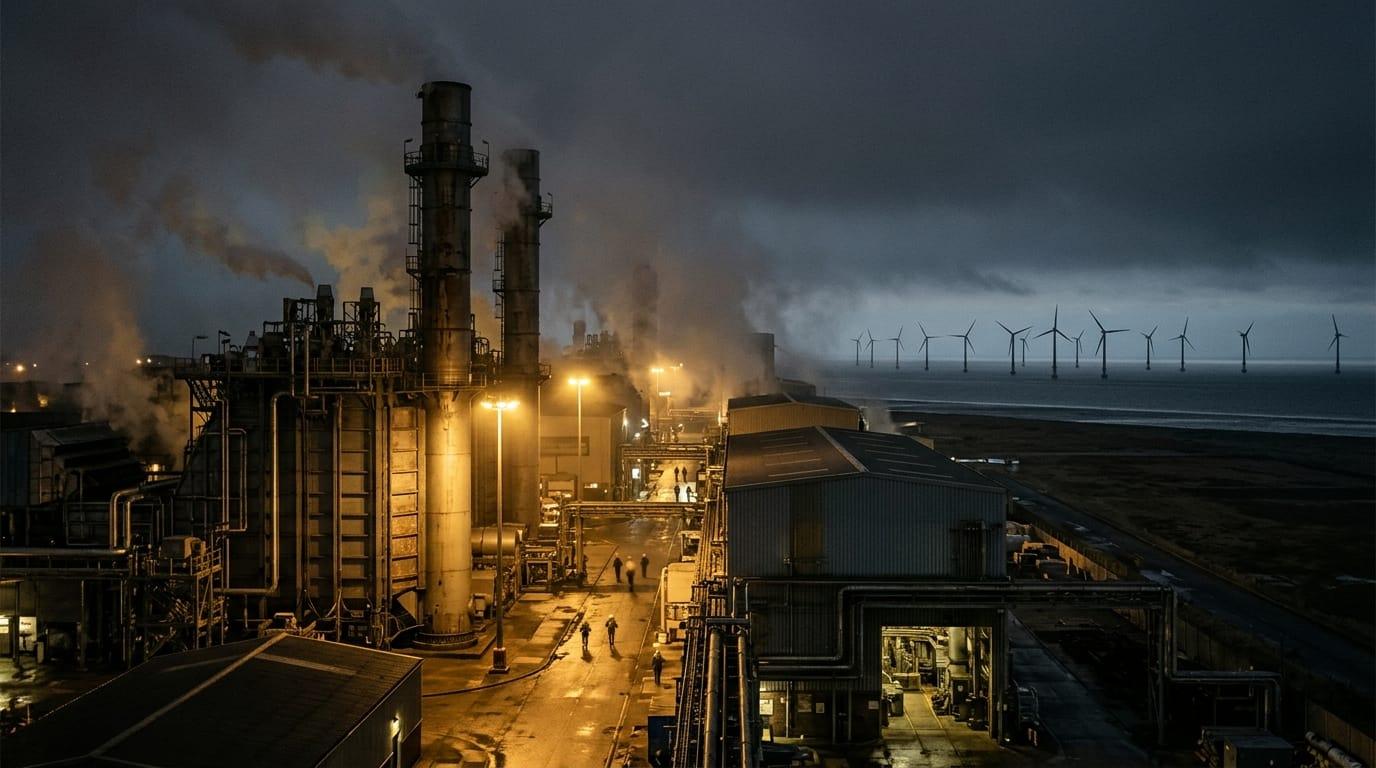
Britain's grid operator issued an emergency margin notice and paid gas plants the equivalent of £1.4 million per hour. This is what a renewables-dependent grid looks like when the wind stops.
Key takeaways
- NESO paid roughly £1,500/MWh, about 10 times the average market rate, to at least three gas plants during the evening peak on November 9, with Langage Power Station in Devon receiving the equivalent of £1.4 million per hour, according to market transparency data published by Elexon.
- Britain has issued seven Electricity Margin Notices so far in 2026, against one for the entire year of 2025, as the grid grows more dependent on weather-variable generation while aging dispatchable capacity retires.
- Grid-balancing costs hit a record £553 million in September 2026 alone and are tracking above £3 billion for the full year, costs that get socialized into consumer energy bills.
Britain's National Energy System Operator (NESO) issued an Electricity Margin Notice at 7:17pm on Sunday, November 8, flagging a 1,388 MW shortfall against an 808 MW contingency requirement for the 6am to 11am window on Monday, November 9, as low wind output ran into a third consecutive day. By Monday morning the notice was cancelled after the shortfall narrowed, but not before the balancing mechanism had already done its expensive work. This is a preview of a structurally constrained winter.
What NESO's Emergency Payments Actually Show
The Elexon BMRS market transparency data shows NESO accepted offer prices of around £1,500/MWh from at least three gas plants, Langage (Devon), Rye House (Hertfordshire), and Seabank (Bristol), during the 3:30pm to 5pm evening peak. The £1.4 million per hour figure for Langage is a rate derived from that offer price, not a confirmed lump-sum wire transfer, but it is directionally accurate and consistent with the underlying data.
That rate is roughly 10 times the average wholesale price. For context, September 2026 alone produced a record £553 million in grid-balancing costs. The year-to-date figure sits above £3 billion.
Every pound of that gets recovered through consumer bills and network charges. The costs are real; they are just obscured.
Kathryn Porter, an independent energy analyst quoted by The Telegraph (accessible via Yahoo Finance mirror), flagged the structural fragility plainly: "The question is, what happens if the modest wind recovery forecast for tomorrow evening is delayed, or if demand is higher than forecast, given the size of Neso's forecast errors, when margins are this thin there could be trouble." She also noted that a morning EMN was itself "unusual," since notices historically cover the evening peak, not Monday mornings.
NESO's own Winter Outlook puts the de-rated margin at 5.9 GW (9.5% of peak demand) and flags December and January as the most likely window for tight days.
The Structural Problem the Data Makes Legible
Monday's episode was the seventh Electricity Margin Notice of 2026, against one for all of 2025. The pattern is not random weather variance. It reflects a grid that has built out intermittent generation capacity without building proportional dispatchable backup to cover the gaps when that generation disappears.
The result is a system that simultaneously pays wind farms constraint payments to curtail output during surplus periods and pays gas plants 10 times the market rate to generate during shortfalls. That double payment is the transition's load-bearing cost structure, one that grows heavier as the remaining gas fleet ages and new firm capacity (nuclear, long-duration storage, new CCGT) is not yet online in sufficient volume. The AI data center build-out layering new, inelastic demand onto already-tight grids is not helping the math.
The falsifiable thesis here: Britain's emergency gas payments are not a temporary transition friction but a recurring, worsening structural feature until firm dispatchable capacity replaces what is being retired. That argument weakens only if NESO can demonstrate a credible near-term plan to bring material new firm capacity online, or if flexible demand-response assets are formally integrated into the balancing mechanism at scale, reducing the system's dependence on gas peakers for fast-response stabilization without paying emergency rates to do it.
The economics of flexible load point directly at Bitcoin miners as grid stabilizers. A miner operating as an interruptible load consumes power during surplus renewable generation that would otherwise require curtailment payments, then unplugs in seconds when grid margins tighten, faster than any gas turbine can physically ramp. NESO is currently paying on both ends of the same imbalance: curtailment on the surplus side, emergency procurement on the shortage side. Flexible industrial load closes that loop without the 10x price spike. The BMRS data makes this case arithmetically; the energy establishment has largely not engaged with it.
What to Watch This Winter
NESO's own guidance flags December and January as the highest-risk window. The critical variables are wind output duration (how many consecutive low-wind days), cold demand spikes, and whether any additional gas capacity can be contracted into the balancing mechanism before then. If another multi-day wind lull coincides with a cold snap in January, the November 9 episode looks mild by comparison. Watch the BMRS SYSWARN feed and the balancing costs that follow.
Sources
Frequently Asked Questions
What is an Electricity Margin Notice and does it mean power cuts are coming?
An EMN is a market signal, not a blackout warning. NESO issues one when it forecasts that available generation capacity may fall below the required contingency buffer, and it asks generators to declare any additional capacity they can bring online.
The November 9 notice was cancelled before the morning window it covered. No supply interruption occurred. The concern is not any single notice but the sharply rising frequency: seven in 2026 versus one in all of 2025.
Why can't excess wind power be stored to cover days like this?
Grid-scale battery storage at current capacity and cost cannot substitute for days of dispatchable generation. Britain's installed battery capacity can cover minutes to a few hours of system balancing, not a three-day wind drought across a large grid. That gap is why aging gas plants retain effective pricing power during low-wind periods. Long-duration storage and expanded nuclear capacity are the structural answers, but neither is available at the scale needed in the near term.
How much do grid-balancing costs add to British energy bills?
Grid-balancing costs are recovered through network charges embedded in consumer and business electricity bills. With balancing costs tracking above £3 billion for 2026 and September alone reaching £553 million, the annual per-household impact runs to hundreds of pounds. The costs are not itemized on bills, they are socialized across all users through regulated network charges, which is precisely why they attract so little political attention relative to their scale.