Amazon's $2B Gilroy AI Data Center Cleared by One Bureaucrat, No Vote
A 45-year-old industrial zoning classification let Amazon plant a 49-megawatt data center in a disadvantaged California community without a single elected vote. Gilroy is now scrambling to rewrite its rules before Phase 2 arrives.
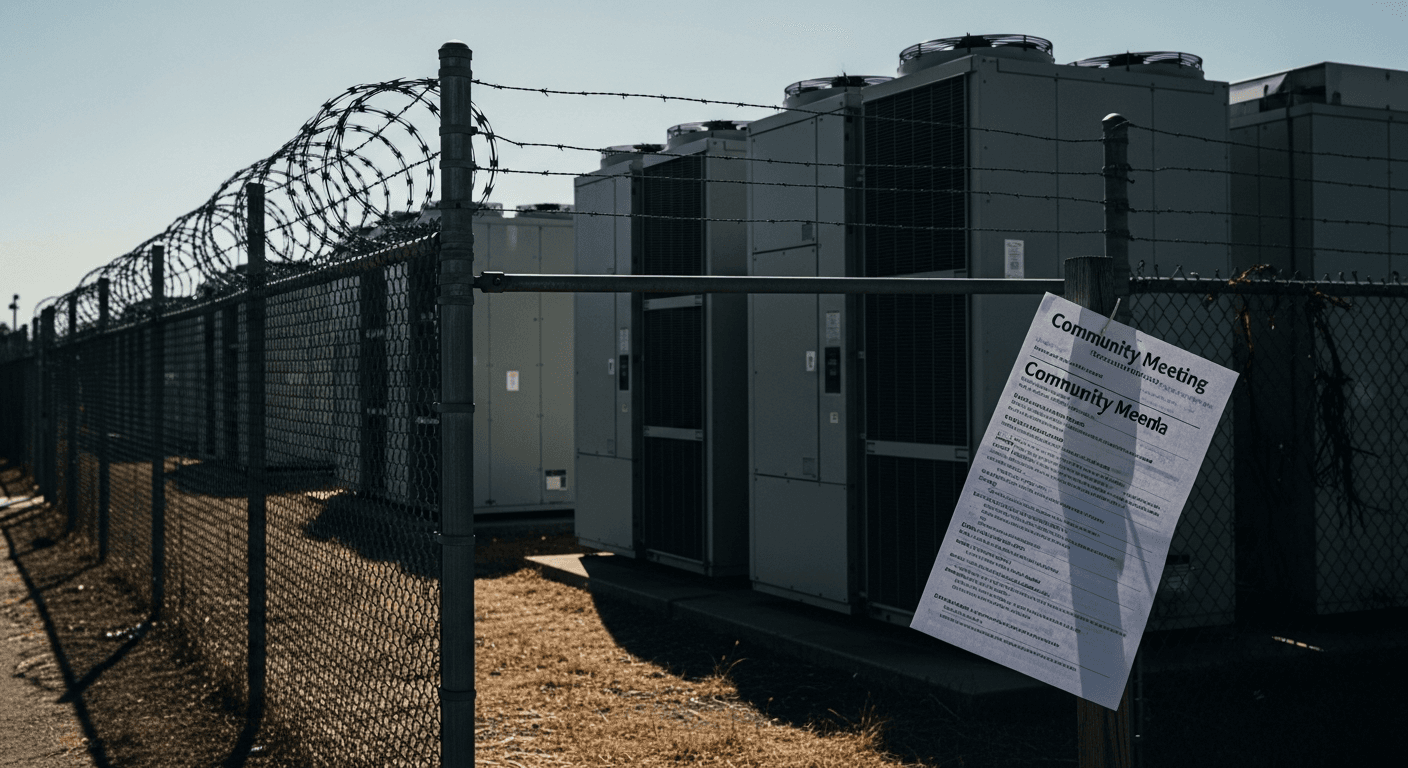
A 45-year-old zoning rule handed a single city administrator the authority to greenlight a 49-megawatt AI data center. Gilroy residents found out after the fact.
Key takeaways
- Amazon's 49-megawatt Gilroy data center was approved at the staff level by Community Development Director Sharon Goei under a 1981 industrial zoning classification that requires no City Council vote and no Planning Commission review.
- The facility sits above the sole-source drinking water aquifer for three California cities, draws the equivalent power of tens of thousands of homes, and is permitted to run diesel backup generators in a state-designated disadvantaged community where no Spanish-language notice was issued.
- Gilroy's City Council is now pursuing zoning reform before Phase 2 permits are filed, after a June 15, 2026 public hearing packed the chamber, with 17 of 21 speakers opposing further data center development.
Amazon Web Services planted a 438,500-square-foot AI data center on a 56-acre parcel at 8050 Camino Arroyo in Gilroy, California without a City Council vote, without a Planning Commission hearing, and without notifying the surrounding community in Spanish, per the City of Gilroy's official project page and the CEQAnet state environmental filing. The approval was signed by Community Development Director Sharon Goei under Gilroy's M2 General Industrial zoning district, a classification written in 1981, before the internet existed and before "data center" was a land-use category anyone needed to define.
The mechanism is straightforward: M2 zoning permits warehouse and industrial uses by right, requiring only a staff-level Architectural and Site Review Permit. No elected body ever saw the application. The community had no formal comment window. First reported by Broadband Breakfast, the approval drew little attention until local opposition coalesced into the Stop Gilroy Data Center group and the story reached Bay Area television.
What the Permit Actually Authorized
The Phase 1 facility runs at 49 megawatts. The California Energy Commission's SPPE filing documents the backup generator buildout across both phases.
The site sits above the Llagas Subbasin, the sole-source drinking water aquifer for Gilroy, San Martin, and Morgan Hill. The surrounding neighborhood is a state-designated disadvantaged community. No Spanish-language notice was provided to a population that community organizers describe as majority Latino.
Amazon purchased the parcel in 2020 and owns additional land in Gilroy beyond the current footprint. Phase 2 is planned.
The community organized. Resident group Stop Gilroy Data Center circulated a petition and showed up at Gilroy City Council on June 15, 2026. Chambers were full. Of 21 public speakers, 17 opposed further data center development.
Lead organizer Britt Smith put it plainly: "Our biggest problem is that the letter of the law is not correct. It is not adequate for our community, what we need in terms of transparency and accessibility."
The Process Worked Exactly as Written
That is the problem. No one broke a rule. Goei applied the M2 classification correctly. AWS filed the right paperwork.
The process produced this outcome not because someone went rogue, but because the code was never designed for a facility of this scale and consequence.
A 1981 industrial zoning ordinance cannot anticipate a 49-megawatt computing load, backup generator fleets, or the groundwater liability of siting hyperscale infrastructure above a sole-source aquifer. The classification didn't fail. It was simply never built to handle this. That gap was exploited, whether deliberately or not, and Amazon's $2 billion facility is now in the ground, a figure Amazon itself cited in a public statement to the Gilroy Dispatch.
This pattern is not unique to Gilroy. More than 69 jurisdictions have enacted data center bans or moratoriums as of mid-2026, according to Data Center Watch data cited in trade coverage. At least $130 billion in data center projects were blocked or delayed in Q1 2026 alone.
The thesis here is falsifiable: if the record shows AWS proactively sought a full public hearing before breaking ground, and voluntarily disclosed all environmental impacts in the community's language, this is a company operating lawfully inside a permissive code. The story only holds if city staff and the applicant both understood the M2 route would foreclose public comment and chose it regardless. The CEQA timeline on file is the document to audit.
For anyone who has spent time thinking about why permissionless systems matter, the Gilroy situation is an unusually clean case study. The residents now fighting for zoning reform are asking for exactly what sound system design requires: rules that don't depend on whether the right administrator is paying attention on the right day. A single point of approval with no appeal, no elected check, and no requirement to notify the affected community in their language is a system optimized to fail the public when the stakes get high enough.
What Happens Before Phase 2
The City Council is weighing zoning code changes that would require Planning Commission review for future data center applications. That reform has not passed. Amazon owns additional Gilroy land and Phase 2 is in the pipeline.
If the code is not updated before Phase 2's permit application is filed, the 1981 M2 classification applies again. The community will have watched it happen once, been handed a public hearing, and still been unable to stop the replay. The June 15 council meeting was not a resolution. It was a warning.
Sources
Frequently Asked Questions
Can the existing Gilroy data center be reversed or shut down?
The Phase 1 permit has already been issued and construction is underway. A CEQA challenge could theoretically slow or modify the project, but retroactive permit reversals are historically rare and slow-moving. The practical community lever is blocking Phase 2 through zoning reform before a new application is filed under the existing M2 classification.
Why did the 1981 M2 zoning allow this without a public vote?
Gilroy's M2 General Industrial district, established in the city's original zoning code, lists warehouse and industrial uses as permitted by right. Staff can approve them through an Architectural and Site Review Permit with no council or commission involvement. Data centers were never enumerated as a separate category, so they've been administratively folded into routine industrial use, giving a single city employee the authority to approve facilities of any scale.
Is this pattern occurring elsewhere?
Yes. More than 69 jurisdictions across the United States have passed data center bans or moratoriums as of mid-2026. Several states are moving toward legislation requiring mandatory public hearings for hyperscale facilities above defined power-draw thresholds.