142 Protests in 42 States Signal Hard Ceiling on AI Data Center Buildout
HumansFirst organized 142 protests across 42 states on July 18, 2026, the first nationally coordinated day of action against AI data center construction. Data Center Watch puts cumulative blocked or delayed projects at roughly $286 billion since 2025.
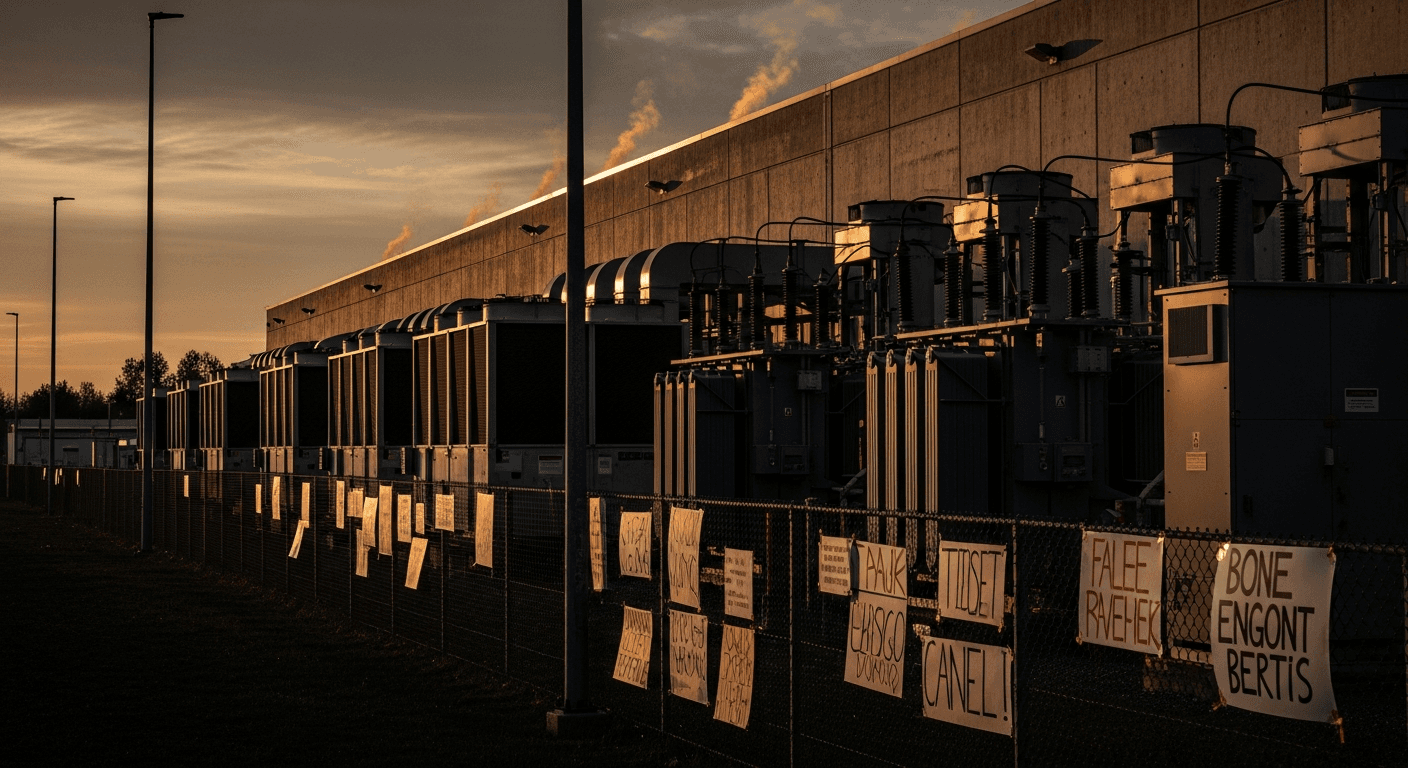
HumansFirst's first national day of action reveals a grassroots resistance movement that has blocked or delayed roughly $286 billion in AI infrastructure, and it's hardening.
Key takeaways
- On July 18, 2026, HumansFirst organized 142 protests across 42 states against AI data center construction, the first nationally coordinated day of action against the AI infrastructure buildout.
- Data Center Watch's Q1 2026 report tallies 75-plus projects worth $130 billion blocked or delayed in that quarter alone; opposition groups more than doubled to 833 across 49 states since the end of 2025.
- The same grid friction now strangling centralized AI capex is the bottleneck Bitcoin miners have been navigating for years, and it points toward distributed, behind-the-meter compute as the durable model.
HumansFirst staged 142 protests across 42 states on July 18, 2026, the first nationally coordinated day of action against AI data center construction in the United States, per Reuters. The demonstrations mark the public face of a resistance movement that, per Data Center Watch's Q1 2026 report, has blocked or delayed more than $130 billion in AI infrastructure in Q1 2026 alone, with cumulative blocked and delayed investment reaching approximately $286 billion since 2025, per Morgan Stanley's July 14, 2026 research note.
Amy Kremer, co-founder of HumansFirst and a Tea Party veteran, described the sentiment driving the coalition: "They just woke up one day and found out they're going to have this monstrosity in their community, and they don't want it." The group frames its fight as nonpartisan. Kremer has criticized Republicans for giving Big Tech a "free pass" on the buildout.
The Scale of Opposition
The protest count is striking. What matters more is what it represents underneath. Data Center Watch (a project of 10a Labs, which counts AI companies among its clients) tracked 75-plus projects worth $130 billion blocked or delayed in Q1 2026 alone. Cumulative blocked and delayed investment across 2025 and Q1 2026 reached approximately $286 billion, per Morgan Stanley's July 14, 2026 research note (an institutional note with no public URL). Against Morgan Stanley's estimate of $877 billion in total AI capital spending in 2026, that is roughly one dollar in three of planned AI infrastructure held up by opposition.
Opposition groups more than doubled from 396 at the end of 2025 to 833 by March 2026, spread across 49 states. More than 300 bills targeting the data center buildout were introduced in state legislatures in the first half of 2026.
Public opinion data reinforces the structural read. A June 2026 Reuters/Ipsos poll found only 14% of Americans would support an AI data center in their own community. A March 2026 Gallup poll put neighborhood opposition to new AI data centers at roughly 70%, higher than opposition to nuclear power plants. The resistance is not a Twitter phenomenon.
New York Governor Kathy Hochul signed an executive order on July 14, 2026, imposing the nation's first statewide permitting freeze on new AI data centers drawing 50 megawatts or more of power, per CNBC. As TFTC has covered, the New York moratorium sets a replicable template that other states are watching.
What This Means for the Power Market Bitcoin Miners Live In
The centralized AI buildout is hitting the same wall Bitcoin miners encountered years earlier: grid scarcity, ratepayer backlash, and permitting friction at the local level. The difference is that miners built an operational playbook for exactly this environment. They co-locate at stranded generation, absorb curtailment risk, and move fast at the local level before opposition coalesces. Hyperscalers built for colocation campuses and long-term utility agreements. That playbook is now running into a wall of organized community resistance that miners learned to navigate early.
Every megawatt a hyperscaler cannot secure in a data center corridor in Northern Virginia or Ohio is a megawatt that stays available somewhere else, at lower cost. The AI buildout's repricing effect on power has been real and compressing for miners operating in high-demand grids. A hardening permitting environment in major markets changes that calculus. Miners with existing behind-the-meter deals and already-operating sites are insulated from a freeze that only restricts new entrants.
The deeper point for the compute race: a massively distributed, location-agnostic, incentive-driven energy consumer is structurally resistant to the centralized opposition that can kill a large-scale campus. Bitcoin miners have been quietly demonstrating that architecture for years. The AI industry is running into it at scale now.
The falsifiable version of this thesis: if hyperscalers successfully route around local opposition through federal preemption legislation, expedited permitting, or direct utility contracts that bypass community zoning boards, the gridlock breaks and centralized buildout resumes its trajectory. That would remove the relative advantage of distributed compute and tighten the power markets miners depend on. Watch for federal preemption language in any AI infrastructure bill moving through Congress, and watch whether Texas, Virginia, or Georgia follow New York's permitting model.
What to Watch
The July 18 protests are a pressure test, not a ceiling. If New York's 50 MW permitting freeze becomes a model legislation that spreads to high-density data center states, the entire AI infrastructure timeline shifts. The political dynamics around secret data center deals have already produced electoral consequences at the local level. Whether the movement can sustain that pressure into state legislative sessions in 2027, and whether the industry's lobbying response or a federal preemption play arrives first, will determine whether this is a speed bump or a structural constraint on the $877 billion buildout.
Sources
- Data Center Watch Q1 2026 Report
- Data Center Watch original report
- Morgan Stanley research note, July 14, 2026 (institutional, no public URL)
- Gallup poll, March 2-18, 2026: Americans Oppose AI Data Centers in Their Area
- Amy Kremer quote first reported by Reuters (Valerie Volcovici and Lisa Baertlein), July 18, 2026
Frequently Asked Questions
What is HumansFirst and who is behind it?
HumansFirst is a nonprofit coordinating opposition to AI data center construction across the United States. Co-founders include Amy Kremer, who co-founded Women for Trump and was a leading organizer during the Tea Party movement. The group frames its coalition as nonpartisan, drawing from both conservative and progressive communities opposed to large-scale data center development in their neighborhoods.
How does the AI data center permitting fight affect Bitcoin miners?
Miners operating at stranded-energy sites with existing grid contracts are insulated from new permitting freezes that only bind new entrants. The broader effect is on power pricing: where hyperscalers are blocked from locking up grid capacity in major corridors, the available power at those locations stays cheaper for existing operators. The risk runs the other way if federal preemption legislation passes, which could accelerate hyperscaler buildout and reprice power markets upward across the board.
What does New York's permitting freeze on AI data centers actually cover?
Governor Hochul signed an executive order on July 14, 2026, imposing a statewide permitting freeze targeting new AI data centers drawing 50 megawatts or more of power, per CNBC. It is the first statewide action of its kind in the United States. The 50 MW threshold is significant: it covers hyperscale facilities while leaving smaller deployments unaffected. Other states are watching whether the model holds up legally and politically before introducing similar legislation.