
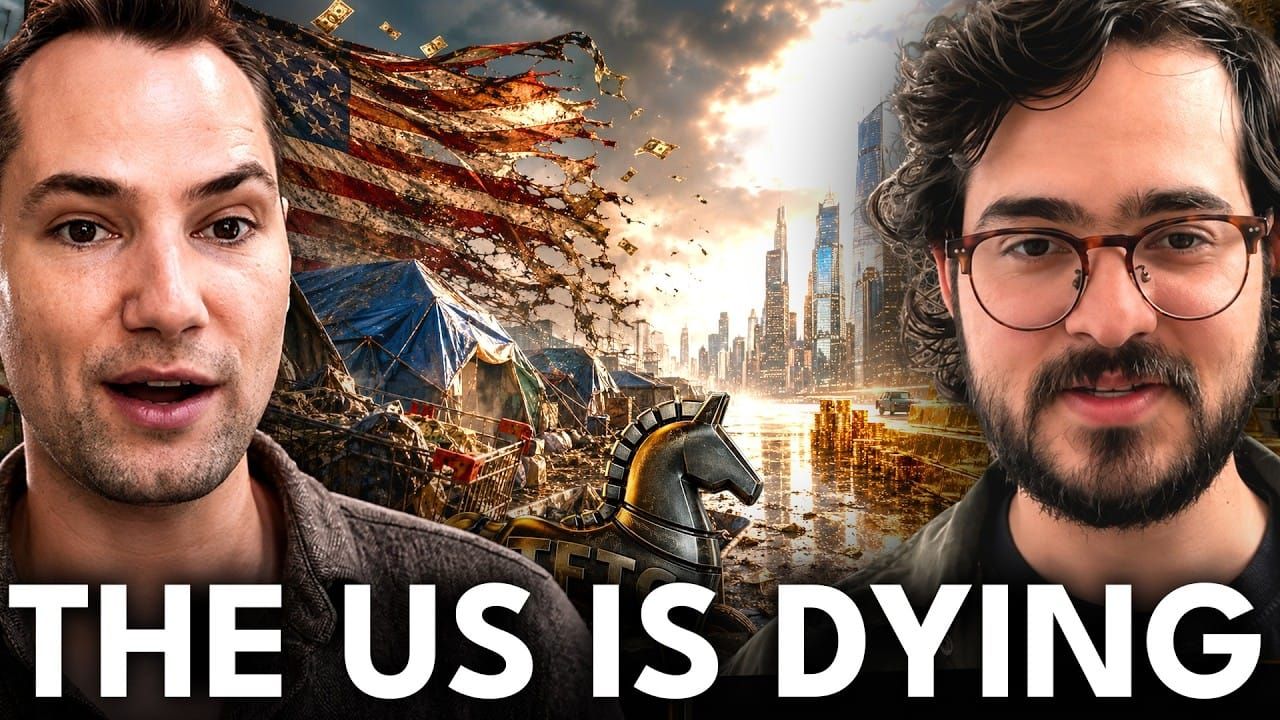
Pablo Antonio and DC Posch spent months at San Francisco farmers' markets documenting how food-stamp fraud quietly funds the fentanyl trade. Their conclusion is uncomfortable: the NGO complex built to help addicts has an incentive to keep them addicted. Plus the case for rebuilding a beautiful city.
↓ Jump to the video and timestamps
Pablo Antonio and DC Posch came on the show this week, and they came with field work most people only theorize about. The two of them, along with a group of friends who all have day jobs, started a civic project in San Francisco and spent a couple of months going to the city's farmers' markets every Sunday with cameras. What they documented is a quiet pipeline that turns food-stamp balances into untraceable cash, and a chunk of that cash into fentanyl. The clip of it went viral last month, and it is the kind of thing that is easy to dismiss until you hear the mechanics laid out by the people who actually traced them.
I have been to San Francisco enough times over the last decade to have my own data points, none of them good until recently. I have had a car broken into and stripped in Golden Gate Park, watched a man pleasuring himself on the steps of my hotel, and walked through the Tenderloin to the old Square headquarters back when it was at its worst. So I came into this one sympathetic to the diagnosis. What I did not expect was how much of the conversation would be about beauty.
Because that is the turn Pablo and DC make, and it is the reason this is not just another doom-loop segment. The first half is the disease: the fraud, the addiction economy, the NGO complex that profits from the status quo. The second half is the prescription, and it is more ambitious than "manage the decline." Their argument is that the same city producing the most valuable companies on earth has spent seventy years building almost nothing worth looking at, and that rebuilding a place worth living in is a political act, not a cosmetic one. Here is the case they made.
The mechanism DC walked through is specific enough to be checkable, which is the whole point of having gone and filmed it. Food stamps in most settings are surveilled well. The federal government runs a transaction-monitoring system called ALERT, the Anti-Fraud Locator using EBT Retailer Transactions, which scans roughly 250 million SNAP transactions a month looking for patterns that signal trafficking. Try to buy a non-eligible item at a Walmart with an EBT card and the point of sale simply blocks it.
The farmers'-market exception is where it breaks. Some markets issue paper coupons against an EBT swipe, sometimes topped up with matching funds meant to stretch a benefit further at local produce stands. Once the balance is on paper, the tracking is gone. DC described an ecosystem of buyers who will purchase that paper at a discount, and the worked example he gave was turning thirty dollars of food-stamp balance into ninety dollars of paper coupons, then selling it for forty-five dollars cash. The matching funds that were supposed to help a family eat better end up funding the resale spread.
One detail he flagged surprised me, because it cuts against the usual assumption about who qualifies. In most states, SNAP has no asset test under what is called broad-based categorical eligibility, so the value of what you own is not part of the calculation. His illustration was someone who just left a job at Google and starts at another company in six months, who can be technically eligible during the gap regardless of savings. The policy was built to keep working families from falling off a cliff. The side of it Pablo and DC documented is the part that gets gamed.
The thing Pablo and DC kept pushing back on is the vocabulary. A lot of the people the city counts as homeless, they argue, are not homeless in the way the word implies. Many live in single-room-occupancy units, the SRO hotels that make up much of San Francisco's permanent supportive housing stock. They are on the street during the day and indoors at night. The visible crisis, in their telling, is a drug crisis wearing a housing label.
To report it, they did something simple: they bought people coffee and listened. DC said that connecting as a person rather than a caseworker or a cop got addicts to volunteer the whole arithmetic of their lives, how much the habit costs a month, where the money comes from, why they do not need the food benefit because free meals are available elsewhere. What comes through in his account is not contempt. It is closer to grief at watching people get processed by a system. Pablo went further, describing what shifted for him when the group started meeting the mothers of men living on the street. The screaming stranger on the bus is one thing. The photograph of that same person as a five-year-old, held by a mother who has spent years trying to find him, is another. Both were insistent on the same point: these people should not be demonized, they need help, and what they are getting instead is enablement.
That is the bridge to the part of the argument that gives the episode its title.
Here is where the policy critique gets concrete and verifiable. California adopted Housing First as state policy in 2016, which prohibits state homelessness funding from going to programs that require sobriety or abstinence. The intent is humane on its face: get people a roof first, stabilize, then treat. The consequence Pablo and DC describe is that someone fighting to stay clean can be placed in a building where neighbors are actively using, which is close to the worst possible environment for recovery.
This is not a fringe complaint anymore. Assemblymember Matt Haney of San Francisco carried AB 255, which would have let local jurisdictions direct up to a quarter of their state homelessness money to sober, abstinence-based recovery housing. It moved through the legislature, and then Governor Newsom vetoed it in October 2025, saying it conflicted with the state's "evidence-based Housing First policy". So the specific reform Pablo and DC point to as obvious, letting the state fund sober housing for people who want it, was on the desk and got sent back.
DC credited the organization that connected them with those mothers: Mothers Against Drug Deaths, co-founded by Jacqui Berlinn after her son became addicted to fentanyl on the streets of San Francisco. Their push is treatment-first over housing-first, including the kind of sober-housing funding AB 255 would have unlocked, and they have spent years making the problem impossible for the city to ignore. This is the documented, supportable version of the on-the-ground story, and it is more than enough to make the point without reaching for anything that can't be cited.
The harder question is motive, and it is the one I put to them directly. Is this bad policy that comes from a good place, or is the degradation effectively the point, a way to keep dollars flowing to the agencies and NGOs paid to manage it? Their answer was the honest one: both, in some mix. Pablo was deliberate about not painting with a broad brush. He assumes there are good people inside government and the NGOs who genuinely care, and he is wary of the story where everyone is a villain. The problem he describes is structural. When an apparatus is funded in proportion to the size of a problem, the incentive to actually solve it gets weak, and the people at the top can be blind to what the situation on the ground has become. That is a more useful diagnosis than cartoon corruption, and a harder one to wave away.
What kept this from being a pure indictment is that all three of us had noticed the same thing: it is getting better. Pablo said that under the current administration, basically everything that matters has improved, and he wanted to go further and deeper rather than declare victory. DC pointed out that the mayor is polling about as well as any recent San Francisco mayor has at this point in a term.
That is verifiable, and it is striking. Daniel Lurie, who took office in January 2025, has held an approval rating in the low-to-mid seventies across multiple San Francisco Chronicle polls through 2026, above where any recent San Francisco mayor has stood at the same stage. On the campaign trail, the guys overstated it as the highest approval of any mayor in the country, which I can't confirm and have left out of the framing here. The supportable version is impressive enough: a first-time officeholder running a city that had become a national punchline, with broad approval for cleaning up downtown and the streets. Pablo's read is that the gains came from doing the unfashionable thing and enforcing the law, and that the work is maybe a tenth done. The opening on the table is bigger than the cleanup.
My own evidence is anecdotal but real. I avoided San Francisco for years after a string of bad trips. When I was back this past November and had time to walk around, it was noticeably better than 2019. That does not erase the structural problems Pablo and DC laid out. It does suggest they are solvable, which is the more hopeful read.
This is the part I did not see coming, and the part that has stuck with me since. Pablo's day job is aesthetics. He has spent years posting what he calls Greco-futurist renderings, before-and-after images that take a real San Francisco block and show what it could look like if anyone built with ambition. His frustration is that a city this productive, sitting on this much talent and capital, looks from the air almost exactly as it did seventy years ago. DC put the contradiction sharply: the same people who will tell you they can build a billion-dollar company, a robot factory in the Nevada desert, a rocket to orbit, will tell you that a few beautiful buildings next to Golden Gate Park is impossible. Everyone implicitly assumes it cannot be done, and so it does not get done.
Their answer is to build an existence proof. The first project is a monument to Aaron Swartz, the open-internet activist who helped develop RSS and the technical architecture for Creative Commons and died in 2013 while facing federal charges for downloading academic articles. Pablo had a marble bust of Swartz made, and the plan is to set it on a stone bench positioned to face Salesforce Tower, staging two visions of technology against each other. One is the glass corporate tower; the other is an inviting bench at human scale built around values Swartz fought for, free speech, open access to information, and privacy. Pablo's claim is not subtle: you build the better thing so people can see it, fall for it, and want more of it.
Pablo is sharp about what this is not. He is not arguing for nostalgia. When I floated the Art Deco revival happening in a few places, he pushed back, and his framing was the most quotable thing he said:
The future should look like the future, and we shouldn't larp the past. We should learn from it and we should revive it whenever it's needed.
His model is the Italian Renaissance, which he points out was not a costume reenactment of antiquity but an attempt to absorb the Greeks and then surpass them. He extends it to who builds: the great merchants of Florence and Venice had no inherited legitimacy the way kings claimed to, so they manufactured it through beauty and patronage, by building things that made a city worth remembering. His pitch to today's tech wealth is the same, that legitimacy is built, and beauty is how you build it.
The most practical thread is how Pablo and DC talk about housing, because it refuses the usual fight. The cost of living, Pablo argues, is now the city's deepest wound, worse in daily terms than the drug crisis that gets the headlines, and it is crushing exactly the young people who should be starting families and careers there. But he does not want to villainize the homeowner who bought decades ago, or the tech worker now bidding millions for that house. His way out is to convince both that the answer is to build, a lot, and to build big, beautiful, and affordable so that the supply expands and everyone wins instead of fighting over a frozen stock.
DC's contribution is the counterintuitive one about top-down versus emergent growth. I brought up Strong Towns, the case that healthy cities grow like organisms from the bottom up rather than from a central plan, which is a theme we have hit before on the show in conversations about Bitcoin and urbanism. DC's pushback was Haussmann's nineteenth-century renovation of Paris, a top-down master plan that gave the city the boulevards and apartment blocks people now travel to see. His synthesis is that you can drop the bones of a place deliberately, the reef, and let the emergent ecosystem grow on top. He is blunt that large swaths of San Francisco are single-story stucco with a driveway into each garage, that it looks like the Simpsons intro, and that there is plenty of room to build up without bulldozing the Victorians anyone actually loves.
What I told them, and what I keep coming back to, is that this rhymes with a lesson I have absorbed slowly: stop trying to fix everyone's problems and fix your own city. Pablo and DC are a working example of it. They picked one place, did the unglamorous reporting, and are now trying to build the alternative in stone. As I have written about the drug crisis in Kensington back home in Philadelphia, the temptation is always to zoom out to national policy. The more useful move is the local one. Their parting line was that the future does not just unfold on its own. It gets driven by the will of specific people who decide to build it.
Pablo Antonio is a designer and the originator of the "Greco-futurist" renderings he has been posting for years, reimagining San Francisco blocks with classically-rooted architecture. He is leading the Aaron Swartz monument project and co-writing a forthcoming "Little Orange Book" of ideas for rebuilding the city, named for the international orange of the Golden Gate Bridge.
DC Posch is a builder and one half of the civic-investigation project that documented the EBT-to-fentanyl pipeline at San Francisco's farmers' markets. He is fluent in both the policy mechanics of the city's drug economy and the technology debates around open-source AI, which he covered with Marty in the back half of the conversation.
The two run a San Francisco civic group with friends who hold day jobs, taking time off to work on projects aimed at improving the city, from the fraud investigation to the architecture renderings.