Fund manager John Tinsman screens for the highest-growth, lowest-marginal-cost companies on the market, and his read on AI is blunt: the data-center economics are some of the best he has seen, the token shortage is the real story, and the build-out is barely a year into a decade-long cycle.
↓ Jump to the video and timestamps
We have had a lot of people on this show over the last year to talk about AI and the markets, and most of them have been some flavor of cautious. John Tinsman is not. He runs AOT Invest, where he manages an ETF built around a simple screen: own the companies growing earnings the fastest while spending the least to produce one more unit of what they sell. I found some clips of him laying out his thesis, reached out, and we threw this conversation together on about twelve hours' notice. I am glad we did, because his read on the AI build-out is the most bullish I have heard from someone who actually sits in the numbers all day.
His starting point is one most analysts are still tiptoeing around. The hyperscalers are spending what looks like an insane amount of money on data centers, and the popular take is that this ends the way every capex frenzy ends. John's response is that almost nobody has done the math on what those data centers actually earn once they switch on, and when you do the math, the returns are so good that the spending is not a warning sign. It is rational. His phrase for the whole thing was the one I keep coming back to:
this is absurd. I've never seen anything like this before.
This is a markets conversation, not a Bitcoin one, but it sits squarely in the questions we care about here: where the wealth is being created, who captures it, and what it means when the most powerful spenders in the economy stop caring what the Fed does. Here is the case he made.
The cleanest way into John's thesis is the deal that put him on a lot of people's radar. xAI agreed to provide Anthropic with the entire output of its Colossus 1 data center near Memphis, and the arrangement surfaced through SpaceX's S-1 filing when it went out ahead of the IPO. Anthropic is paying $1.25 billion a month for it, on the order of $15 billion a year.
John's point was that the commentary got the story exactly backwards. People opened the filing, saw how much xAI was losing, and dunked on it, while missing that this single contract turns on roughly $15 billion in annual revenue against a facility that, by the public estimates, cost somewhere between three and four billion dollars to build and a couple hundred million a year to run. He read it out as plainly as it sounds: a build that cheap, leased for that much, over a multi-year term, pencils out to something close to a 10x return on the capital. And because the hardware is unlikely to be worthless in three years, he thinks the real return is higher than that.
That is one site. Now multiply it. The hyperscalers are collectively spending around $725 billion in 2026, and historically the likes of Microsoft and Google have run returns on invested capital north of 35%. John's open question is whether that number is now trending toward 100% as the cloud businesses accelerate and margins fatten. If the United States is building this compute and leasing it to the rest of the world at fat margins, the spending is not a bubble inflating. It is a moat being poured.
He is not blind to the risk, and he was careful to say so. The honest move when you invest is to keep the downside in view. His argument is just that right now the upside is the thing people are refusing to look at, and the asymmetry runs the other way from the consensus.
To understand why John reads the build-out the way he does, you have to understand the screen behind his funds. He came out of market making, a world of speed and statistical probability, and tried to carry that probabilistic thinking into long-term investing. The first thing his research kept surfacing was obvious in hindsight: over a ten-year horizon, the stocks that rise the most are the ones that grow earnings the most, and the best predictor of high earnings growth tomorrow is high earnings growth today. So his AOTG ETF, which he launched on the Nasdaq in 2022, weights toward the fastest growers rather than by market cap. His framing is that a market-cap-weighted growth fund can end up with a giant slug of a company barely outgrowing inflation, when the actual growth is sitting in names like Micron or AMD.
The second factor is the one he says nobody else was using: low marginal cost, the cost to produce one more unit. A company like Microsoft can sell one more copy of its software at close to zero added cost, which means near-100% margins, which means it can scale to meet demand without taking on debt and still throw off cash to keep innovating. Compare that to a manufacturer that has to build a $99 million airplane to sell a $100 million one, and has to build a new factory and price below cost to take share. John learned this in the family fertilizer business, where the lesson drilled into him was that growth in a capital-heavy industry mostly means lighting money on fire. His funds chase the opposite: high-growth, low-marginal-cost companies bought at sane valuations. He is candid that he is a large holder himself, and by his telling the AOTG fund has roughly doubled-and-then-some since its 2022 launch, though that is a self-reported figure and the usual caveats about a young fund's track record apply.
That screen is why the semiconductor names showed up in his book first. The chips have to be ordered before a data center exists, so the orders, and the pricing power, hit the chipmakers first. When you are selling a part that is essential to a build earning 200% returns, you can keep raising prices, and the memory and CPU names have been repricing accordingly.
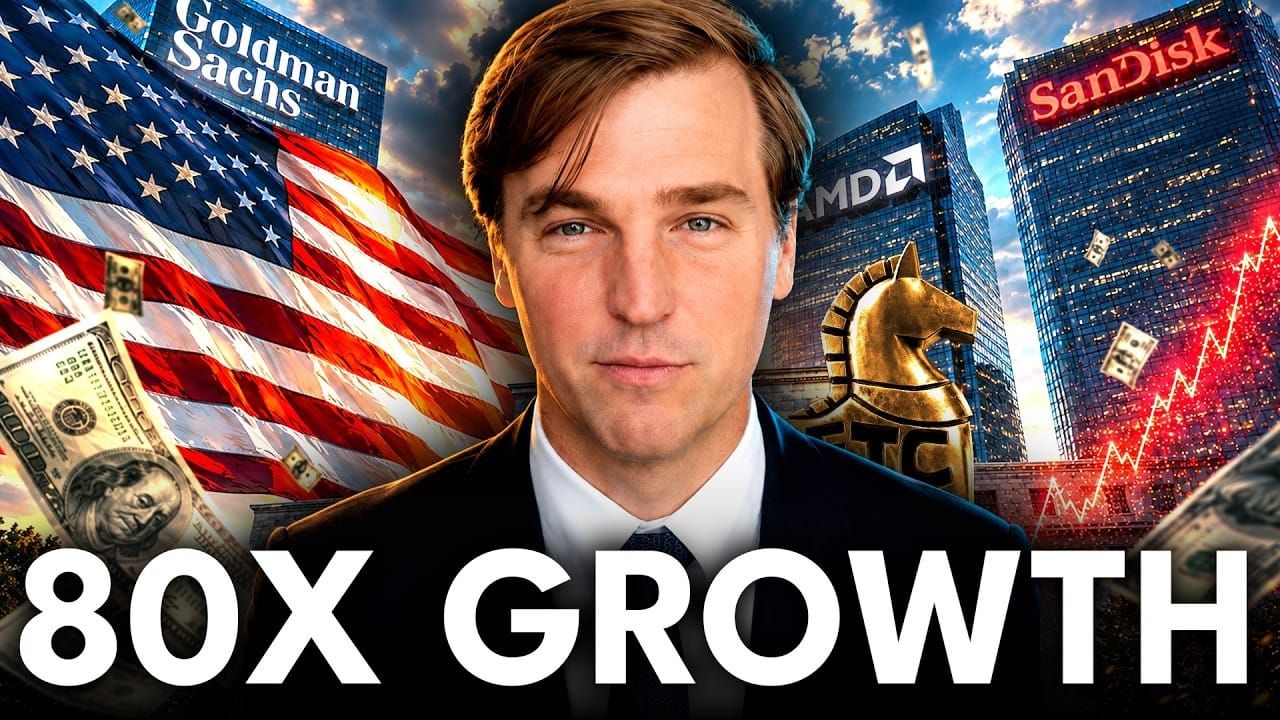
The reason John is relaxed about the spending is that the demand behind it is, in his read, almost incomprehensibly large and nowhere near met. He pointed to Anthropic, whose usage and revenue grew about 80x over a year on the way to a roughly $30 billion run rate, a pace its own CEO called crazy because they had planned for a tenth of it.
Anthropic grew their tokens sold by 80x in, in 12 months. 12 months.
And the forecasts say the curve keeps going. Goldman Sachs Research projects token consumption rising roughly 24x by 2030, to something like 120 quadrillion tokens a month, driven largely by autonomous agents rather than people typing prompts. John's framing is that the market simply does not know how to price growth like that. Analysts are built to value a company growing 20% or 30% a year. Nobody has a model for a business that could plausibly earn 25x more next year, so the bullish case keeps getting underwritten as if it were ordinary, and the stocks keep gapping past the estimates.
His reason for thinking the demand is real rather than hype is grounded in unit economics. Anyone buying these tokens at scale has already run the comparison against human labor, because it would be foolish not to. He used the call center as the example: most routine customer-service interactions, the fraud flag, the replacement card, can be handled by a model for a fraction of the cost of a person, so banks and card networks are buying tokens because the return is there, not because it is fashionable. Software teams buy them because they can ship far more code per dollar. And the kicker is that the people doing this today, in New York and Silicon Valley, are the first 1%. The other 99% of the country and the world has barely started. That gap is what the explosive token forecasts are really describing.
The standard objection to all of this is that we have seen this movie and it ends in a crash, with the dot-com bust as the reference. John and I both think that comparison gets the mechanism wrong. In the late 1990s the fiber went into the ground ahead of demand that did not exist yet. The software, the payment rails, the logistics, none of it was built, so the capacity sat there waiting for a digital economy that took another decade to show up. The AI build is the inverse. The models work today, the people using them want more, and the tokens to serve that appetite simply are not there yet. The supply is chasing demand, not the other way around.
The historical rhyme John reached for was older than the internet. He compared it to the moment the world decided to build railroads because hauling freight by wagon down the Oregon Trail no longer made sense. Wells Fargo started as a stagecoach delivery service and became a bank when the rails put the wagons out of business almost overnight. His point is that once a tool drops the cost of doing something by a factor of a thousand, you do not go back. Software has always been gated by the price of the expensive humans sitting in the seats. Take that ceiling away and adoption does not slow down, it compounds, because the savings only get larger. If token demand really climbs 24x and the compute to serve it is years from being built, this is not the top of a cycle. It is closer to the first year or two of what could be one of the longest capex build-outs in history.
That framing is also where the Fed loses its grip on the story. A Morgan Stanley note that made the rounds while we were recording asked whether AI has made the US economy inelastic: the biggest spenders are simply too well funded and too committed to pull back when rates rise. If your project is earning a triple-digit return, a Fed hike of a point or two does not change the decision. The hyperscalers were sitting on more cash than the Treasury to begin with, and a lot of this is being funded out of that cash and current profits rather than borrowing, which is exactly why the central bank's usual transmission mechanism is weaker here than it has been in a long time.
Most of the AI trade has been a hardware story, and John has ridden that: first Nvidia, then the memory makers like Micron and SanDisk, then the CPU names. But the part he thinks is most underpriced is software, and the logic is the low-marginal-cost screen applied to a second-order effect.
Software has always been capped by the number of humans you could put in front of it. The expensive input to Adobe was never the subscription, it was the salaried person doing the work inside it. Strip that ceiling away, and one operator running a fleet of agents can hold many subscriptions at once, drawing in one tool, writing copy in another, doing sales outreach in a third. Demand that was throttled by headcount gets unthrottled, and because each additional sale lands at very high margin, the earnings effect is violent. He sketched the arithmetic on a company with a 5% or 10% margin: if revenue keeps growing while operating costs hold flat, the incremental sales fall almost entirely to profit, and a modest top-line gain can mean triple-digit earnings-per-share growth at a stock that was trading on a low multiple. Those, in his view, are the conditions for the best trades, the same setup that existed in memory a year ago when everyone was bearish and the multiples were cheap.
I told John this matches what we have seen on our side of it. We are a small media company, and we have been running an agentic setup since January that has expanded what six of us can produce by orders of magnitude. The implementation is the hard part, and the companies that think strategically about it will pull away from the ones that throw money at it and waste it, the way headcount got treated as a virtue in the easy-money 2010s. The leanest operators win, and the model keeps moving under you, so staying current is the whole game. Jack Dorsey's conversation with Sequoia about rebuilding Block around an intelligence layer instead of an org chart is the clearest version of the right approach I have seen.
The last stretch of the conversation took a turn I did not expect, into fertilizer, because John's family runs a blending business in the middle of farm country and he sees the supply chain from the inside. It is the dark counterpart to the data-center optimism, and it is worth sitting with.
The Strait of Hormuz disruption has tightened the global fertilizer market hard. Roughly a quarter of the world's urea exports move through that chokepoint, and with Middle East supply constrained, prices have spiked: nitrogen has run up around 80% since February, and sulfur has roughly doubled since the start of the year. Sulfur matters more than it sounds, because it is the input to the sulfuric acid used to process phosphate ore, so the squeeze cascades. Mosaic has been curtailing phosphate production it cannot run profitably, which sends phosphate prices higher still.
The cruel part, in John's telling, is who absorbs it. US nitrogen producers like CF Industries are having strong years, buying cheap domestic natural gas and selling into a starved global market. But his family's blending business pays the higher input costs and watches volumes fall as farmers cut back, and corn has not rallied to match the cost spike, so the farm economics are genuinely tough. He noted that lenders who normally extend credit easily are pulling back from stretched operators, which is the kind of thing you see before bankruptcies, not the 1980s farm crisis yet, but an uncomfortable rhyme. The optimism about AI and the strain on the food supply are running at the same time, and one does not cancel the other.
John Tinsman is the founder and portfolio manager of AOT Invest, where he runs the AOT Growth and Innovation ETF (AOTG) and a related fund on the Nasdaq, screening for high-growth, low-marginal-cost companies. He came up as a commodities market maker before launching the firm in 2022, studied economics at Northwestern with a stint as a visiting student at Oxford, and is also involved in his family's fertilizer business, Twin State, in Iowa. He posts his research on X.