How a Martha's Vineyard tick bite and a chance encounter with a CIA black-ops operative at a Texas birthday party launched Kris Newby's 20-year investigation into the Cold War bioweapon program behind today's Lyme and Alpha-Gal explosion.
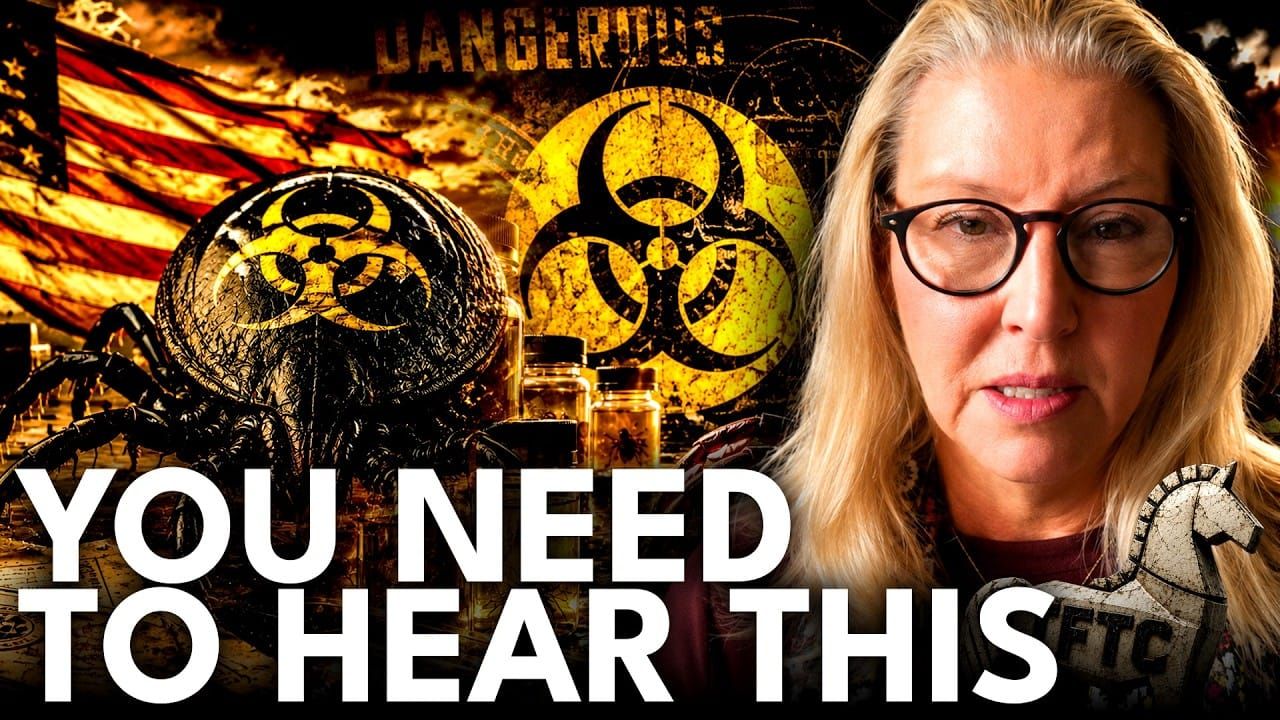
This week's episode is with Kris Newby, the investigative journalist behind Bitten: The Secret History of Lyme Disease and Biological Weapons (2019, three-time award winner). She's been on the Lyme beat for over two decades, and she didn't choose it. A tick bite in Martha's Vineyard in 2002 left her and her husband bankrupt and chronically ill, and what she investigated trying to figure out what happened to her family turned into a Cold War bioweapons story.
We covered the documented record: the 1953 Fort Detrick arthropod weapons program that ran for sixteen years across multiple administrations, the Cuban tick drop in Operation Mongoose that's now in the JFK assassination files, the 1960s Norfolk radioactive tick releases that pushed the Lone Star tick north and seeded today's Alpha-Gal syndrome explosion, and the NIH funding moral hazard that's kept the whole story buried for forty years.
Below: the moments from the conversation that hit hardest, including the Texas birthday party where the story broke open, the Willy Burgdorfer interview where the discoverer of Lyme disease said he "didn't tell you everything," and what Kris hopes RFK Jr. will actually do with the Smith amendment declassification.
Kris wasn't a Lyme journalist in 2002. She was a Silicon Valley tech writer with two engineering degrees. She and her husband Paul were in Martha's Vineyard when they were both bitten. What followed was the standard chronic Lyme nightmare: gaslighting from doctors who said "wait and see," misdiagnoses, escalating symptoms, mounting medical bills, and the slow realization that something was very wrong with how the medical establishment treats this disease.
"What happened to our family was so devastating," she said. "And after I figured out what was wrong and we both got back on our feet, I said, I never want this to happen to another family again. So I'm doing everything I can to educate people to get fast treatment."
The investigation that started as personal medical detective work expanded into the documentary Under Our Skin (2008), nominated for an Academy Award, then into Bitten (2019), then into her current Substack and the chemical-weapons book she's working on now.
Two pieces of practical advice from the conversation that anyone in tick country should take seriously this summer. First, if you pull off an engorged tick, don't accept "wait and see" from a doctor. Insist on doxycycline and a course longer than two days. Two days has been questioned by the clinicians who actually treat chronic Lyme. Second, send the tick itself to a state tick-screening program. The PA Tick Research Lab at East Stroudsburg University runs a free service for Pennsylvania residents (funded by the PA Department of Health since 2018). Tick tests are DNA-based and come back in days; human antibody tests take three weeks to develop a measurable signal, by which time you could be deep into a chronic infection that's much harder to treat.
Two weeks after Under Our Skin finished editing, Kris thought she was done with Lyme. She had a job lined up at Stanford med school writing science content. She went to a Texas birthday party for her husband's family. She didn't know anyone there.
She sat next to an older man in his seventies who'd had a few drinks. She asked what he'd done before retirement. He said he'd worked "for the company" (CIA, black ops, Vietnam-era). He started telling stories about things he'd done in Vietnam. Decapitated skulls dropped on Viet Cong positions. War crimes. The whole table had wide eyes.
At the end he said the weirdest thing he'd ever done was drop infected ticks on Cuban sugarcane workers under Colonel Edward Lansdale, who ran the CIA's Operation Mongoose dirty operations in the Caribbean.
"Of all the gin joints in all the world," is how Kris described her reaction. There was no public record of the US ever conducting offensive bioweapons operations against foreign nations. She'd just spent five years investigating the tick weaponization program for a documentary. There was no way this man could have known what she'd been working on. He was just telling a war story over drinks.
"That's when I said, well, I can't walk away from this story," Kris said. "No one else is going to want to do it. It's too hot to handle."
A few years later, the JFK assassination files release included the Cuban tick drop documentation. The files came out together because the Mongoose Cuba operations and the Castro assassination plots were filed together under the same dirty-ops program. The Pentagon hadn't intended to declassify the tick operations. It happened because they were in the wrong folder.
Burgdorfer is the central figure of the whole story. The Swiss researcher who came to America in 1951, worked at Rocky Mountain Labs on weaponizing fleas, ticks, and mosquitoes for thirty years, and then in 1982 published the paper identifying Borrelia burgdorferi as the cause of Lyme disease. The disease bears his name. The full story of his other work didn't surface until Kris spent five years interviewing him.
The scene she described from the documentary interview is the kind of thing that doesn't make it into the polished version of how journalism works. They were at Burgdorfer's house in Hamilton, Montana. Andy Wilson, the documentary director, had been setting up lights for forty-five minutes. There was a hard knock on the door. The head scientist at Rocky Mountain Labs (two and a half blocks away) was standing on the porch saying he'd been told to sit in on the interview.
"We couldn't get anyone in the government, in the CDC or the NIH, to go on camera about Lyme disease," Kris said. "Like what it is and why it's so hard to diagnose, treat, and cure." But the moment they got Burgdorfer on camera, NIH suddenly wanted to monitor what he said. The director refused. Burgdorfer was retired. He was a private citizen. The scientist eventually left.
In the interview that followed, Burgdorfer said on camera what no one at NIH had ever said publicly: Lyme disease can be chronic. It can affect the nervous system seriously. It's worse for children whose neurological systems are still developing. NIH was still actively denying that chronic Lyme was real. They mostly still are.
As the lighting was being shut down, Burgdorfer told Kris with what she described as a sly smile that he "didn't tell you everything."
It took a few more years for her to understand what he meant. She returned to interview him again. She found his hidden files. She got the surviving documentation of the tick weaponization program from his garage. She traced the connection between Burgdorfer's lab work in the 1950s and 1960s and the spread of Lyme in the 1970s and 1980s.
Burgdorfer himself ended up with Lyme. The infection came from rabbit urine splashing in his eyes while cleaning lab cages on a weekend (the techs were off). Multiple bullseye rashes documented down the side of his torso. He filed for workers' compensation. He believed the chronic infection caused his Parkinson's disease, which forced him onto disability. The man who helped engineer the bioweapon got it himself. And that's about when he started talking to journalists.
He died in 2014. The files he kept in his garage are the foundation of the unclassified record that exists today.
One of the threads I keep coming back to is the question of how any of this becomes acceptable to the people doing it. Burgdorfer wasn't a sadist. Daniel Sonnenschein wasn't a sadist. Most of the people in the Cold War bioweapons program were career scientists doing jobs that paid well in a context that told them they were defending the country. How does that work psychologically?
Kris is from a military family. Her father was a Navy pilot who brought the first drums of Agent Orange to Vietnam. So she's thought about this question her whole life.
"How can all the people in the military organization not think about the bigger implications?" she said. "They're just following orders. So if we look at Willie, that's the interesting thing about what I learned about him for the book Bitten. He was a very smart, ambitious Swiss researcher who had a chance to come over to America. He was excited."
The compartmentalization, she said, becomes almost biological. "I spent a lot of time thinking about that for my second book, which is about nerve agents. And it's the Nazi prison guard question. Like, how did well meaning Germans all of a sudden become Nazi prison guards? Oh, here's a bar of soap, come into the shower. And the same thing at Dugway proving grounds and the nerve agents. They were very isolated in a compound in the desert, and their work was so secretive, they couldn't share it with their family or friends or the people at church."
She called it "slow acting novocaine." You all of a sudden don't feel about the ten thousand guinea pigs that died. You're not thinking about life, just thinking about the results of the experiments you're told to run.
It's the same mechanism we saw with COVID gain-of-function research. The Wuhan-EcoHealth Alliance funding structure. The career incentive to stay silent on origins. The biosecurity-clearance gatekeeping that filters out researchers who'd ask the wrong questions. We've been doing this for a long time, and the institutional architecture that enabled the Cold War tick program is the same institutional architecture that enabled the COVID-era pandemic research. What is the government even for? I keep asking myself that question.
I wrote a separate longer piece on the Cold War bioweapon program behind today's Lyme and Alpha-Gal crisis: the 1953 Fort Detrick documents, the JFK files showing the Cuban tick drop, the Norfolk radioactive tick releases, the NIH funding patterns that buried the story, the LYMErix vaccine politics, the Smith amendment and pending GAO investigation, and practical prevention guidance for this summer. Read it here →
Kris Newby is an award-winning science writer based in Utah (she moved there from California in part because there are very few ticks). She has a BS in engineering from the University of Utah and an MS in engineering from Stanford, and previously worked as a science writer for Stanford Medical School and various Silicon Valley companies before her family's Lyme diagnosis pulled her into investigative journalism. She was senior producer of the documentary Under Our Skin (2008, a 2010 Academy Award semifinalist) and author of Bitten: The Secret History of Lyme Disease and Biological Weapons (2019), which won three international awards including the 2020 International Book Award for Narrative Nonfiction (Gold), the 2020 Nautilus Book Award for Investigative Reporting (Silver), and the 2021 Nellie Bly Award for Investigative Journalism. She's currently working on a book about chemical weapons and nerve agents.
Find her at:
Sponsored by: Bitkey (Bitcoin self-custody, code TFTC for 10% off), Aven (Bitcoin-backed line of credit), CrowdHealth (healthcare without insurance, code TFTC for $99/mo first 3 months), Unchained (multi-sig vaults, code TFTC10 for 10% off), and Salt of the Earth (electrolyte drink mix).