

Search on TFTC
Midjourney's Full-Body Scanner and the Good Side of the AI Revolution

Midjourney's Full-Body Scanner and the Good Side of the AI Revolution

Jun 18, 2026
Bitcoin Brief

Midjourney's Full-Body Scanner and the Good Side of the AI Revolution

TFTC - Truth for the Commoner

Bitcoin Brief

Sup, freaks.

In the middle of a heavy macro week, something genuinely exciting broke through the noise. The company behind the AI image generator we use every single day at TFTC to create our newsletter thumbnails just revealed a project that has nothing to do with pictures. Midjourney, the fully bootstrapped company that reached $200M in revenue in year one with zero institutional investors, has unveiled a full-body ultrasonic CT scanner. The first new whole-body medical imaging modality in roughly 50 years. No radiation, no magnets, no sedation. Sixty seconds in a water bath and you walk away with sub-millimeter 3D tissue maps. It is already outperforming MRI on some metrics on day one. More on that below, plus the first Warsh-era dot plot results, why Bitcoin flatlined while equities celebrated an Iran peace deal, and on-chain data showing the capitulation deepening even as long-term holders keep absorbing coins.

Missed yesterday? Catch up here.


LEAD STORY

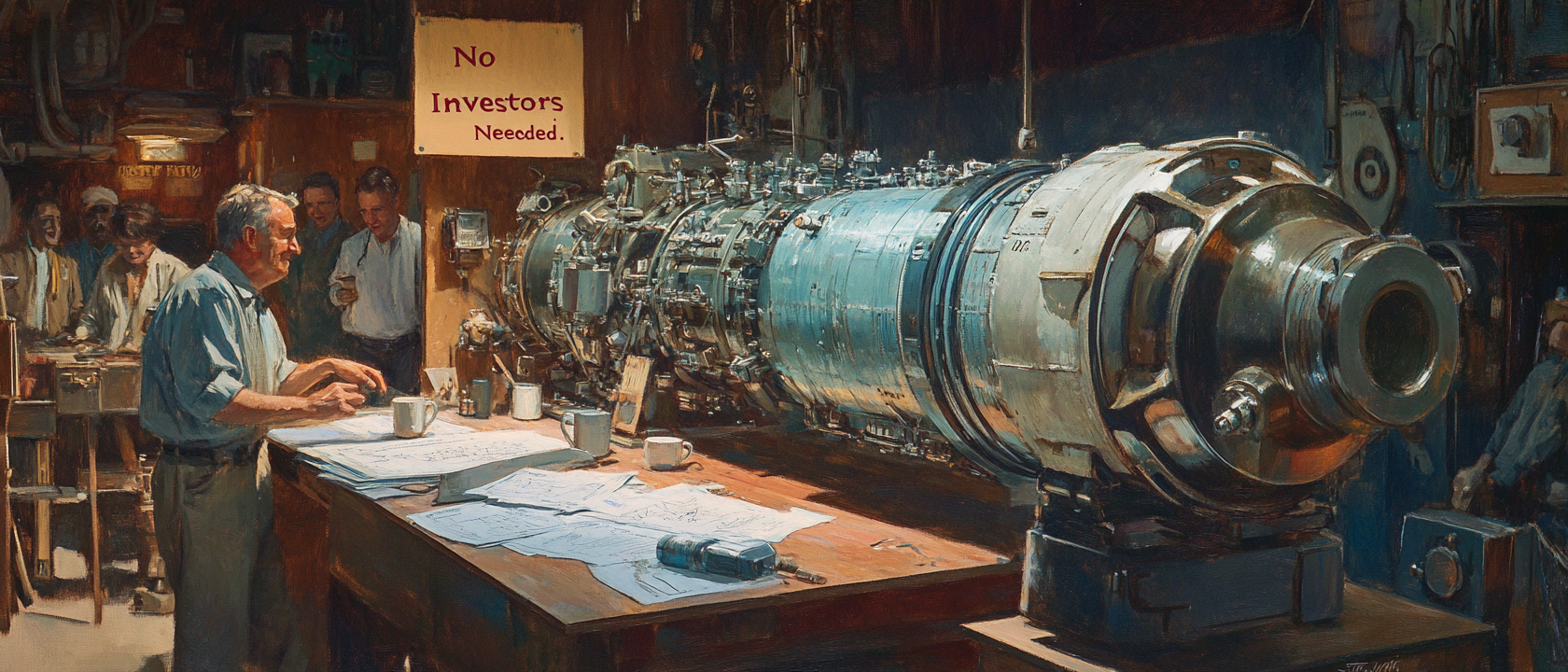
Midjourney Builds a Full-Body Ultrasonic CT Scanner. No Radiation. No Investors. No Precedent.

Start with the sourcing context. Nick St. Pierre posted the thread explaining this project, and his own bio identifies him as an "unofficial Midjourney shill." He is not a Midjourney employee. This is not an official press release from the company. It is a well-informed and enthusiastic fan laying out what Midjourney appears to have built, and it deserves to be read with that framing. The details are extraordinary enough to cover in full, but do not mistake a fan explainer for a corporate announcement.

What was described: a full-body ultrasonic CT scanner. 358,000 ultrasonic transducers across 40 rings, firing 100 million times per second. The patient lowers into a water bath for roughly 60 seconds. No radiation, no magnetic field, no sedation required. The scanner generates 17 gigabytes per second of raw data, with each full scan reconstruction requiring 806 terabytes of compute running across 21 on-site servers delivering two petaflops of processing. The output is sub-millimeter 3D tissue maps. On day one of testing, it was already outperforming MRI on some tissue boundary and muscle fiber detail measurements, at roughly 10 times lower cost and 60 times faster scan time. This would be the first new whole-body medical imaging modality in approximately 50 years.

There are people quietly building tools that could save millions of lives, and they are doing it without venture capital, without government grants, without asking anyone for permission. Today's lead story is one of the most encouraging developments in technology we have covered in this newsletter.

For every AI doomer insisting that nothing real is happening at the tip of the AI revolution, that the valuations are fantasy, that the productivity gains are illusory: this is undeniable. Midjourney reached $200 million in revenue in its first year selling image generation subscriptions. Fully bootstrapped, zero institutional investors. David Holz started with approximately $200,000, called Google cold when he needed 10,000 GPUs, and built the whole operation on trust and product quality. His mentor told him early that he could bootstrap the entire thing. He did. That self-funded model then quietly redirected its resources toward building a medical scanner using an entirely different modality from anything the imaging industry has attempted in five decades. The technology is legitimate. The investment is worth it. Midjourney arguably built the coolest AI application yet, and they did it without a single check from a VC fund.

We have talked on this show with guests like Dr. Ahmad Ammous about the ways hospitals fail human beings before the medicine even starts. The environment is clinical to the point of being punishing. Fluorescent lighting, cold institutional surfaces, rooms optimized for sterility in every sense, including the emotional one. Patients arrive already afraid and spend their time in a physical space designed to reinforce that fear. What Midjourney is building instead is a spa. Not metaphorically. The first location in Union Square, San Francisco is a 25,000 square foot, four-floor space combining hot tubs, saunas, cold plunges, and a gym alongside 9 to 10 scanners. They are reimagining what preventive healthcare looks and feels like from the foundation up. That choice is not incidental. It reflects a coherent philosophy about human dignity and what the experience of caring for your body should feel like.

The gravity of what gets disrupted here is worth appreciating slowly. Medical imaging technology that has defined the diagnostic landscape for decades. MRI machines that cost millions of dollars, scan times measured in hours, access bottlenecked by credentialed facilities, insurance authorization, and scheduling queues that stretch weeks out. What Midjourney is describing is 10 times cheaper and 60 times faster, available in a location you could walk into. Tumor detection caught years earlier. Disease screening for people who currently skip it because it is too expensive or too slow. Blood clot identification. Pregnancy imaging. The FDA regulatory path extends from body composition to physician data sharing, blood flow analysis, and eventually incisionless surgery via focused ultrasound. Total capex to reach full scale is modeled at $20 billion, with Holz planning to self-fund the first Union Square location and projecting a six-month payback per site. The target is 50,000 scanners across roughly 5,000 locations globally, generating a billion scans per month. The downstream impact on population health outcomes is genuinely massive for humanity.

We use Midjourney every single day at TFTC to generate thumbnail images for this newsletter. We have watched this company operate with genuine craft and bootstrapped integrity for years, building slowly, staying independent, putting product quality above growth metrics at every turn. Here is the irony worth sitting with: an AI company that had solved a hard technical problem, was printing money from it, and could have deployed that capital on literally any problem in the world chose medical scanning. They did not take venture money. They did not sell to a strategic acquirer. The most impactful AI application may have come from a company that never took a dollar of VC funding. That is the story of Midjourney in a sentence, and it is a very good one.


SIGNAL

MONETARY POLICY

The Dot Plot Just Flipped. Nine of 18 Fed Officials Now Project at Least One Rate Hike by Year-End.

Why it matters: In March the Fed was projecting a cut. The first Warsh-era dot plot shows a committee that has pivoted fully to hiking, while Warsh simultaneously launches a structural overhaul of how the institution operates.

The updated dot plot reversed the March projections completely. Nine of 18 FOMC officials now see at least one rate hike by year-end. Eight see rates on hold. One sees a cut. The median rate projection for 2026 moved from 3.4 percent to 3.8 percent. Warsh did not submit his own dot, consistent with his longstanding criticism that the mechanism creates false precision and misleads market expectations.

The structural story runs alongside the rate story. Warsh announced five task forces to overhaul Fed operations: communications, balance sheet management, data sources, productivity and AI, and inflation frameworks. Policy statements are getting shorter. The communications architecture that gave markets a roadmap every six weeks is being redesigned. This is a new Fed. As Luke Gromen warned on the show, the bond market has been saying tick-tock in both rate posture and institutional design.

Fed dot plot June 2026 showing majority of officials projecting rate hikes by year-end

POLICY

The Bank Secrecy Act Was Barely Constitutional in the 1970s. It's a Surveillance Dragnet Now.

The $10,000 reporting threshold that justified the BSA would be roughly $130,000 today.

Kyle Olney helped the government resolve more than 140 failing banks during the 2008 financial crisis for the FDIC. He knows how Washington wields financial power. In our conversation with Kyle about the second front in the policy fight, he made the case that the Bank Secrecy Act is probably unconstitutional. When the BSA passed in the 1970s, the $10,000 reporting threshold was the inflation-adjusted equivalent of roughly $130,000 today. Supreme Court justices at the time barely found the law passable, and only because they believed a $10,000 transaction was uncommon enough that few ordinary Americans would ever trigger a suspicious activity report.

The statute was never indexed for inflation. Fifty years of currency debasement later, $10,000 is a routine transaction for millions of Americans: a security deposit, a used car, a modest home repair. The BSA has become exactly what those original justices feared, a financial surveillance dragnet that sweeps up ordinary people conducting ordinary commerce. Kyle points out that even on its own terms, the system is theater: Jeffrey Epstein triggered over a thousand suspicious activity reports moving more than a billion dollars through the banking system over a decade, and nothing was done.

Meanwhile, the CLARITY Act is moving through the Senate. If the BRCA carve-out that protects non-custodial developers gets diluted, writing open-source wallet software could become a federal crime. Two separate battles, one shared principle: the right to transact without asking the government for permission.

REGULATION

Illinois Just Signed the Most Aggressive Bitcoin Tax in the United States

Why it matters: This is not a capital gains tax. It is a tax on movement. Illinois is charging on every transfer, exchange, and custody arrangement involving digital assets, with no comparable treatment of any other financial instrument in existence.

Starting January 2027, Illinois will impose a 0.20 percent tax on the gross value of digital assets exchanged, transferred, or stored for customers. Buy bitcoin in Illinois: taxed. Transfer it: taxed. Hold it with a custodian: taxed. No profit required. No capital gain required. Move $1 million through a bank wire and Illinois takes nothing. Move that same $1 million as a digital asset and the state takes $2,000. No comparable tax on stocks, bonds, derivatives, or bank deposits exists anywhere in the country. The message to every Bitcoin company operating in Illinois is unambiguous: leave.

TECHNOLOGY

Block Ships Builderbot: Fifteen Percent of Production Code Now AI-Generated

Why it matters: This is what AI-native engineering looks like at scale, inside a company that also enables Bitcoin purchases for millions of merchants worldwide.

Block rolled out Builderbot, an AI orchestration layer deployed across their entire codebase. 200,000 operations per day. 1,500 pull requests merged per week, roughly 15 percent of all production code changes. Engineers use Slack to tag @builderbot with a task description. It picks up tickets from Linear or Jira, creates branches, writes code, opens PRs, and monitors CI automatically. What previously took months now takes days. Builderbot is built on goose, Block's open source agent framework, contributed to the Linux Foundation's Agentic AI Foundation. Block also co-developed MCP with Anthropic. One hundred percent of Block's engineers now regularly use AI tools. This is not a pilot. It is production at scale. And Block enables Bitcoin purchases for millions of merchants through Square and Cash App.


AI INFRASTRUCTURE

ARK's GW Economics: $38 Billion to Build, $14 Billion a Year in Revenue

The math behind AI data centers is better than most people think.

ARK Invest's Big Ideas 2026 report lays out the GW-scale economics: $38 billion to build one gigawatt of AI data center capacity, generating $14 billion or more in annual revenue at a 39% operating margin. The counterintuitive finding: GPU rental prices are rising, not falling. Token throughput per watt is climbing faster than token prices are declining. That means the revenue per megawatt is improving even as the technology gets more efficient. For operators who can actually get power to their sites, the unit economics are getting better with every generation of silicon.


AI INFRASTRUCTURE

Half of 2026 Data Centers Haven't Broken Ground

The physical world cannot keep pace with AI demand.

Jefferies reports that only 50% of U.S. data center capacity planned for 2026 is currently under construction. The cumulative deficit of undelivered capacity has hit 20.4 GW since 2021. Hyperscaler capex is projected at $770 billion this year, but the bottlenecks are physical: labor shortages, cooling equipment, transformers, backup generators. Meanwhile, over 8 GW of clean power capacity was canceled in Q1 2026 alone, with total cancellations since early 2025 exceeding 21 GW. More than 75 data center projects worth $130 billion have been blocked or delayed in the first four months of 2026. The demand is real. The construction pipeline is not keeping up.


Sponsored

Unchained

We are living through the Age of Debasement. Every dollar printed erodes your purchasing power. Unchained's free online event brings together Bitcoin experts to help you understand what that means for your savings, your strategy, and why holding Bitcoin in collaborative custody is one of the most important decisions you can make right now.

Watch: The Age of Debasement

Sponsor

Sponsored

Aven

The Aven Bitcoin Visa Card lets you borrow against your BTC without selling it. Fixed-rate, fixed-term loans up to 10 years, 7.99 to 11.99% APR, credit lines up to $1M, and 2% cash back on everything. No annual fees. No origination fees. Your Bitcoin is custodied by BitGo and the card is issued by Coastal Community Bank.

Learn More

Sponsor

⚡ FREEDOM TECH CORNER

Set Up Silent Payments in Sparrow Wallet

One address you can share publicly. Every payment lands at a unique address on-chain. Nobody watching can tell those payments share a recipient.

Sparrow Wallet now supports Silent Payments (BIP-352). You publish a single sp1 address, share it as widely as you want, and every sender automatically generates a unique on-chain address. No address reuse, no XPUB to manage, no interaction with the sender required. Paired with the new Frigate server software, scanning for incoming payments is practical for daily use. Follow this hands-on guide to set up your own sp1 address this week.


DATA SNAPSHOT

Bitcoin Price$63,952
Sats per Dollar1,564
Block Height954,225
Network Hashrate819.8 EH/s
Daily Fees$217,909

On-Chain Metrics
MVRV Z-Score0.37 Fair value. No froth, no deep undervalue signal.
LTH-SOPR0.84 Long-term holders spending at 16% below cost basis. Capitulation-grade reading.
STH Realized Price$72,409 Short-term holders are underwater by over $8,000 per coin on average.
NUPL0.17 Hope-Fear zone. Market participants are not in profit on average.
Supply in Profit0.5% Historically low. Characteristic of late-stage capitulation phases.
Realized Price$53,462 Aggregate cost basis of all coins currently in circulation.

⚡ Looking for the best Bitcoin-only products and services?
Browse BitcoinProducts.com


If this landed, forward it to someone who could use more signal and less noise. The Bitcoin Brief is free, always will be.

See you tomorrow,

Marty Bent


Follow: @MartyBent · @TFTC21

Nostr: primal.net/marty

YouTube: TFTC · Podcasts: tftc.io/podcasts

Spread the signal,
earn Bitcoin.

Get your unique referral link when you subscribe.

Current
Price

Current Block Height

Current Mempool Size

Current Difficulty

Subscribe