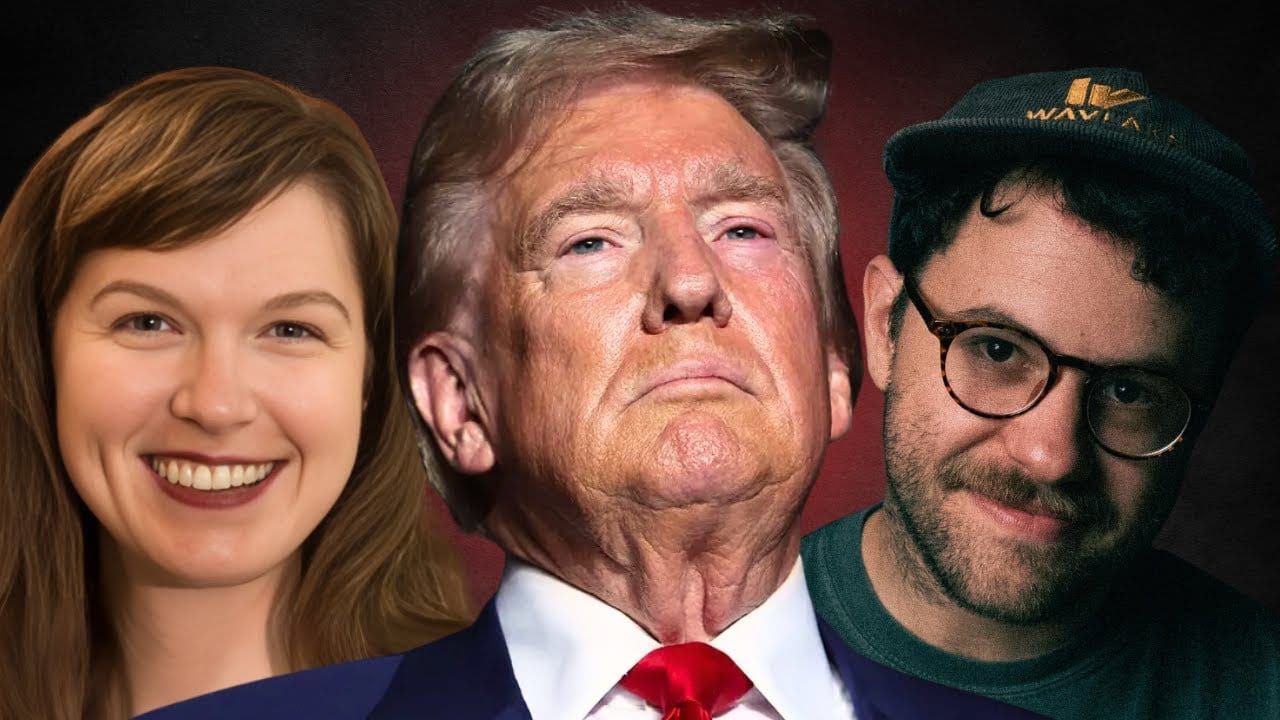
Recorded the week after the 2024 election, Whitney Webb and Mark Goodwin warn that the result didn't change the plan: stablecoins are being built into a programmable, surveillable dollar designed to extend US reach over anyone who touches it, and to fund the debt rather than escape it.
↓ Jump to the video and timestamps
This conversation was recorded the week after the 2024 election, with Bitcoin euphoric and Washington suddenly friendly. Whitney Webb and Mark Goodwin came on to make the unfashionable argument: the election didn't change the plan. The same financial machinery is being built no matter who won, and the friendly posture toward Bitcoin is the most important part to be suspicious of.
Webb stated the core of it in a single line, and it's the sentence the whole episode orbits.
"Stablecoins have the potential to be just as programmable and surveillable as a CBDC could be, and the Fed and the national security community, meaning the CIA among other agencies, have been very open that stablecoins will ensure dollar hegemony."
That is the thesis of the piece on how the digital dollar arrived without a CBDC, stated by the journalists who called it early. That piece documents the policy. This episode is the political read on why both parties wanted it, and why a Bitcoin crowd cheering the new administration may be cheering its own enclosure.
Webb's opening move is to defuse the euphoria without arguing anyone into a corner. She says she understands the lesser-of-two-evils logic, but the precedent from Trump's first term, campaign rhetoric diverging sharply from policy action, is the reason to stay skeptical rather than relax. Her specific worry is targeted: the people most opposed to the surveillance state, COVID-era dissidents and gun owners on the right, are exactly the cohort most likely to go complacent if they trust the person now in power. Goodwin puts it more bluntly, calling the two-party contest a "purple party" and asking why the country re-discovers its faith in elections every four years. Their shared prescription is the one Webb has repeated on the show for years: change comes bottom-up, from local resilience and from building alternatives, not from getting the right person into the White House.
The load-bearing historical claim is about the last crisis response, and it's the most checkable. Webb's account is that the 2020 fiscal response was effectively designed by BlackRock, drawing on a paper its executives co-authored in 2019 advocating a "going direct" approach, and that elements began rolling out before a pandemic was formally declared. The result, in their telling, was the largest wealth transfer in modern US history and more money printed than at any prior point. The reason it matters now is forward-looking: the next administration faces a debt crisis born of that fiscal irresponsibility, and the same playbook, manufacture the emergency, route the rescue through the people who caused it, is the most predictable thing in Washington. The detail that lands hardest is that the deflationary system these players now favor is one they prefer precisely because, as Goodwin puts it, they've already acquired the assets.
This is where it becomes a Bitcoin story. The properties people fear in a central bank digital currency, programmable, surveillable, freezable, don't require a central bank, and Webb's point is that the national-security establishment has said the quiet part out loud: stablecoins ensure dollar hegemony. The signals stack up. Trump told the 2024 Bitcoin conference that Bitcoin and the dollar aren't competitors and that Bitcoin would strengthen the dollar. Senator Lummis frames her crypto advocacy as necessary to preserve dollar dominance. Tether describes itself as a partner of US dollar hegemony. For a movement that spent a decade calling fiat broken money, Webb argues, those should be alarms, not endorsements.
Goodwin adds the legislative mechanics, and they rhyme with everything else in this series. He reads the Lummis-Gillibrand stablecoin bill as a king-making exercise, with carve-outs and thresholds that favor whoever is already at scale, which is why Lummis herself acknowledged the framework advantages Circle's USDC over Tether. Neither, in their view, is the good guy. USDC is about as deeply tied to BlackRock as a stablecoin can be.
The sharpest argument in the episode is Goodwin's, and it reframes the whole stablecoin debate.
"What I really think is happening with the stablecoin play is extending the regulatory reach of the US government by saying anyone that touches a dollar is under our jurisdiction, while they just spent the last 30 years spreading the dollar all across the world."
The globe is already dollarized, so a regime that regulates every dollar stablecoin hands Washington jurisdiction over an enormous share of global financial activity, with the freeze-and-seize switch attached. Webb's concrete fear is the holder in Argentina whose Tether can be frozen at OFAC's behest with no accountability, the same way the US military treats the IMF and sanctions as instruments of power. Goodwin extends it to Bitcoin itself: as Lightning Labs and similar projects put dollar instruments onto Bitcoin via Taproot Assets, the question becomes whether everyone transacting on those rails gets pulled under that regulatory umbrella. The Tornado Cash and Samourai prosecutions are the warning shot, cases where, as Goodwin notes, the law effectively got written after the fact to criminalize writing code.
Webb's read on the cabinet is that you learn more from the Treasury shortlist than from any speech. The most-floated name on the campaign trail was a hedge-fund manager famous for the 2008 trade that shorted subprime mortgages sold to state pension funds, a trade celebrated as one of the greatest ever and, in her framing, a robbery of ordinary Americans with no accountability. The eventual pick, Scott Bessent, is a former Soros money manager. Her point isn't that any one of them is uniquely villainous. It's that the bench is drawn entirely from the same Goldman-to-Treasury-and-back rotation that produced every prior crisis, which is why expecting a fundamentally different outcome is the naive position.
The constructive close is aimed at bitcoiners, and it's the same warning that runs through all of it: orange-washing. Goodwin is blunt that scaling Bitcoin through dollar-denominated tokens is a centralization force and a strategic error, and he singles out the "don't be a martyr, stablecoins on Lightning are a multi-trillion-dollar industry" pitch as consent-manufacturing for exactly the wrong future. His deeper point is that decentralization doesn't mean unstoppable, that control reasserts itself at the granular choke points, ISPs, energy markets, chip makers, and through lawfare and financial sanctions rather than brute force. The exit is to build dollar-like instruments that don't touch Treasuries at all, Chaumian ecash through Cashu and Fedimint and Lightning-based stable channels, so that scaling happens in Bitcoin rather than in someone else's debt. That privacy-preserving cash layer is the subject of our later conversation with Calle.
The post-election read this conversation offers is the political half of the full account of how the digital dollar arrived without a CBDC. That piece shows how the GENIUS Act folded private stablecoins into the Bank Secrecy Act and required issuers to freeze and block transactions. Webb and Goodwin explain why both parties wanted it, and why the friendliest moment for Bitcoin is the one to watch most closely.
Whitney Webb is an investigative journalist and the author of One Nation Under Blackmail. Mark Goodwin is her co-author at Unlimited Hangout and the author of The Bitcoin Dollar. Together they report on the public-private financial system, stablecoins, and the synthetic-CBDC thesis.