The ECB just confirmed what gold bulls have known for a year: gold has overtaken Treasuries as the world's top reserve collateral asset. Vince Lanci explains the transition, China's vault network, and why Bitcoin is the one exit that can't be co-opted at the on-ramp.
↓ Jump to the video and timestamps
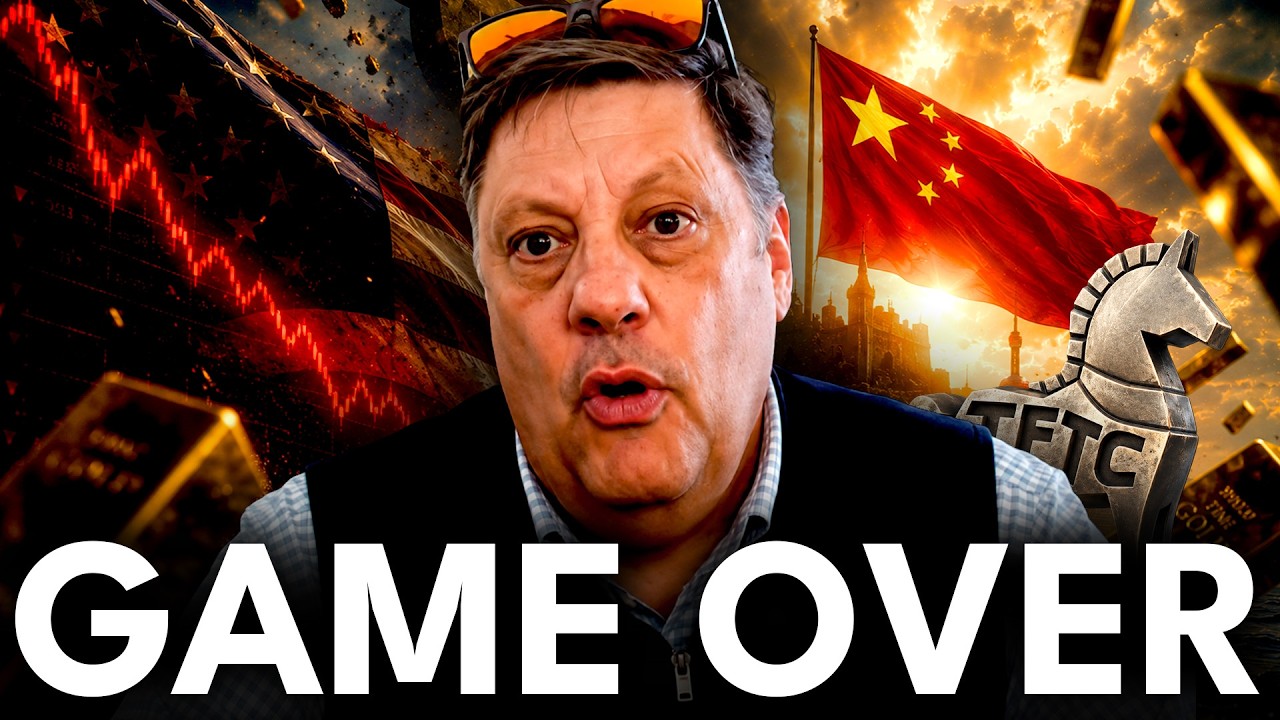
Vince Lanci came on the show to talk through his new book, As Good As Gold: The Return of Real Money, and within the first ten minutes we were already in the territory that I think most financial commentators are too scared or too credentialed to touch. The argument is this: the global monetary system doesn't run on currency. It runs on collateral. And the collateral that has backed everything for the past fifty years, US Treasury securities, is losing its throne in real time.
This isn't prediction anymore. The ECB came out and confirmed that gold has overtaken Treasuries as the world's top reserve asset, sitting at 27% of global reserves against Treasuries at 22%. Lanci's read is that the ECB is underlining that data point now because stablecoin dollars are scaring the hell out of them and they want to talk the dollar down. Both things can be true simultaneously.
What matters is that the data is what it is.
My frame for the whole conversation is that this is a controlled demolition in slow motion, not a sudden collapse. Lanci uses the analogy of an engine swap: the economy is a car doing 80 miles an hour and they're trying to swap the engine without stopping the car. That's his framing, not mine, but I think it's exactly right.
And in that context, Bitcoin is the one asset in my portfolio whose rules I actually know and no central bank can trivially override. That matters more to me right now than almost anything else.
Lanci spent years writing about gold and macro before this book, and the insight that drove As Good As Gold came out of an unlikely place. He was helping draft questions for a Michael Saylor gold-versus-Bitcoin debate roughly four years ago. That process sent him deep into the three classical definitions of money: store of value, medium of exchange, and unit of account.
What he found in the historical record is the core of the book. Before Bretton Woods, gold served all three functions simultaneously. When Bretton Woods began in 1944, they peeled off medium of exchange. The dollar took that role while gold theoretically remained the store of value. Then Nixon closed the gold window in 1971 and gold was stripped of all three. Treasuries stepped in to fill the collateral vacuum.
The point Lanci hammers is that most of the debate about dollar dominance is focused on the wrong layer. People argue about which currency will dethrone the dollar. Lanci thinks that's not the right question. The dollar can remain dominant even as Treasuries lose their role as the primary collateral backing it. He says it plainly: "The central argument of the book is that we're living through a collateral transition, not necessarily a currency transition."
My Bitcoin journey is what educated me on how collateral actually works. When you go deep on sound money, you end up learning about repo markets and rehypothecation whether you want to or not. Lanci's framing confirmed what I'd pieced together over years: the system runs on trust, and when trust in the underlying collateral changes, everything downstream changes with it.
I flagged the ECB data point and Lanci picked it up immediately. Gold at 27% of global reserves, Treasuries at 22%. Lanci's question wasn't whether the data was true. He says gold bugs have known this for about a year.
His question was: why is the ECB emphasizing it now?
His read: the ECB is scared shitless of stablecoin dollar expansion into European markets and they're talking the dollar down to protect the euro. Christine Lagarde has said explicitly that US dollar stablecoin expansion into markets outside the US is bad for the euro. The ECB is racing to launch the digital euro to preempt private stablecoins from occupying that space first.
I think that's exactly right and it connects to something broader. The EU has lost manufacturing competitiveness. ESG mandates hollowed out the energy base, which hollowed out the industrial base, particularly in Germany. Stakeholder capitalism is the ideology that drove that, and they encouraged it. Now they have rising social tension from the migration crisis, speech suppression happening in plain sight across the UK and Ireland, and an economy that's losing ground.
Tight control over the monetary plumbing is one of the few levers they have left.
Don't tell me not to believe my lion eyes. What's happening in the UK (people being handcuffed for tweets, social tensions that were entirely predictable and entirely caused by deliberate policy choices) is observable, not theoretical. The ECB announcing gold's supremacy over Treasuries right now is the same pattern. They're closing the doors and windows they can still close.
The GENIUS Act and the CLARITY Act moving through Congress are the US legislative response to all of this. The banks are already nervous about both. Lanci's take is that Bessent understands the clock is running and stablecoins backed by a diverse collateral basket (gold, Bitcoin, Treasuries) may end up being the mechanism that keeps the dollar relevant as Treasuries lose their grip.
This is where the conversation got into territory that I don't think gets nearly enough coverage in English-language financial media.
Lanci explained the Shanghai Gold Exchange vault warrant program (something we first got into when he came on last fall). The short version: China has been building a network of physical gold vaults across Saudi Arabia, parts of Africa including Ghana, and throughout the Middle East. The explicit goal is to make gold repo-able in the same way Treasuries are repo-able in Western finance.
Here's how the repo mechanic works, in Lanci's plain-English framing: repo is basically throwing your collateral into a pawn shop and getting cash for it. You don't have to sell the asset. You pledge it, borrow against it, and buy it back later. In Western finance, you can do this with Treasuries at the press of a button because Treasuries carry the High Quality Liquid Asset designation (HQLA), which is the label that makes an asset eligible for repo.
Gold in the West does not carry that label, so as long as gold isn't HQLA, you can't use it as repo collateral. Western financial regulators have no interest in changing that, because it would put gold in direct competition with Treasuries.
China's move is to build a parallel system that sidesteps the HQLA designation entirely. The negotiation with Saudi Arabia is the clearest example. China wanted Saudi Arabia to price oil in yuan. Saudi Arabia said fine, but we don't trust your currency, we want to convert yuan into gold. China said fine, and then Saudi Arabia said: what if we want to use that gold as collateral for something else while you're holding it?
China said fine, keep the gold in a vault in your own country. That vault is part of our network. Borrow against it, build infrastructure with it.
Countries like Ghana have enormous gold reserves and almost no roads. China's offer: put your gold in an in-country vault that's part of the network, repo against it to fund highway construction, and the construction contracts go to Chinese companies. That's how China's manufacturing sector gets export legs through the Belt and Road initiative. That's the new plumbing.
Lanci noted that Tether has been buying gold alongside Bitcoin, and his read is that they're not speculating. They're building collateral infrastructure. Tether Gold (XAUt) already exists as a product. Whether the business is fully deployed yet or not, the positioning is deliberate.
When I mentioned that Scott Bessent was on the Hill the day our first recording got cut off by a power outage, and that he told Tim Scott the Bitcoin Strategic Reserve Act is "very high priority," Lanci connected it directly to this. The US government sees the collateral transition happening and is trying to position Bitcoin before the window closes. That's not a coincidence.
I laid out the three-path framework and I want to be direct about where I land on it.
Path one: central bank digital currencies. State-controlled, programmable, you get your allowance, they can decide what you can and can't buy. The authoritarian dream.
Path two: privately issued stablecoins. They run on peer-to-peer distributed blockchains. They look like free-market money. But they are centrally issued by a third party (in most cases Tether or Circle), and if the US government goes to Tether and says hey, we need you to freeze that account, they do it.
You still have the functionality of a CBDC with stablecoins. It just has a friendlier free-market face on it.
Lanci put it well: "There's the illusion of separation of church and state." JPMorgan isn't going to obviously block everything the government wants. But they'll raise minimums. They'll comply in ways that aren't ham-fisted but are just as effective. If you're big enough to be on their radar, they'll get to you.
Path three: Bitcoin. This is the only one of the three that can't be frozen on request at the protocol level. Lanci's honest concession is that on-ramps and off-ramps can still be restricted. That's true. But his point, which I agree with completely, is that the more the government overreaches, the more they create their own competition. Black markets emerge. Alternative rails get built. Bitcoin benefits from overreach.
I know what Bitcoin is. I know what I own. I know who cannot control it rather trivially. That rule set and that anchor give me a lot of peace of mind.
Worst comes to worst, I have an allocation in an asset that is outside the trivial control of central banks and states. Gold can make a strong argument for similar properties, but Bitcoin makes it stronger.
Lanci put it clearly: "If you fully believe the premise that Bitcoin can't be co-opted, and from everything I've seen, that's true, then eventually there'll be an opportunity for it and it will slip in and become money."
This part of the conversation is where Lanci got personal in a way I think lands harder than any chart.
He grew up in South Philly. His father had an Italian deli (pasta, pizza, ravioli, the whole operation). In 1976 Philadelphia hosted the MLB All-Star Game as part of the US bicentennial celebration. The streets were immaculate. Federal money poured in.
Everything looked clean and functional. Lanci turned to his father as a ten-year-old at the All-Star Game and asked if Philadelphia was going to be the capital again. His father said: no, next year we're all going to be broke. Three years after the bicentennial cleanup, the deli shut down.
The parallel he's drawing to right now is not subtle. The US semiquincentennial (the 250th anniversary) is coming. The 2026 FIFA World Cup is coming, hosted across the US, Canada, and Mexico, opening in mid-June 2026. Both are massive federal spending events.
Both will produce the same kind of temporary cleanliness that preceded the 1977-79 inflation surge. The cleanup precedes the hangover.
Lanci's read on the inflation chart overlay, tracking the 1970s against the 2020s, is that we're currently sitting around the 1975 equivalent. That implies another year of relative stability followed by a real inflation uptick in the 1977-79 window.
The latest PPI numbers came in well over expectations. Oil is sitting near $90. Chris Martenson, who I had on the week before, made the point that we're draining strategic petroleum reserves globally and there's a hard deadline on that. Once the SPR is tapped out, the real supply disruption shows up in prices.
The Volcker option is gone. You can't jack rates to 18% with the current federal interest expense. The math doesn't work. So the Fed will wave the magic wand, call it fighting inflation, and tolerate the inflation rather than triggering a recession.
They always err that way. They have a revealed preference for inflation over contraction, and the current debt load has removed even the pretense of the alternative.
The AI race is accelerating something I find genuinely troubling, and I said it plainly on this episode.
The current administration has framed AI as an existential competition. Directionally, that's not wrong. The consequences of losing the AI race to China are severe. But the response (taking equity stakes in private AI companies, building what will inevitably become regulatory moats in back rooms on the Hill) is importing the Chinese model to beat the Chinese model.
A lot of people in the US government and in the tech sector have thrown their hands up and decided we have to be more like China to beat China in this particular race.
You can squint and see the regulatory moat licensing regimes already being drafted. Once the government has equity stakes in these companies, they can tell them what to do. What starts as a wartime procurement relationship becomes corporate capture in the other direction.
Lanci made the horseshoe observation and I think he's right: Bernie Sanders calling for the federal government to take a 50% stake in AI hyperscalers so those revenues flow to Washington, and the Trump administration doing something functionally similar through equity stakes under national security framing, are the same position on policy. Lanci's line, not mine, but I agree with it.
I've been rereading Hans-Hermann Hoppe's Democracy: The God That Failed and the core argument keeps coming back to me. Monarchs have skin in the game. They're hereditary landowners with a duty to steward the productive capital within their domain across generations, because their reputation and ultimately their head depend on it. Democratic politicians cycle through every four or eight years and can always hand the bag to the next guy.
The low time preference that good stewardship requires is structurally unavailable to them. We need a Cincinnatus, someone who comes from the fields, fixes the thing, and goes back to his farm. What we have instead is a revolving door of bag-passers getting equity stakes in AI companies on the way out.
Lanci described the controlled takedown clearly: they know the current engine isn't working and they're trying to swap it out while the car is doing 80 miles an hour. That's a generous read. It assumes the people doing the swapping are competent and acting in good faith. I'm not sure about either.
What I do know is that in this environment (collateral transition underway, stablecoin kill-switches confirmed, inflation tracking the 1970s, AI authoritarianism creeping in from both sides of the political aisle) Bitcoin is the thing I know.
Lanci made the CME futures point: when they launched Bitcoin futures in December 2017, the price crashed. He's explicit that this is his contention, not proven causation, but it tracks. Now Bitcoin is in an ETF wrapper with BlackRock in the picture, and Lanci's concern is the same one he has about gold, that the paper market can be used to manage the price.
His counterpoint to his own concern is also the right one: even with gold, it doesn't work anymore. The suppression eventually fails. If Bitcoin is harder than gold, the suppression fails faster.
Philosopher Hannah Arendt argued that governments which lose the authority of their people respond by squeezing harder, and that overreach accelerates their own competition. Bitcoin is the beneficiary of that dynamic. The tighter the fist gets on stablecoins and on-ramps, the stronger the case for the thing the fist can't close around.
I'm not anxious about the chaos of the transition because Bitcoin is the one fixed point in the system. I know what I own, I know who cannot control it rather trivially, and that gives me a lot of peace of mind when everything else is being renegotiated.
Collateral is the asset you pledge as security when borrowing. In the global financial system, the most important collateral is what central banks and financial institutions use to back their transactions. Historically that was gold, and for the past fifty years, US Treasury securities. Repo markets, where institutions borrow cash against collateral overnight, depend entirely on this.
Lanci's argument is that understanding collateral, not currency, is the key to understanding how monetary power actually works.
Central banks (particularly in the Global South and BRICS-aligned economies) have been reducing their Treasury holdings and accumulating gold, accelerating after the US weaponized dollar reserves against Russia in 2022. The ECB published data showing gold at 27% of global reserves versus Treasuries at 22%, confirming a shift that gold-market observers had been tracking for roughly a year before the announcement. The underlying cause is eroding trust in Treasuries as a neutral reserve asset.
In Western finance, you can repo Treasuries instantly because they carry the High Quality Liquid Asset designation. Gold in the West doesn't have that label, so it can't be used as repo collateral. China is building a parallel system (physical vaults in Saudi Arabia, Africa, and the Middle East) where countries can store gold in their own territory, borrow against it, and use it as collateral for infrastructure financing. It sidesteps the HQLA designation entirely and creates an alternative to the Treasury-based repo system that has underpinned dollar dominance.
A central bank digital currency is issued and controlled directly by a government or central bank, programmable, surveyable, and restrictable by design. A stablecoin is privately issued on a distributed blockchain, which sounds more free-market. The practical difference is smaller than it appears. Stablecoins are centrally issued by companies like Tether, which comply with government freeze requests on specific accounts when compelled to.
The kill-switch exists regardless of the blockchain underneath. Lanci calls it the illusion of separation of church and state.
Repo (short for repurchase agreement) is essentially a collateralized short-term loan. You hand over an asset as collateral, get cash, and agree to buy it back at a set price later. It's the pawn shop of global finance, and it's how banks, governments, and institutions manage liquidity constantly.
For an asset to be usable as repo collateral in Western finance, it needs the HQLA label. Treasuries have it. Gold doesn't, which limits its role. Bitcoin has no such label yet. China building vault infrastructure to make gold repo-able outside the Western HQLA framework is an attempt to route around that restriction entirely.
Lanci believes it is, and the chart overlay tracking the 2020s against the 1970s puts us roughly at the 1975 equivalent, which implies relative calm before another uptick. His structural catalysts are the 2026 FIFA World Cup and the US 250th anniversary semiquincentennial, both of which will drive federal spending the way the 1976 Philadelphia bicentennial did before the 1977-79 surge. The Fed can't deploy the Volcker response (raising rates to 18%) because current federal interest expense makes that structurally impossible. The path of least resistance is tolerating inflation over triggering a recession.
Not at the protocol level. That's the core of what makes Bitcoin different from stablecoins and CBDCs. What governments can do is restrict on-ramps and off-ramps: exchanges, payment processors, banking relationships.
Lanci's concession is that most people will encounter those restrictions before they encounter the base layer. His counter is that government overreach creates its own competition. Black markets emerge, alternative rails get built, and the harder the squeeze, the faster the alternatives develop. History suggests suppression of a sound asset eventually fails.
Vince Lanci is a veteran options and commodities trader and the author of As Good As Gold: The Return of Real Money. He writes on precious metals, macroeconomics, and market structure, and is a recurring guest on TFTC.