Attorney Preston Byrne on how foreign governments launder censorship through US platforms, why the UK Online Safety Act tries to govern American servers, the 4chan v. Ofcom lawsuit he's litigating, and the Granite Act's plan to strip foreign regulators' immunity and make them bear the cost.
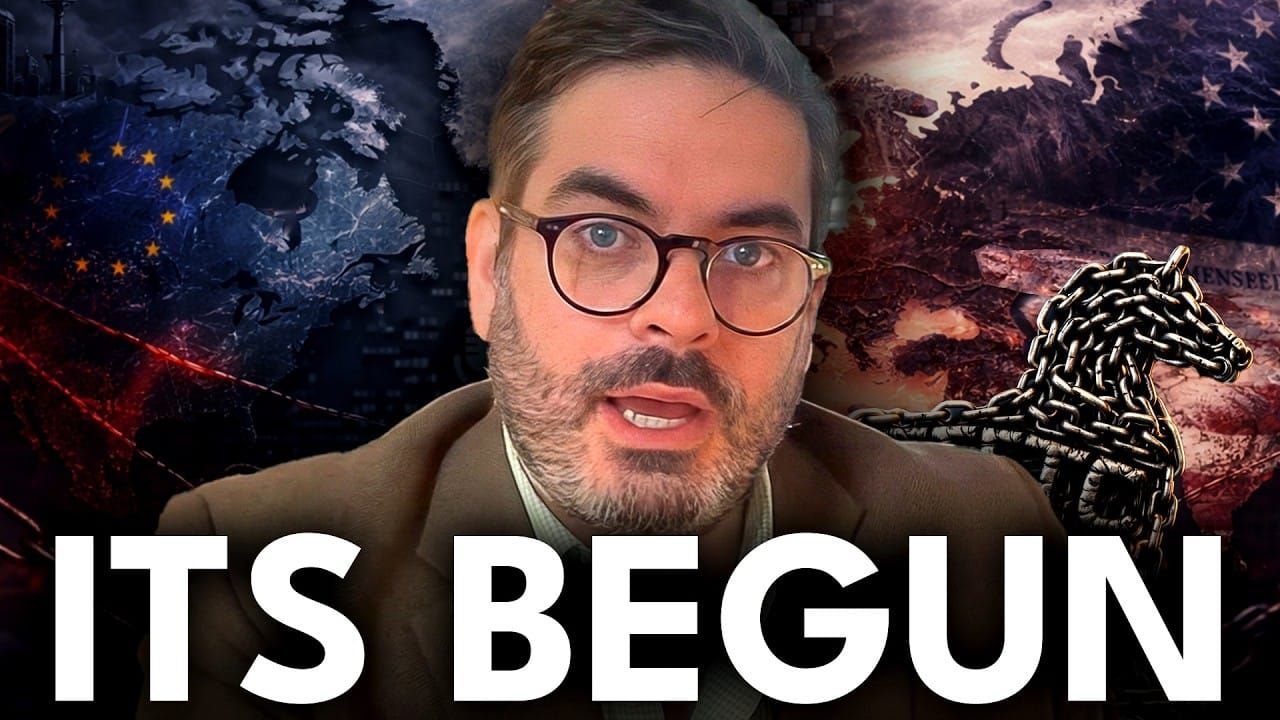
↓ Jump to the video and timestamps
Preston Byrne is the attorney on the other end of a censorship fight most people don't know is happening. He opened the conversation by describing the mechanism in a single breath, and it's worth quoting in full because everything else follows from it.
"When the UK was trying to censor these targets, the UK was essentially saying, our rules get to govern what Americans do on American servers. The First Amendment ceases to exist. We're going to launder that censorship through a third party and we're going to conscript the American to carry it out for us."
Byrne has been a lawyer in the crypto industry since 2013 and has spent close to a decade representing US platforms in free-speech fights. The current one started early in 2025, when three foreign regimes came online in the same window: the EU's Digital Services Act, the UK's Online Safety Act, and Australia's near-identical Online Safety Act. The UK moved first, sending letters to American companies starting in late February. It went after four of the smallest targets it could find: a mental-health discussion board, the social network Gab, the message board Kiwi Farms, and 4chan, which Byrne notes was once accurately described as "a bunch of Mac Minis running in a closet." The point of picking the smallest players was to prove a principle: that the UK could make even an entirely US-based company obey British speech rules.
This is the "it's already global" front of the piece on how the digital dollar arrived without a CBDC. The jurisdictional question Byrne is litigating over speech is the same one financial surveillance produces next, the first time a foreign regulator or a compliant stablecoin issuer freezes an American's money under another country's rules.
Byrne's central insight is about indirection. A government that openly censored its own citizens, or DNS-blocked content directly, would have to bear the full political cost, and the attribution would land squarely on the state. The modern approach avoids that. Instead of ordering specific content removed, the UK Online Safety Act and the EU Digital Services Act impose broad "duties" on platforms and fine them for failing to comply, often acting on complaints from accredited third-party flaggers. The platform does the actual censoring, and the platform is American. As Byrne puts it, the regimes conscript the American company to carry out the foreign state's censorship, so the First Amendment effectively ceases to exist online if the model holds.
He thinks the Europeans misread the room. America "rolled over" when the EU rolled out GDPR on a global basis, so they assumed the same would happen with speech. Byrne's view is that those are qualitatively different rules and deserved a qualitatively different response, and that assuming otherwise was a mistake.
The abstract argument has a concrete test case, and Byrne is in it. Ofcom announced in mid-August that it intended to fine 4chan £20,000. Two days later, on August 28, 4chan and Kiwi Farms sued Ofcom in US federal court in the District of Columbia, asking the court to confirm one narrow thing: that the orders were never validly served. The UK had simply emailed them. No Hague Service Convention, no Mutual Legal Assistance Treaty procedure, no letters rogatory between courts, none of the machinery American due process requires before a foreign authority can compel an American to do anything. Byrne's clients aren't asking for damages or an injunction, just a declaration that an emailed order from London doesn't bind a company whose servers and assets are entirely in the United States.
What Ofcom actually demanded is worth dwelling on, because it shows how far the reach goes. It didn't yet order specific posts removed. It demanded that 4chan produce an internal risk assessment, an audit in which the company would, in Byrne's words, "confess their sins," document how it was complying and how it intended to come into compliance. Byrne's team looked at that and saw three constitutional problems stacked on top of each other: compelled speech under the First Amendment, a warrantless demand for internal records under the Fourth, and a demand to testify against yourself under the Fifth.
Ofcom's answer was to claim it can't be sued at all. Under the Foreign Sovereign Immunities Act, a foreign sovereign engaged in sovereign conduct is generally immune from suit in American courts, which makes it a threshold jurisdictional issue: if Ofcom qualifies, the case is dismissed before the constitutional questions are ever reached. Byrne doesn't pretend this is easy. He calls the immunity defense formidable.
But beating Ofcom in court was never the only goal. Byrne was blunt that a major purpose of the suit was to create a comprehensive public record proving a structural problem: when 30 or more sovereigns coordinate extraterritorial censorship regimes, American law currently disadvantages the American defender and massively advantages the foreign attacker. The foreign state gets to hide behind sovereign immunity, while the American has to find specialized lawyers willing to run federal litigation for free. He frames it as a coordinated effort across roughly 31 sovereigns, the EU member states plus the UK and Australia, with New Zealand and Singapore watching to see if it works. The message landed. Byrne says the case has been noticed at the highest levels of government, Senator Eric Schmitt has confirmed a federal censorship-shield bill is being worked on, and he expects movement in the first or second quarter of 2026.
The change in administration matters here. Under Biden, Byrne says, the US gave reciprocal treatment to censorship notices served under Germany's Network Enforcement Act and largely ignored complaints that this violated the First Amendment. After the Trump administration was informed of the German notices against one target, those notices "immediately stopped being served."
Byrne's proposed fix is a bill he drafted with Colin Crossman, the Deputy Secretary of State for Wyoming, called the Granite Act, for Guaranteeing Rights Against Novel International Tyranny and Extortion. He describes it as having two pieces.
The shield says a foreign order that would violate an American's constitutional rights if issued by a US government entity is unenforceable here, and it bars any US agency from cooperating with or giving effect to such an order, with a civil cause of action against any agency that does. The practical value is that instead of answering a foreign censor with a 20-page memo, an American can answer with a citation: here's the statute, go away.
The sword is what gives it teeth. Byrne, who cheerfully calls it a "thermonuclear civil cause of action," would let an American who receives one of these notices counter-sue the foreign censor for three times the threatened fine, in an American court, with the censor's sovereign immunity stripped for that claim, recoverable against any sovereign assets held in American banks. The design goal isn't to build a lucrative practice suing foreign governments. It's deterrence. If foreign notices become "catnip for plaintiff's counsel" working on contingency, lawyers will line up to defend American speech, and the foreign government will learn it can't enforce anything here and will pay a steep political price for trying. Byrne calls the whole structure mutually assured destruction, and the point, he stressed repeatedly, is the threat, because Ofcom can't actually enforce its orders in the US. The censorship happens anyway because, as he put it, you tell a tech company's risk-averse legal team you'll throw them in jail, "and guess what? They follow the rules."
The part that hit closest to home for TFTC is the role of NGOs. The foreign regimes run on "trusted flaggers" and, in the UK, a "super-complaints" regime that lets accredited organizations nominate content for removal. Byrne describes these groups as the ones holding the laser designator: they paint the target, write a sophisticated, well-cited report cherry-picking the worst posts out of hundreds of millions, and hand it to a regulator who treats it as independent research.
Marty noted that TFTC has been on the receiving end of the domestic version. The Center for Countering Digital Hate put the channel on a list of "climate deniers" for hosting climate scientists who dissent from the mainstream view, then sent the list to YouTube with a recommendation to demonetize the channel and pull the climate content. Byrne's point is that advocating for censorship is itself protected speech in the US, which is why X lost its lawsuit against CCDH. The problem is when those same NGOs marry their advocacy to foreign state power, steering Ofcom and the European Commission toward American targets, calling down coercive force from abroad that the First Amendment forbids at home.
He pushed back hard on the premise that these small sites are irresponsible. The smallest platforms, he said, are often the most responsive when it actually matters: a tip his team sent to the FBI's National Threat Operations Center at 10 p.m. on a Saturday got a callback from West Virginia at 10:22. The targeting has nothing to do with cooperation on real crime. It's about hosting speech that is lawful in the United States and offensive to a foreign government.
Byrne, who qualified as a solicitor in the UK, was precise about why British speech law produces this. He pointed to Section 127 of the Communications Act 2003, which criminalizes "grossly offensive" speech, a standard he calls inherently subjective. American doctrine asks about the character of speech, whether it's a true threat, and stays content-neutral; British law asks whether someone was offended, which is a judgment about the content itself. He used the case of Hamit Coskin, prosecuted for burning a Quran outside the Turkish embassy in London, an act that would be squarely protected expression in the US. Coskin was acquitted of a public-order offense, and the Crown is appealing.
Byrne wrote a UK Free Speech Act as a 2020 thought experiment, a bill that would repeal large swaths of British speech law in one move, including Part 3 of the Public Order Act, sections of the Terrorism Acts, and Section 127. He says it has been "ingested by more than one and fewer than three political organizations" in the UK, though no party in government will touch it. His timetable is a five-to-ten-year fight, faster if Reform wins the next election, which isn't legally required until 2028 or 2029. He's also blunt that the UK is no longer a safe place for a free-speech activist, citing Graham Linehan's arrest on arrival over a single tweet as the reason he won't fly there himself.
The most forward-looking part of the conversation is where Byrne thinks this goes if the extraterritorial route is blocked. The UK is already pivoting toward client-side scanning, telling Apple and Google that to sell devices in Britain they must build on-device scanning the state can use. Byrne disagrees with it, but concedes it's within the UK's sovereign power and doesn't intrude on American rights, because it applies only to phones sold there. The difference is attribution. Client-side scanning is censorship the government has to own directly, a "nerf device run by the state" that "calls home to the police" when a citizen tries to view something forbidden. His bet is that owning the censorship that openly raises the political temperature for reform in a way that laundering it through American companies never did.
The reason this sits on a Bitcoin podcast is that speech is the leading indicator. The extraterritorial machinery being built to govern what Americans can say online is structurally identical to the machinery that will be pointed at what Americans can do with their money. A foreign regulator pressuring a global platform looks exactly like a foreign regulator, or a compliant stablecoin issuer, pressuring a global payment rail. Byrne's case is a dry run for the financial version, which is why anyone who cares about Bitcoin privacy should be watching the censorship fight closely.
The international front Byrne describes is one chapter of a larger story. The full account traces how the same cross-border pressure shows up in finance, from foreign governments choking stablecoin on-ramps with digital-ID requirements to the question of whose rules apply when an American's money gets frozen. Byrne's litigation is the speech-side preview of that fight.
Preston Byrne is a US- and UK-qualified attorney who represents technology platforms in cross-border censorship and regulatory disputes. He is on the Legal Advisory Council of the UK Free Speech Union, drafted the Granite Act and a UK Free Speech Act, and litigates these cases largely pro bono.