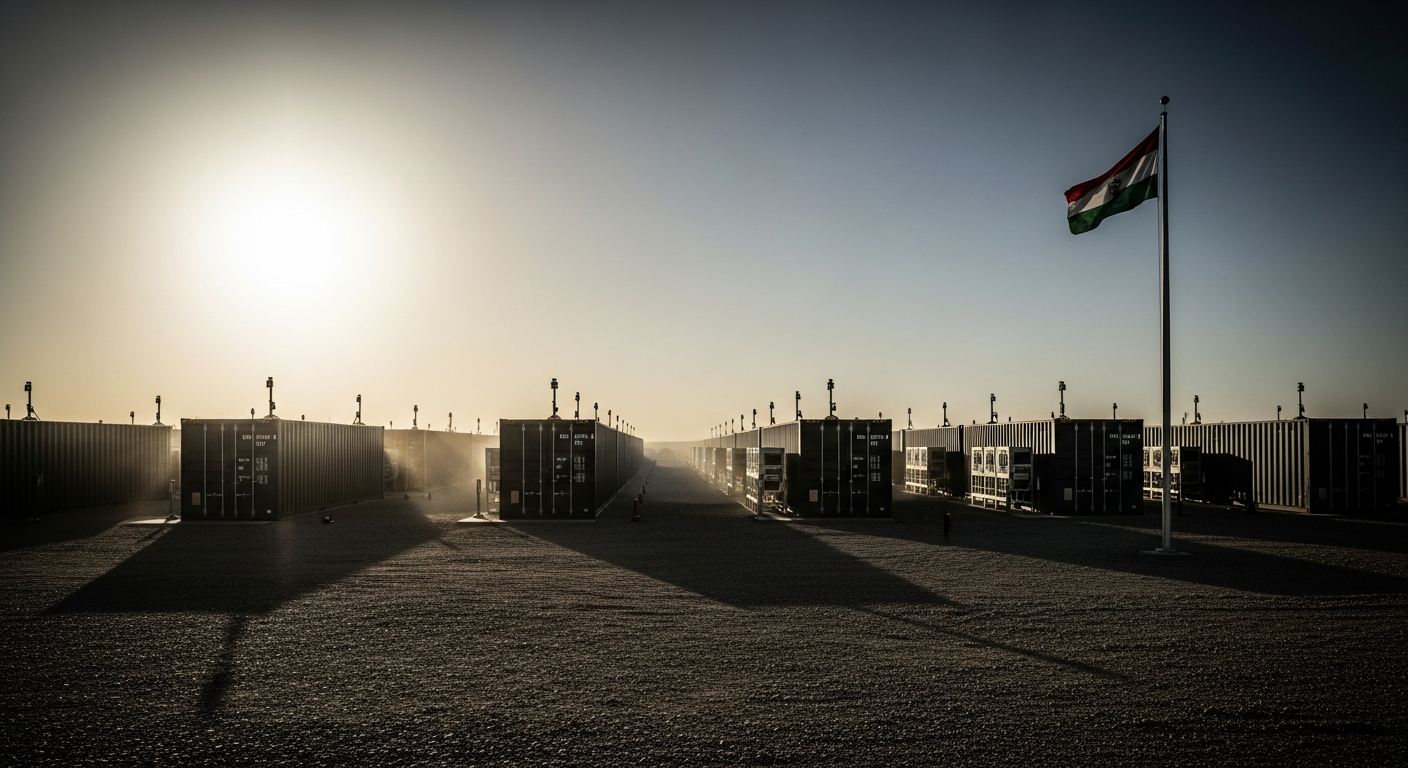
A BPI fellow's 2036 forecast makes the case that stranded-power nations will mine their way to monetary sovereignty. The data on Bhutan is the first stress test.
Key takeaways
Jacob Langenkamp, a fellow at the Bitcoin Policy Institute and founder of Bridger (a Bitcoin mining company operating in Africa), published a forward-looking scenario in Bitcoin Magazine's 2036 Issue arguing that sovereign nations will displace corporate miners as the dominant force in Bitcoin's hashrate, with stranded energy as the structural driver. The piece, first published in Bitcoin Magazine's 2036 Issue on June 24, 2026, is analytical and speculative, not a news announcement. But the thesis is worth pressure-testing because it maps directly onto where the next major wave of hashrate could come from.
The core logic is straightforward. Public mining companies built their business model around securing cheap grid-connected power in first-world markets, buying ASICs on short payback cycles, and running tight margins. That model is already being squeezed by the AI/HPC buildout, which outbids Bitcoin miners for available grid capacity. Many public miners pivoted. The ones that didn't are largely gone.
Meanwhile, a different problem has been accumulating across the Global South: nations with surplus hydroelectric or stranded generation capacity and no high-voltage transmission infrastructure to export it. Every hour that power goes unmonetized, the economics of the state-owned utility that built the plant get slightly worse. Langenkamp's argument is that Bitcoin mining solves this directly. The network buys electricity over the internet. No cross-border transmission required.
The mining deal looks like a mineral extraction joint venture: the foreign mining company operates the equipment, the sovereign takes a royalty in Bitcoin.
That framing matters because it reframes the whole conversation. A government discovers that stranded power is a wasting asset and Bitcoin is the only global buyer available right now. The environmental critique flips too: the marginal energy being mined here would otherwise be curtailed.
Langenkamp also lays out a geopolitical layer. In his scenario, "middle powers" caught between U.S. dollar-stablecoin expansion and Chinese Digital Yuan swap lines use Bitcoin as a neutral exit. Sovereign mining becomes the most cost-effective accumulation method for any nation with energy independence. Brazil's Bill 4501/2024, presented to the Chamber of Deputies by Federal Deputy Luiz Gastão on February 13, 2026, is cited as an example: it targets acquisition of up to 1 million BTC over five years and includes provisions allowing tax payments in Bitcoin and exempting Bitcoin transaction capital gains from taxation.
Note the conflict of interest: Langenkamp runs Bridger, a company that profits from sovereign mining adoption in the Global South. That context belongs in any honest reading of the piece.
Langenkamp holds up Bhutan as the pioneering sovereign miner. Bhutan's Druk Holding and Investments began mining Bitcoin around 2019 using surplus hydroelectric power, accumulated a peak of roughly 13,000 BTC by October 2024 (valued at approximately $1.4 billion at the time), and became the most documented case of sovereign Bitcoin mining globally.
Here is what the 2036 scenario does not reckon with: Arkham Intelligence on-chain data, first reported by CoinDesk, shows Bhutan held roughly 3,954 BTC as of April 2026, down from that 13,000 BTC peak. That is approximately 70% liquidated in 18 months. Mining appears to have ceased around November 2024. DHI has not publicly confirmed the halt, but the on-chain data is unambiguous.
Post-halving margin compression is the obvious culprit. A small sovereign operation running hydro in a single geography cannot absorb the economics of a halving cycle the way a diversified, large-scale miner can. Bhutan mined, accumulated, then faced fiscal pressure and sold. That is not a failure of the concept, but it is a real constraint the 2036 thesis has to survive.
The Brazil bill faces its own uncertainty. The bill's capital gains tax exemption provision, while cited in Langenkamp's piece, has not been independently verified as enacted law and should be treated as a legislative proposal only, not an accomplished fact. The 1 million BTC acquisition target and the tax-payment-in-Bitcoin provision are confirmed in the bill text. The bill is still in committee.
The mining economics data are not friendly to new sovereign entrants right now.
The falsifiable version of Langenkamp's thesis: if AI and HPC data center demand extends to energy-stranded Global South markets and offers a better price for that surplus power than Bitcoin mining does, the entire structural argument dissolves. Alternatively, if post-halving economics continue to compress sovereign mining margins and more programs follow Bhutan's trajectory (mine, accumulate, sell under fiscal pressure, exit), the thesis fails in practice even if the electricity logic is sound.
Brazil's bill passing committee would be a genuine confirming signal. A second sovereign operation sustaining mining profitably across a full halving cycle would be stronger still. Neither has happened yet.
The broader geopolitical argument, nations opting out of both the dollar-stablecoin sphere and Digital Yuan CBDC infrastructure simultaneously via sovereign debt hedging and Bitcoin accumulation, is directionally real and documented. Whether mining is the mechanism or just the aspiration depends entirely on whether any sovereign program can demonstrate durable unit economics through the next halving.
Sovereign mining is when a national government or state-owned entity operates Bitcoin mining infrastructure using national energy resources, typically to monetize surplus or stranded power that cannot be exported over the grid. The mined Bitcoin is retained as a national reserve asset rather than sold immediately to cover operating costs.
For a country with surplus generation capacity and no transmission infrastructure to reach neighboring markets, mining converts electricity that would otherwise be curtailed into a globally liquid asset. The acquisition cost can fall well below spot price if the power is genuinely stranded. The network functions as a buyer of last resort for power no one else can purchase.
Bhutan is the most documented case. Druk Holding and Investments accumulated roughly 13,000 BTC via hydropower starting around 2019. By April 2026, approximately 70% of that peak had been sold, and on-chain data suggests mining halted around November 2024. No sovereign program has yet demonstrated sustained profitability through a full post-halving cycle.