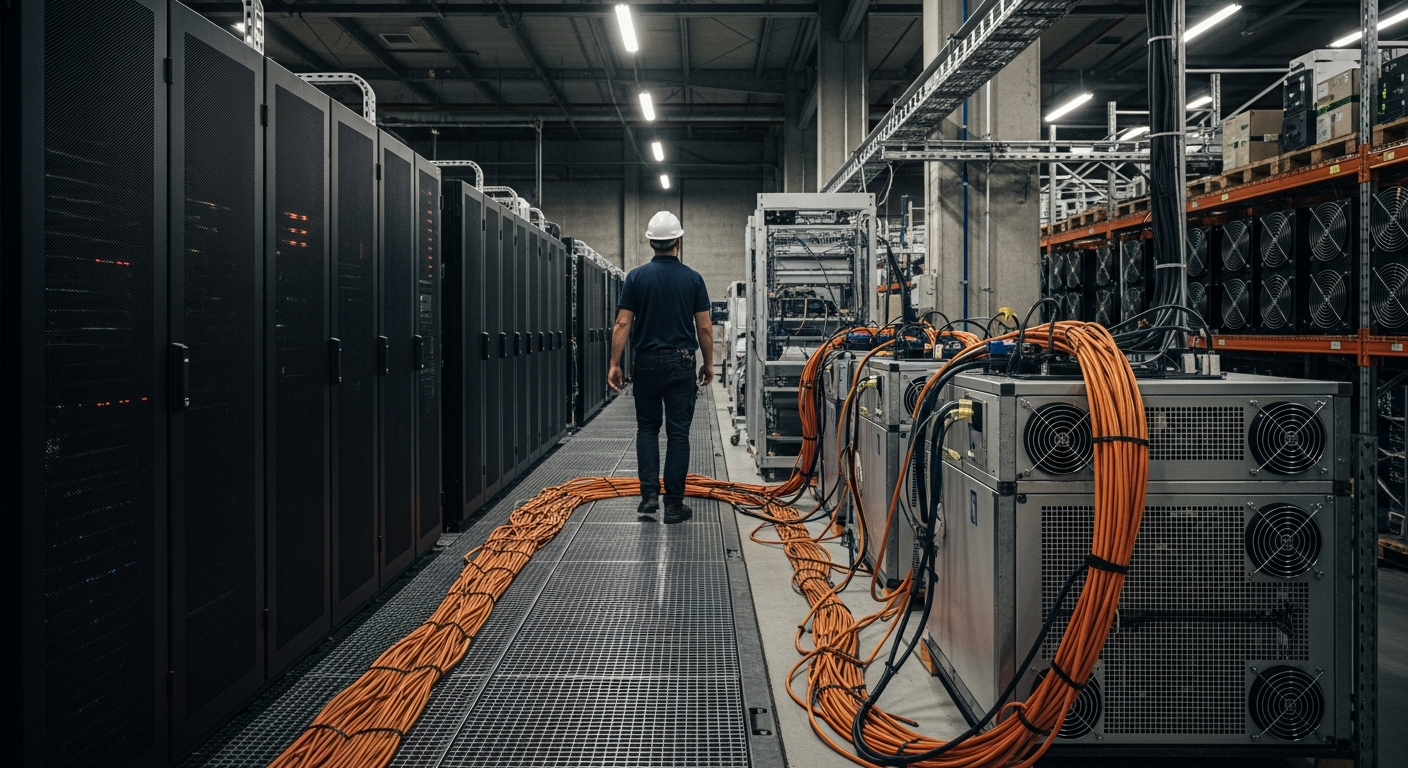
LM Funding America announced June 23 it is pivoting its 26 MW of Bitcoin mining infrastructure in Oklahoma and Mississippi toward AI and high-performance computing, ordering initial GPU hardware and marketing up to 10 MW for co-location customers.
Tampa miner orders GPU hardware, markets cheap Oklahoma power to AI co-location customers as the industry's defining constraint shifts from silicon to watts.
Key takeaways
LM Funding America announced June 23 that it is entering high-performance computing and AI infrastructure, ordering initial GPU server hardware for its Oklahoma facility and marketing available power capacity at both Oklahoma and Mississippi sites to AI co-location customers, per a GlobeNewswire press release. For a company trading near its 52-week low, it is a bet that the power infrastructure Bitcoin mining forced LMFA to build is now worth more per megawatt than any ASIC workload running on it.
LMFA built 26 MW of wholly owned operational power capacity across Oklahoma and Mississippi in 15 months, without outside management, at an average cost of roughly $0.046 per kilowatt-hour. Twenty-two of those megawatts currently support Bitcoin mining. The company says all or part of that capacity is immediately addressable for AI redirection, and up to 10 MW is being actively marketed to co-location and power hosting customers right now.
Chairman and CEO Bruce Rodgers framed it plainly in the press release: "The defining constraint in AI infrastructure is no longer floor space or fiber, it is power."
The revenue math the company is working from, based on industry benchmarks rather than signed contracts, runs $800K to $2M per megawatt annually. At full 26 MW deployment, that implies $20M to $50M in annual revenue. The buildout cost to get there: $10 to $12M per megawatt, or roughly $260M to $312M for the full site, which management acknowledges would require additional debt or capital markets funding beyond what the Bitcoin treasury and mining cash flow can cover.
LMFA is also in discussions with its Oklahoma power provider for a potential 10 to 50 MW expansion, subject to load studies. That is contingent and unsigned.
This is the thesis Bitcoin miners have been building toward for years, often without articulating it clearly. Miners found and contracted cheap, stranded, or interruptible power in places no hyperscaler bothered looking. Rural Oklahoma. Mississippi. West Texas. The economics of Bitcoin mining forced that discipline. AI capex is now chasing exactly the same map.
The broader industry numbers support the directional logic. According to CoinShares' Q1 2026 report, publicly listed miners have announced more than $70 billion in AI and HPC contracts, and the sector could derive up to 70% of its revenue from AI by the end of 2026, up from roughly 30% currently. VanEck estimates a $50 billion near-term funding gap for the full industry pivot, with long-term capital needs potentially reaching $221 billion. The AI capex cycle is real, and power scarcity is the binding constraint.
LMFA's BTC-NAV discount tells a specific story. With 322.7 BTC on the balance sheet valued at roughly $23.8 million as of May 31, 2026, the company had approximately $1.11 per share in Bitcoin alone against a share price near $0.26 as of May 29. The stock was trading around $0.20 in premarket on June 23. The market is pricing near-zero operational value for 26 MW of cheap, wholly owned power. Either the market is right that a small operator cannot compete with capitalized data center players for the same AI contracts, or it is mis-pricing real infrastructure.
Rodgers addressed the NAV gap directly: "Our Bitcoin treasury is real, it is liquid, and at current prices it is worth multiples of our stock price."
Management says the initial AI expansion will be funded through Bitcoin mining operations and the BTC treasury, not through new equity or debt issuance at this stage.
The falsifiable question here is straightforward. If LMFA secures AI co-location contracts at or above $800K per MW annually within the next two quarters, without meaningful equity dilution or BTC liquidation, the power-first miner model holds. The company proves that Bitcoin miners who built discipline around cheap watts can convert that infrastructure into AI revenue without becoming a distressed seller of either shares or Bitcoin.
If the Oklahoma capacity sits uncontracted through Q4 2026, or if LMFA is forced to sell BTC to fund the GPU buildout, the pivot reads as a distressed exit from compressed mining economics rather than a deliberate infrastructure play. The $260M to $312M full-buildout number against a $23.8M treasury makes the sequencing fragile. Hyperscaler co-location deals have to arrive before the balance sheet does.
There is a second-order effect worth watching for the Bitcoin network. Every megawatt redirected from ASICs to GPUs is hash rate leaving. LMFA at 26 MW is small enough that the direct impact on network security is noise. But if the CoinShares projection of 70% AI revenue across listed miners by end of 2026 materializes, the composition of Bitcoin's security budget shifts at exactly the moment the post-halving subsidy decline accelerates. Fee revenue has to carry more weight. That transition is coming regardless of what LMFA does; the aggregate miner pivot toward AI simply compresses the timeline.
LMFA's next proof point is a signed co-location or power hosting contract in Oklahoma. Absent that, the announcement is a roadmap, not a pivot. The company's investor relations page at lmfunding.com and any subsequent SEC filings will be the signal to watch over the next 60 to 90 days.
LMFA's contribution is small enough that its individual impact on hash rate is negligible. The concern is aggregate. CoinShares projects listed miners could derive up to 70% of revenue from AI by end of 2026. If that materializes, a meaningful share of the physical infrastructure currently securing Bitcoin shifts to GPU workloads, and Bitcoin's security budget becomes more dependent on transaction fee revenue at a period of declining block subsidies. That is a structural shift to monitor, not an immediate crisis.
The market is pricing significant execution risk on the AI pivot and near-zero operational value for the power infrastructure. With a full buildout requiring $260M to $312M in capital against a $23.8M Bitcoin treasury and a stock near its 52-week low, the gap between BTC NAV and share price reflects skepticism that a small operator can close AI co-location deals before better-capitalized competitors lock up comparable rural power nodes. The discount is either a deep value signal or the market correctly pricing the probability that the pivot stalls.
LMFA estimates $10 to $12M per megawatt for a full AI-grade buildout, based on industry benchmarks. Unlike ASIC deployments, GPU infrastructure at AI scale typically requires upgraded cooling, power conditioning, and Tier III data center specifications. The hardware and civil work are capital-intensive, and the capital has to come from somewhere. LMFA says the initial GPU deployment will be funded from Bitcoin mining cash flow and treasury; any expansion beyond that requires new debt or equity.