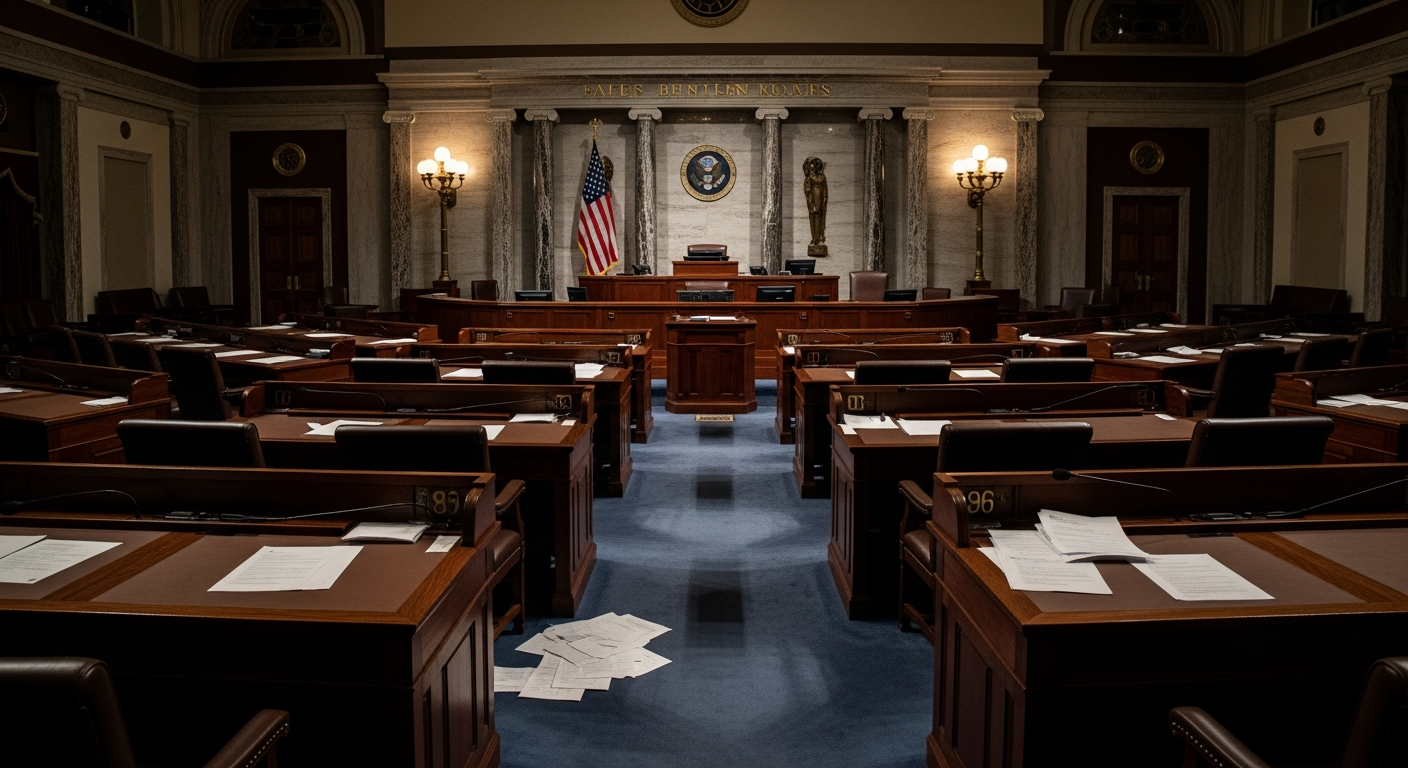
The Senate passed the 21st Century ROAD to Housing Act 85-5 on June 22, burying a four-year Federal Reserve CBDC ban inside it. The House votes next. Then Trump's desk. The permissionless carve-out is real. The 2030 sunset is the problem.
The strongest legislative signal yet against a surveillance digital dollar comes with an expiration date.
Key takeaways
The U.S. Senate passed the 21st Century ROAD to Housing Act 85-5 on Monday night, June 22, 2026, with a four-year prohibition on Federal Reserve CBDC issuance buried inside a sweeping housing affordability package. Because the Senate amended the bill, it now returns to the House, which is expected to vote within days, before it can go to President Trump's desk. It is the furthest Congress has ever gone toward formally blocking a digital dollar. It is also, by design, temporary.
Section 1001 of H.R. 6644 states that "the Board of Governors of the Federal Reserve System or a Federal reserve bank may not issue or create a central bank digital currency or any digital asset that is substantially similar to a central bank digital currency directly or indirectly through a financial institution or other intermediary." The full bill text is published by the Senate Banking Committee.
The standalone CBDC legislation, the Anti-CBDC Surveillance State Act championed by Rep. Tom Emmer (R-MN) and Sen. Ted Cruz (R-TX), cleared the House but stalled in the Senate for years. The workaround: attach it to a bipartisan housing bill with enough political gravity to move. Senate Banking Committee Chairman Tim Scott (R-SC) and Ranking Member Elizabeth Warren (D-MA) co-led the housing vehicle, joined by House Financial Services Chairman French Hill (R-AR) and Ranking Member Maxine Waters (D-CA).
The bipartisan scaffolding is what produced the lopsided margin. The Senate first passed a version of this bill 89-10 in March 2026 with the CBDC ban already inside it. The House passed its amended version 390-9 on February 9, 2026. The June 22 vote, 85-5, reflects the Senate ratifying the final reconciled bicameral text, with several members absent due to flight delays caused by severe thunderstorms at Reagan National Airport. Because the Senate amended the bill, it now returns to the House before heading to the President.
Trump's alignment was never in question. He signed an executive order in January 2025 declaring that a CBDC would "threaten the stability of the financial system, individual privacy, and the sovereignty of the United States." New Fed Chair Kevin Warsh has publicly opposed a U.S. CBDC. There was no active federal CBDC project to block. Congress banned something that wasn't being built, and it still took years and a housing bill to get it done.
The provision that deserves more attention than the prohibition itself: Section 1001 explicitly protects "dollar-denominated currency that is open, permissionless, and private." Congress has drawn a statutory line between two categories of digital money. The surveillance rail, a Fed-controlled coin, is banned. The freedom rail, permissionless, private, open, is protected.
That distinction is now in federal statute. Bitcoin and open stablecoin protocols can point to it. The digital dollar debate has been theoretical for years; this makes the legal boundary concrete. Whatever fills the international payment gap over the next four years, dollar-denominated private instruments built on open rails have explicit congressional cover.
The global context sharpens this. China continues expanding its e-CNY network. The U.S. just legally walled off the government-coin approach for four years while leaving the private, permissionless alternative fully intact. If open stablecoins and Bitcoin-denominated instruments dominate cross-border dollar flows before 2030, the political case for a Fed surveillance coin weakens considerably. That is the scenario worth watching, not the scenario where a non-existent CBDC project gets banned on paper.
The AI surveillance infrastructure already embedded in KYC pipelines is a reminder of why the permissionless carve-out is not a technicality. The architecture of financial surveillance does not require a CBDC to function. It requires programmable, permissioned money. The carve-out matters because it signals which architecture Congress, at least this Congress, has decided to protect.
The ban expires December 31, 2030. That is not a minor footnote.
The 85-5 vote looks decisive. It is not a durable coalition. Warren co-sponsored the housing vehicle, not the CBDC ban specifically. When the housing urgency is gone and a new Congress convenes with different pressures, the bipartisan cover may not reassemble. The CBDC-specific political capital was always limited enough that it required a popular housing bill as the vehicle to move at all.
The falsifiable thesis here: this vote is the strongest legislative signal yet that a U.S. surveillance digital dollar will not be built this political cycle. The trigger that disproves it: Congress passes a permanent ban before 2030, or the standalone Anti-CBDC Surveillance State Act gets attached to another must-pass vehicle before the sunset. The trigger that confirms the weakness: a future administration waits out the clock and arrives at January 2031 with fresh congressional backing and a four-year-old precedent that expired quietly.
Rep. Anna Paulina Luna (R-FL) has publicly called for a permanent ban. Emmer and Cruz have the same position. The pressure needs to continue before the clock runs out, not after.
The House is expected to vote on the Senate's version on June 23 or shortly after, per the Senate Banking Committee's press release on the Senate passage. Trump's signature follows a successful House vote. After that, the next objective is clear: a standalone permanent ban, or a no-sunset amendment attached to the next available legislative vehicle before the four-year clock has run much further.
No. Section 1001 explicitly exempts any "dollar-denominated currency that is open, permissionless, and private." Bitcoin, privately issued stablecoins like USDC, and similar assets are not touched by the prohibition. The ban targets only a Federal Reserve-issued or Federal Reserve-controlled digital currency.
The prohibition sunsets. After that date, the Fed's path forward depends on whether Congress has separately legislated a permanent ban in the interim. The standalone Anti-CBDC Surveillance State Act has not yet passed both chambers. The 2030 sunset is the pressure point Bitcoiners and privacy advocates need to be tracking now.
Legislative bundling. The standalone CBDC ban had repeatedly stalled in the Senate despite clearing the House. Attaching it to a broadly popular bipartisan housing affordability bill, one both parties were motivated to pass, was the workaround that finally got it across the finish line.