

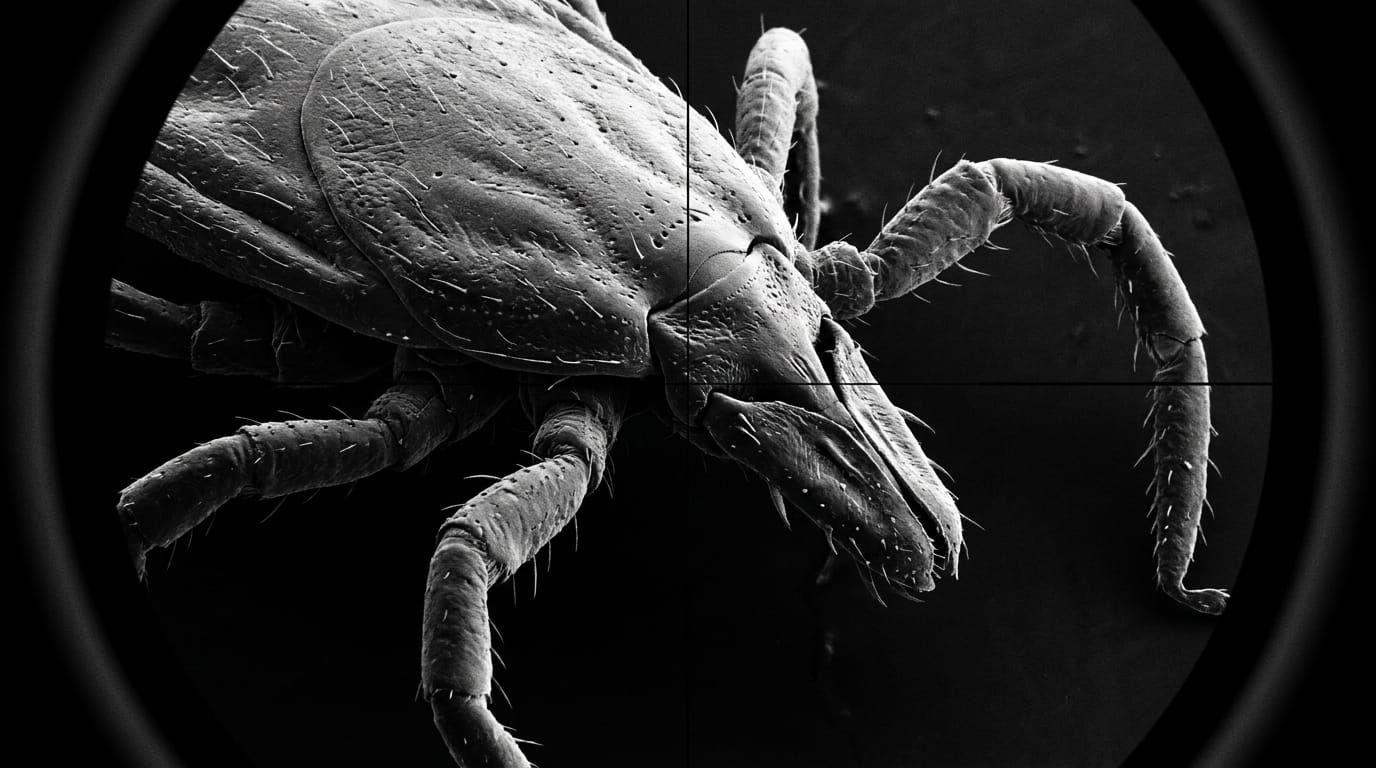
The 1953 Army document, the 1960s radioactive tick releases, the 2019 Smith amendment forcing Pentagon declassification — here's what's documented about America's Lyme bioweapon history and what to do about it this summer.
Step into a Pennsylvania backyard this summer and you'll find more ticks than at any point in recorded history. CDC modeling estimates that approximately 476,000 Americans get diagnosed with Lyme disease every year, most of whom never get counted in official surveillance data. Alpha-Gal syndrome, a tick-bite-induced red meat allergy that didn't medically exist before the 1980s, now affects hundreds of thousands of Americans. None of this is an accident.
In 1953, the Biological Warfare Laboratories at Fort Detrick established a formal program to weaponize arthropods. The Army's own document laid out the case in plain language: ticks inject pathogens directly into the body bypassing masks, they remain alive and dangerous for months, and they tie up an enemy's medical resources. By the late 1960s the Army and the Atomic Energy Commission were releasing radioactive ticks along the Atlantic bird flyway, specifically to track how far poisoned ticks would spread. A 2019 congressional amendment finally forced the Pentagon to declassify what they actually did with the program. A Government Accountability Office report is pending.
Kris Newby, the Stanford-affiliated investigative journalist who wrote Bitten: The Secret History of Lyme Disease and Biological Weapons, has been on this beat for over two decades. Our recent TFTC conversation with Kris Newby is the substrate of this piece. Below is the documented record, the parts still hidden, and the practical reality for anyone whose family spends time outdoors.
This guide covers the 1953 Fort Detrick arthropod program in primary sources, the Burgdorfer story from Swiss bioweapons scientist to Lyme's official discoverer, Operation Mongoose and the Cuban tick drop confirmed in the JFK files, the Norfolk radioactive tick releases documented in the published Army record, how Alpha-Gal syndrome maps to that history, why NIH funding patterns kept the story buried for forty years, the LYMErix vaccine politics that pushed the cure aside, the 2019 Smith amendment and the pending GAO investigation, and what to actually do this summer to protect your family.
| Year | Documented event | Primary source |
|---|---|---|
| 1951 | Willy Burgdorfer recruited to Rocky Mountain Labs (NIH) for arthropod bioweapons work | Bitten (Newby), Burgdorfer interviews 2013-2014 |
| 1953 | Fort Detrick's Biological Warfare Laboratories establish formal arthropod program | Army Chemical Corps records |
| 1961-1962 | Operation Mongoose: CIA drops infected ticks on Cuban sugarcane workers | National Archives JFK assassination files (declassified across multiple releases, 2017-2025) |
| 1966-1969 | Daniel Sonnenschein releases ~282,800 radioactive ticks along Atlantic bird flyway in Norfolk, Virginia | Sonnenschein's published military / AEC contract papers |
| 1970s | Lyme disease begins aggressive spread, starting in northern Wisconsin | CDC surveillance records |
| 1980 | Bayh-Dole Act passes, opening the NIH-pharma profit-sharing pipeline | Public Law 96-517 |
| 1982 | Borrelia burgdorferi identified, published in Science | Burgdorfer et al., Science, 1982 |
| 1998 | LYMErix vaccine approved | FDA |
| 2002 | LYMErix pulled "for low sales" | FDA |
| 2013-2014 | Newby interviews Burgdorfer at end of life; he says he "didn't tell everything" | Bitten (Newby) |
| 2019 | Rep. Chris Smith amendment passes — Pentagon ordered to declassify program | Smith House press release |
| 2026 | Pfizer's third-attempt Lyme vaccine slated to launch; GAO report pending | Pfizer / GAO public docket |
Reported Lyme cases have grown from roughly 50 per year before 1980 to about 89,000 reported to CDC in 2023. The 2023 figure is partly an artifact of the 2022 surveillance methodology change — 15 states that historically accounted for ~90% of Lyme cases now need only a positive blood test result to report, so the apparent jump that year reflects new reporting rules, not new disease. The underlying trend (with the case definition revisions baked in) has been pointing up for forty years, but each definition change rebases year-over-year comparisons.
| Period | Reported annual cases (CDC surveillance) | CDC's estimated true annual diagnoses |
|---|---|---|
| Pre-1980 (baseline) | ~50 | (no surveillance) |
| 1992 (first year of standardized national reporting) | 9,908 | — |
| 2006 | 19,931 | — |
| 2008 (probable cases added to case definition) | ~28,000 | — |
| 2017–2019 (annual average per CDC MMWR) | 37,118 | ~329,000 (per 2005–2010 modeling) |
| 2021 | 24,611 | ~476,000 (per 2010–2018 modeling) |
| 2023 (after the 2022 surveillance change) | ~89,000 | likely ~476,000+ |
Two patterns underneath the numbers. First, the CDC's own surveillance case definition has been modified in 1991, 1996, 2008, 2011, 2017, and again in 2022. Every revision rebases the year-over-year comparison. Second, the gap between reported cases (under 100,000) and the CDC's insurance-claims-based estimate of true diagnoses (~476,000) is roughly 5-to-1, because most Lyme diagnoses never enter the surveillance system at all.
The defensible synthesis: Lyme is the most common vector-borne illness in the United States, expanding in both case count and geographic range, with the federal government's own modeling estimating nearly half a million new diagnoses per year. The 1980s baseline of a few hundred cases per year was real. The current half-million-per-year diagnosis count is also real. Whatever happened to the curve between those two points is the story.
The conspiracy framing isn't necessary. The Army wrote it down.
In 1953, the Biological Warfare Laboratories at Fort Detrick, Maryland established a program to study the use of arthropods (ticks, fleas, and mosquitoes) for spreading anti-personnel bioweapons agents. The Army's own justification, which Newby read aloud from the source document on our podcast, lays out three operational advantages: arthropods inject the pathogen directly into the body so a gas mask is no protection, they remain alive and dangerous for some time so an area stays contaminated, and they would disable soldiers and everyone around them and tie up enemy medical resources at the same time.
There was a cost calculation. A 1950s Army cost report estimated tick-borne tularemia (still on the federal Select Agent list) could kill a target for one dollar and thirty-three cents. People in the program called bioweapons "the poor man's nuke" because the infrastructure stays intact when the population gets sick — and at $1.33 per target, the per-unit math was hard to argue with.
Burgdorfer was hired at Rocky Mountain Labs in Hamilton, Montana in 1951. His role was to mix multiple pathogens into single ticks. He documented attempts to combine Rocky Mountain spotted fever with Colorado tick fever virus in the same tick. It's not clear from the unclassified record whether he succeeded at all the combinations he tried. The strategic premise was simple: if you released ticks carrying two or three diseases in an area you wanted to eventually invade, the resulting illness would have no fingerprints. It would just be an unsolvable medical mystery and an easy target for ground forces.
This was the official program. It ran for at least sixteen years under different administrations. Nixon formally terminated the offensive bioweapons program in 1969, but the research had already produced the techniques, the trained scientists, the labs, and the strains. Closing the program doesn't undo the open-air experiments that had already been run. It just means we stopped funding new ones.
What is the government even for? It's a question worth keeping in front of you while reading the rest of this.
Burgdorfer is a useful figure to understand because the same scientist who weaponized ticks in the 1950s and 1960s is the one who got credit for discovering Lyme disease in 1982. The official biography has him as a heroic Swiss researcher who identified the spirochete causing a mysterious illness in northern Wisconsin and Connecticut. The complete biography has him as a bioweapons specialist for thirty years prior, working at the lab that funded the spread of the same tick-borne diseases he later got famous for solving.
Newby spent five years documenting Burgdorfer for the 2008 documentary Under Our Skin. She and director Andy Wilson set up an interview at his house in Hamilton. About forty-five minutes into the lighting setup, there was a hard knock on the door. The head scientist at Rocky Mountain Labs, two and a half blocks away, was standing on the porch. He said he'd been told to sit in on the interview. The film team refused. Burgdorfer was retired. He was a private citizen. The scientist eventually left.
In the interview that followed, Burgdorfer said on camera what nobody at NIH had ever said publicly: Lyme disease can be chronic, it can affect the nervous system seriously, and it's worse for children whose neurological systems are still developing. NIH was still actively denying chronic Lyme. They still are, mostly. The acknowledgment from Burgdorfer was a small bombshell.
As the lighting was being shut down, Burgdorfer told Newby with what she describes as a sly smile that he "didn't tell you everything."
Two weeks after the documentary wrapped, Newby thought she was done with the subject. She went to a Texas birthday party for her husband's family. She didn't know anyone there. She sat next to a man in his 70s who said he'd worked "for the company." CIA, black ops, Vietnam-era. He told stories at the table that had everyone wide-eyed. At the end he said the weirdest thing he'd ever done was drop infected ticks on Cuban sugarcane workers under Colonel Edward Lansdale, who ran the CIA's dirty operations in the Caribbean. The operation he described was Operation Mongoose.
There was no public record at that point of the US ever conducting offensive bioweapons operations against foreign nations. Newby couldn't walk away from that.
A few years later, the Cuban tick drop showed up in the JFK assassination files when the National Archives released them. The same files contained the Mongoose Cuba operations. The reason it ended up there is that those operations were part of the broader effort to remove Castro, which intersected with the assassination history. Files about killing Castro and files about killing American chronic illness via tick research were filed in the same place, for the same reason.
Burgdorfer himself ended up with Lyme disease. The infection came from rabbit urine splashing in his eyes while cleaning lab cages on a weekend (the lab techs were off). He developed multiple bullseye rashes documented down the side of his torso. He filed for workers' compensation. He believed the chronic infection caused his Parkinson's disease, which forced him onto disability. The man who helped engineer the bioweapon got it himself, and that's around the time he started talking to journalists.
He died in 2014. The files he kept in his garage are the foundation of the unclassified record that exists today.
Operation Mongoose ran from late 1961 through October 1962. It was the CIA's covert program to topple the Castro government. Edward Lansdale ran it. It included assassination plots, sabotage operations, economic warfare, and (per the declassified record now) biological attacks on Cuban agriculture.
The Cuban sugarcane worker tick drop is one of those biological attacks. The objective was to disable the workforce that produced Cuba's primary export. Ticks carrying tularemia or Rocky Mountain spotted fever would cause incapacitating illness with no obvious origin. Cuban doctors wouldn't have the diagnostic infrastructure to identify what hit them. Workers couldn't work. The economy would crater. The regime would destabilize.
It's important to understand the operational philosophy. You don't drop bombs because that destroys the infrastructure you want to inherit. You drop ticks because the workers get sick, you wait, and then you take over a functional country. This was articulated explicitly in the Army's 1953 program memo.
Why did the Cuban tick drop end up in the JFK files? Because the same Lansdale operation was running the assassination attempts on Castro. The files were filed together because the operations overlapped. When the National Archives released the JFK records, the Mongoose Cuba bioweapon operations came out with them. The Pentagon hadn't intended to declassify the tick drops. It happened because they were in the wrong folder.
This matters because it tells you what's still classified. If the Cuban operation came out only because it overlapped with the assassination files, then operations that didn't have that overlap are still under seal. The 2019 Smith amendment, discussed in a later section, is what should force those out.
Daniel Sonnenschein was a young, ambitious entomologist at Old Dominion College in the late 1960s. He wanted Old Dominion to be a real university, and he wanted to be the scientist who made it one. He took military contracts. He reported jointly to the Army and the Atomic Energy Commission. His mandate was to develop a tick that could survive Russian winters and could be injected with various pathogens, and to figure out how fast a tick population would spread when introduced to a new ecosystem.
Sonnenschein ordered pregnant ticks (called gravid ticks) from Burgdorfer at Rocky Mountain Labs. He injected the gravid ticks with radioactive fluid, so when they laid their three thousand eggs, every offspring would be detectable. He marked off meter-square grids in swampy lots outside Norfolk, Virginia (on the Atlantic Bird Flyway), put a thousand radioactive ticks in each grid, and tracked the spread over months and years. New ticks that wandered into each grid got painted with fluorescent paint so he could trace them. He published his results.
One of his papers said it would take five days for a tick to travel from coastal Virginia to Long Island on the migratory birds that nest in both places. Within two years, his Lone Star ticks were established in Long Island. The Lone Star tick had previously been native only south of the Mason-Dixon Line. After Sonnenschein's Norfolk releases, the species began the northward migration that has continued ever since.
The Lone Star tick is dangerous in three specific ways the white-footed deer tick is not. First, it has eyes on its shoulders. Most ticks detect prey by sensing carbon dioxide on a blade of grass. Lone Star ticks actively stalk; they can see and smell their target and they swarm. Second, it carries Rocky Mountain spotted fever, the most lethal tick-borne bacterial disease in North America. Third, its bite transmits the protein that causes Alpha-Gal syndrome, the red meat allergy now affecting hundreds of thousands of Americans (more on that in the next section).
A 2019 Newsweek investigation put the total Norfolk-era release count at approximately 282,800 ticks. The exact number from the publicly available papers is in that range. Those are the documented releases. There is no public count for unpublished or classified releases.
The clinical pattern in the years after Sonnenschein's experiments tracks the species migration. Outbreaks of Rocky Mountain spotted fever appeared in Long Island. People died. The Lone Star tick continued northward. The map of Lyme disease intensity in the United States today maps reasonably well onto the bird flyway corridors that Sonnenschein was tracking sixty years ago.
There may be more releases. The published ones are the only ones we know about. Researchers requesting records to investigate origin questions have hit the security-classification wall that the 2019 Smith amendment is trying to break through.
Alpha-Gal syndrome is genuinely strange as a disease. Galactose-α-1,3-galactose is a carbohydrate found in most mammalian meat (beef, pork, lamb) but not in primates. When a Lone Star tick bites a human, its saliva can transmit the carbohydrate into the bloodstream. The human immune system, encountering this carbohydrate where it doesn't belong, develops IgE antibodies to it. After the second exposure (typically a second Lone Star tick bite), eating mammalian meat triggers an allergic reaction.
The reaction is delayed: two to six hours after eating, not minutes. People wake up in the middle of the night vomiting, with hives, sometimes in anaphylactic shock. Some are so allergic they can't be near a Texas barbecue without respiratory symptoms. The allergy can be lifelong, though some patients see it fade after years of strict avoidance.
The CDC's Alpha-Gal Syndrome page confirms the clinical picture. It does not address the historical question of why the syndrome started appearing in clinical records in the 1980s and not before.
That question is the strange one. The Lone Star tick existed in the southern United States for at least centuries. Alpha-Gal as a documented allergic syndrome did not exist before the 1980s. Then it suddenly did, and the geographic distribution of the new allergy maps onto the northward migration of the Lone Star tick that began in the 1970s after the Norfolk experiments.
Newby is careful in the way she frames this. She has not been able to determine whether Alpha-Gal is itself a product of the bioweapon program or whether it's a downstream emergent property of the Lone Star tick range expansion that the bioweapon program triggered. She doesn't have a smoking-gun document tying Alpha-Gal directly to a specific pathogen engineering project. What she has is the timing and the geographic correlation.
The honest position is this: Alpha-Gal is downstream of the bioweapon program either way. Either it's a direct output of the genetic manipulation work that was being done on tick-borne diseases (in which case it's a contained-breach scenario), or it's an emergent consequence of the species being moved into ecosystems where it wasn't supposed to be. Both versions implicate the same program. The difference matters for the question of whether anyone in the original program knew Alpha-Gal would be a consequence.
Hundreds of thousands of Americans now can't eat red meat without risking anaphylaxis. As someone who loves red meat, that scares me. As someone who pays attention to government accountability, it should scare anyone whose family has a Lone Star tick problem.
There is a clean structural reason the Lyme story stayed buried for forty years. Most of the funding for tick-borne disease research at NIH requires a security clearance. The pathogens are biosafety level three. The grants are competitive. The cleared researchers form a small, self-reinforcing circle. Asking origin questions, in that circle, is a career-ending move.
A new PhD student looking to do tick-borne disease research can't afford to wait the year-plus a security clearance takes. So the field gets older researchers with locked-in incentives, not new ones with fresh questions.
The bigger structural problem is downstream of the Bayh-Dole Act of 1980. The act let government scientists and universities patent the products of federally funded research and partner with pharmaceutical companies on commercialization. The intent was technology transfer. The effect was that NIH scientists could now make substantially more than their government salary through licensing royalties on the products of their NIH work.
When the Lyme spirochete was identified in 1982, the researchers (Newby calls them the carpet baggers) patented the surface proteins. Then pharma teamed up with the patent holders to develop a vaccine. The math was simple. Doxycycline cost ten dollars and cured early-stage Lyme. A vaccine would be an annual product with multi-decade revenue.
So the foundational science around Lyme got distorted. The economic incentive was to maintain the myth that two pills of doxy cured the disease and that anyone with persistent symptoms had something else going on. Calling chronic Lyme real would undermine the vaccine market. So NIH and CDC institutionally denied that Lyme could become chronic, even when their own scientist (Burgdorfer) said in a documentary that it absolutely could.
When Newby went through the last twenty years of NIH Lyme-research grants under Fauci-era NIAID, she found a striking pattern: a large share of the money went to internal NIH projects with no incentive to sequence the actual pathogens and ask where they came from. Researchers at universities played along because NIH was their funding source. It's the same dynamic that's surfaced around Wuhan and the EcoHealth Alliance gain-of-function programs. Same NIH. Same biosecurity-clearance dynamics. Same career risk in asking origin questions. The Lyme version of this story is forty years older. We've been doing this for a long time. The Fauci-era NIH funding of gain-of-function research didn't start with COVID.
It seems like Fauci and NIH are at the core of the problems here. The moral hazard isn't an accident. It's the architecture.
There have been three Lyme vaccines. The first two appeared around 1990. The third is Pfizer's, slated to launch this summer.
Pam Weintraub's Cure Unknown documents the original vaccine hearings. She has the receipts on who was paid what by which manufacturer. The pattern she identifies is consistent with the rest of this story: researchers on contract with vaccine makers, NIH advisors with undisclosed conflicts, FDA panels weighted toward the pharma case. The vaccine got approved (LYMErix in 1998) and then was pulled in 2002, officially for "low sales." The unofficial reason in the trade press at the time was that the side effect profile combined with class-action lawsuits made the math stop working for the manufacturer.
The interesting question isn't whether LYMErix worked. It's why the industry consistently picks a vaccine path over the cure path.
The economics are clean. Doxycycline is generic, costs ten dollars covered by insurance, and cures uncomplicated early-stage Lyme. The patient takes their pills and leaves the system. A vaccine, by contrast, is a recurring product: annual booster, multi-decade revenue. And the chronic Lyme patients, the ones who got past the early stage, become decade-long customers for anti-inflammatory drugs and antidepressants prescribed to manage the symptoms. The system makes more money on a population that doesn't quite get cured than on a population that gets cured.
For families dealing with Lyme treatment outside of insurance, this is more than an abstract critique. Chronic Lyme treatment can run into tens of thousands of dollars. My wife and I have used CrowdHealth (a TFTC sponsor I'd use either way) for over five years now, and our most recent hospital bill (for our third child's delivery) is an example of the math: hospital billed $6,157, CrowdHealth negotiated it down to $2,309, we paid $500, the rest was crowdfunded by the membership. CrowdHealth doesn't fix every problem with American healthcare. It does pull you out of the insurance-and-pharma system enough that you can think clearly about what you're actually buying and what it actually costs. Read my longer breakdown of CrowdHealth here.
This is what the LYMErix story is really about. The system priced doxycycline out of relevance. Pfizer's third try in 2026 will be marketed as innovation. The cure has been sitting on the pharmacy shelf for forty years.
Representative Chris Smith (R-NJ) introduced a Lyme bioweapon investigation amendment to the FY2020 National Defense Authorization Act in summer 2019. It passed. The mechanism is straightforward: the Pentagon Inspector General is required to investigate whether the Department of Defense conducted experiments with ticks and other insects regarding their use as biological weapons between 1950 and 1975, and whether any of those weaponized insects were released outside of laboratories either accidentally or intentionally.
Smith spent five years trying to get this through. The earlier attempts were killed in committee. The 2019 version made it because of accumulating press coverage, including Newsweek's investigation and the work of LymeDisease.org, the advocacy organization for chronic Lyme patients.
The investigation is being conducted by the Government Accountability Office. The report is due approximately a year and a half from now. Newby's expectation, which I share, is that the report will come back with substantive material but heavily redacted, similar to the Epstein file releases. A first installment with blackouts is better than nothing. It's the first official acknowledgment that the program existed.
RFK Jr.'s role at the Department of Health and Human Services adds an interesting variable. His family has been affected by Lyme; his properties are in the Martha's Vineyard hot zone that he describes as ground zero. He's been on record about gain-of-function research and the need for biosecurity transparency. Whether his tenure at HHS produces actual follow-through on the GAO findings is the open question. The bureaucratic inertia is real. The biosecurity budget is enormous. The career incentive structure that kept this story buried for forty years doesn't disappear because the cabinet secretary changes.
The Smith amendment is the first official acknowledgment that the program existed. That's the floor. Whatever comes after is the test of whether the system can investigate itself.
The practical reality is that protection is on the individual right now. The federal investigation matters and we should track it. It will not stop you from getting bitten next weekend.
The most important piece of advice from Newby's twenty years of work is this: take every tick bite seriously. If you pull off an engorged tick and your doctor says "wait and see," push back. Two days of doxycycline is not sufficient based on the population of clinicians who actually treat chronic Lyme. Ask for a real course. If they refuse, find a Lyme-literate doctor through the ILADS directory.
Tick screening is faster and cheaper than the human antibody tests. Send the tick you pulled off your skin to a tick-testing program. East Stroudsburg University in Pennsylvania runs a free testing service for Pennsylvania residents and a low-cost one for out-of-staters. Other states have equivalent programs. The wet-paper-towel-in-a-baggie protocol is standard. Results come back in days, not the three weeks an antibody test requires.
For your yard: anti-tick bait boxes for mice are inexpensive and effective. They lure the mice that ticks feed on into a treated nesting box. Guinea fowl and chickens reduce tick populations meaningfully if you can keep them. CO2 traps (commercial or a homemade dry-ice version) collect ticks on your property so you can see what you're actually dealing with.
For the body: permethrin-treated outdoor clothing. It's available for under $25 at sporting goods stores or you can spray your own. Hang your treated outdoor clothing separately so it doesn't transfer onto everyday wear. Wash outdoor clothing after every outdoor trip. Tick checks daily during tick season: armpits, groin, hairline, behind the ears. If you've been in dense undergrowth or tall grass, treat your clothes as contaminated until they've been laundered.
For the Hamptons, Martha's Vineyard, Nantucket, Long Island, and northern Wisconsin (the worst hotspots): treat any outdoor exposure as a real risk and act accordingly. Don't re-wear beach clothes the next day. Don't trust local doctors who minimize the risk. Get the tick screened.
| If you... | Then your immediate priority | Then your follow-up |
|---|---|---|
| Live in a hot zone (Northeast, upper Midwest, Hamptons, Vineyard) | Permethrin-treated outdoor clothing, daily tick checks | CO2 collection box for the yard; consider guinea fowl |
| Just pulled an engorged tick off yourself or a kid | Send the tick to your state's screening program; insist on a real doxycycline course | Don't accept "wait and see"; find a Lyme-literate doctor if needed |
| Have unexplained chronic symptoms starting after outdoor exposure | Request comprehensive tick-borne disease panel; include babesiosis | Read Cure Unknown and Bitten; consider an ILADS-affiliated physician |
| Are concerned about Alpha-Gal | Avoid Lone Star tick exposure (long sleeves, repellent, dedicated outdoor clothing) | IgE testing if you have post-meat-meal symptoms |
| Want to follow the policy investigation | Monitor the GAO report (due ~2027) and Smith amendment implementation | Subscribe to Kris Newby's substack |
| Are dealing with chronic Lyme treatment costs | Look at healthcare options outside the insurance-and-pharma system | CrowdHealth is worth a serious look |
If you spend time in tick country: Treat outdoor clothing with permethrin (commercially available, ~$20) and hang it separately from your other clothes. Run a daily tick check after any outdoor exposure. The check matters more than the repellent.
If you just pulled an engorged tick: Don't toss the tick. Save it. Send it to your state's tick screening program in a baggie with a wet paper towel. Pennsylvania residents can use East Stroudsburg's free service. Results come back in days; antibody tests take three weeks.
If a doctor tells you "wait and see" after a confirmed tick bite: Push back. Two days of doxycycline isn't enough. Cite Newby's work if you have to. If they still refuse, find an ILADS-affiliated Lyme-literate doctor.
If you're heading to the Hamptons or Vineyard this summer: Treat your clothes before you go. Don't re-wear beach clothes the next day. Bring a tick removal tool. Save any ticks you remove. Trust your symptoms over a vacation-area doctor who'd rather not deal with you.
If you want to follow the policy story: Subscribe to Kris Newby's substack. Track the GAO report due in roughly eighteen months. Pay attention to what RFK Jr. at HHS actually does with the declassification mandate. The first official acknowledgment of the program existed is already on the record. What comes next is the test.
Yes, in the sense that the program existed and the documentary record is partly declassified. The 1953 Fort Detrick arthropod weapons program is in the Army Chemical Corps records. Sonnenschein's radioactive tick releases were published in his own military-contracted papers. The Cuban tick drop is confirmed in the JFK assassination files. The 2019 Smith amendment forced declassification of additional records that are now being reviewed by the GAO. What's still classified is the full scope: how many releases happened beyond the published ones, which pathogens were engineered into them, and where the records were destroyed.
Alpha-Gal Syndrome is an allergic condition caused by the bite of a Lone Star tick. The tick's saliva transmits the carbohydrate galactose-α-1,3-galactose into the human bloodstream. The immune system develops IgE antibodies to it, and from then on, eating mammalian meat (beef, pork, lamb) triggers an allergic reaction that can range from hives to anaphylaxis. The reaction is delayed by two to six hours after eating. The syndrome is currently affecting hundreds of thousands of Americans and the case count is growing. The CDC confirms the clinical picture. The historical question of why the syndrome appeared in the 1980s and not before remains open.
The Plum Island connection is more conspiracy-friendly than the actual record supports. The documented bioweapon program ran at Fort Detrick, Maryland; Rocky Mountain Laboratories in Hamilton, Montana; and Old Dominion College/Norfolk, Virginia. Plum Island handled foreign-animal disease research. The geographic proximity of Plum Island to the original Lyme cluster (Lyme, Connecticut) makes the conflation easy. The primary documents point to Burgdorfer's Rocky Mountain Labs work and Sonnenschein's Virginia experiments as the more likely vectors. Plum Island may have played a role in the broader bioweapon ecosystem; it isn't the smoking gun the conspiracy framing suggests.
LYMErix was officially withdrawn for "low sales." The unofficial reasons involved class-action lawsuits over adverse events, a difficult side-effect profile, and changing economics for the manufacturer. Pam Weintraub's Cure Unknown documents the vaccine hearings, including the conflicts of interest among the researchers and advisors. The deeper point is that the cure (doxycycline) was already cheap and effective at the early stage of infection, but the system kept pursuing the recurring-revenue vaccine path. Pfizer's 2026 release is the third attempt at a Lyme vaccine. The economics haven't changed.
Treat outdoor clothing with permethrin. Do daily full-body tick checks during tick season, focusing on armpits, groin, hairline, and behind the ears. Don't re-wear outdoor clothes the next day without washing. Use guinea fowl or chickens around tick-prone yards. Set up CO2 collection boxes if you want to track local tick populations. If you pull an engorged tick, send it to a state tick-screening program; don't rely solely on human antibody tests, which take three weeks to develop a measurable signal.
Same NIH funding structure, same biosecurity-clearance gatekeeping, same career incentive that punishes researchers for asking origin questions. The Lyme story is forty years older; the institutional architecture is the same one that surfaced again around Wuhan and EcoHealth Alliance. Both stories implicate NIH leadership's role in funding pathogen research without sufficient oversight. The COVID origins debate is a more recent and more politically visible instance of a problem that has been operating for decades. See Evidence Contradicts Fauci's Denial of NIH Funding for Gain-of-Function Research for the COVID-specific funding pattern.
The Government Accountability Office is investigating, under the 2019 Smith amendment, whether the Department of Defense conducted experiments with ticks and other arthropods as biological weapons between 1950 and 1975, and whether any such weaponized arthropods were released outside laboratories. The report is due approximately eighteen months from now. Outcomes likely include partial declassification with significant redactions, similar to the Epstein file releases. The first official acknowledgment that the program existed is the floor. The investigation's substantive findings are the next chapter.
Northeast (especially Connecticut, Long Island, Martha's Vineyard, Nantucket, the Hamptons, and southern New York) and upper Midwest (northern Wisconsin and Minnesota) are the original hot zones. The Lone Star tick is expanding northward and now affects most of the eastern seaboard. Pennsylvania has the highest reported Lyme case count in the country. The CDC publishes annual maps, but the actual range of tick exposure is broader than the case-report maps suggest because chronic Lyme cases often aren't diagnosed.
RFK Jr.'s family has been affected personally; he's on the record about gain-of-function research and biosecurity transparency. The Smith amendment timing puts the GAO report inside his tenure. The variables that determine whether anything changes are bureaucratic inertia (the biosecurity budget is enormous and the career-incentive structure that buried the story for forty years doesn't reset with a new cabinet secretary), congressional follow-through (Smith and a few others have to keep pushing), and the GAO's willingness to push back on Pentagon redaction demands. Honest assessment: things might get better, slowly. Don't expect a public reckoning.
Use fine-tipped tweezers. Grip the tick as close to the skin as possible. Pull straight upward with steady, even pressure. Don't twist. After removing, clean the bite area and your hands with alcohol or soap and water. Save the tick in a sealed bag with a damp paper towel. Send the tick to a state-run tick-screening program. Don't wait three weeks for human antibody tests if you develop symptoms; if a bullseye rash or flu-like symptoms appear, contact a Lyme-literate doctor immediately and request a real course of doxycycline.
Sponsored by: Bitkey (bitcoin self-custody hardware wallet, code TFTC for 10% off), Aven (bitcoin-backed line of credit), Unchained (collaborative multi-sig vaults, code TFTC10 for 10% off), Salt of the Earth (electrolyte drink mix).