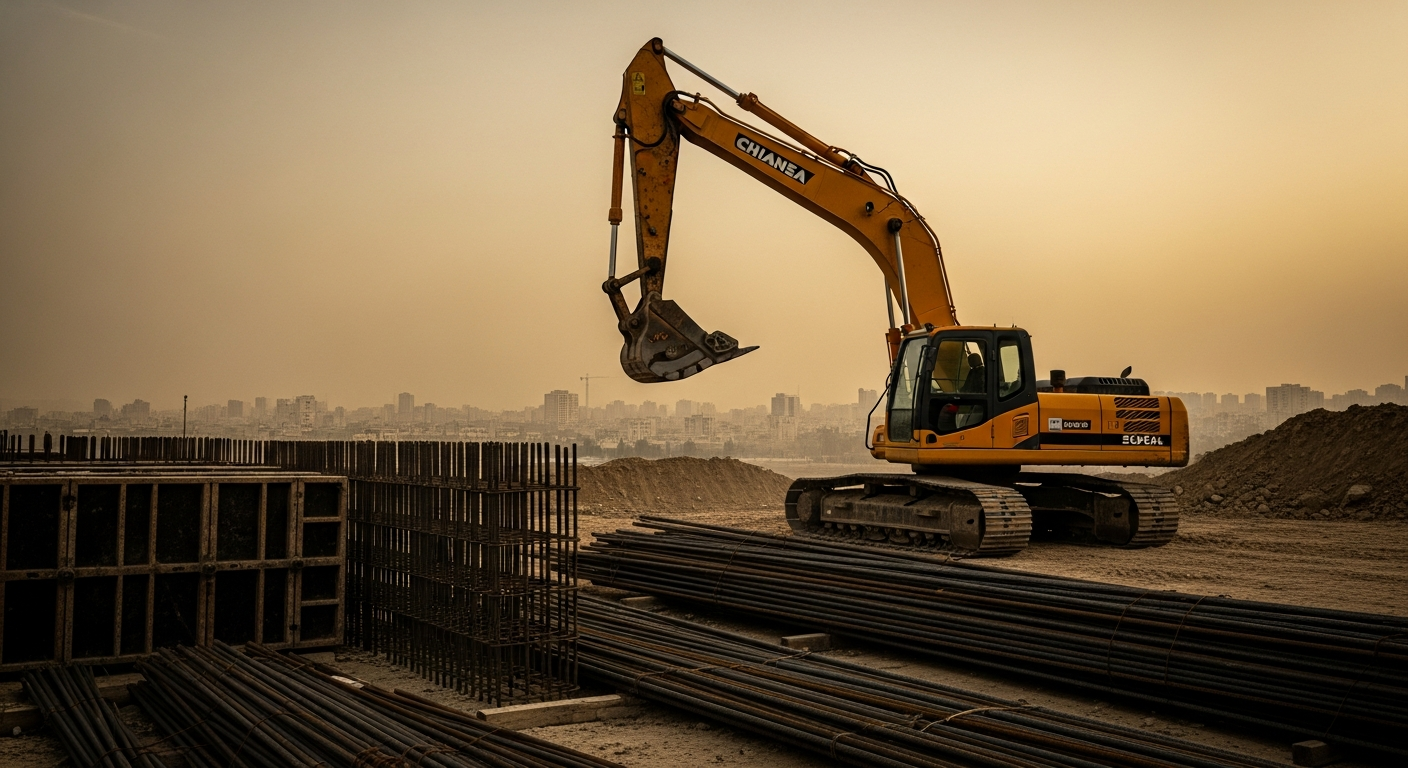
Chinese Foreign Minister Wang Yi pledged reconstruction support for Iran on June 22, signaling Beijing intends to secure long-term oil access in exchange. Every infrastructure contract signed in Tehran under Chinese terms is another barrel that clears outside dollar rails.
Beijing's pledge to rebuild Tehran is an energy lock-in that trades outside dollar rails.
Key takeaways
Chinese Foreign Minister Wang Yi met with Qadir Nizamipour, Deputy Secretary of Iran's Supreme National Security Council, in New Delhi on June 22, on the sidelines of the 16th BRICS National Security Advisors meeting. According to Nikkei Asia, which first reported the reconstruction angle, Wang signaled that China intends to continue providing assistance to Iran and supporting reconstruction and peacebuilding efforts in the region. The meeting date and parties are confirmed in the China Ministry of Foreign Affairs readout mirrored at GlobalSecurity.org.
The backdrop: the U.S.-Israel war on Iran began February 28, 2026. A U.S.-Iran memorandum of understanding toward ending the conflict was signed around June 18, confirmed in the China MFA's June 18 press conference. Iran now faces severe economic devastation and is locked out of Western capital markets. Beijing is the obvious reconstruction partner.
Before the war, China imported roughly 11.6 million barrels per day of crude. In May 2026, that figure fell to approximately 7.8 million barrels per day, an 8-year low not seen since October 2017, according to customs data reported by Bloomberg via EnergyConnects. Iran had been supplying roughly 900,000 barrels per day of that total in 2025, about 7% of China's imports, per China General Administration of Customs data cited by China Data Portal.
The import drawdown was a short-term response to price spikes and supply disruption. The reconstruction bet is a 10-to-20-year energy security play. Different time horizon, different game entirely.
A rebuilt Iranian oil export infrastructure, contracted and financed by Beijing, will almost certainly settle in yuan, bilateral swap arrangements, or barter. Not dollars. The petrodollar system's structural prop is that crude gets invoiced in USD globally, forcing every nation to hold dollar reserves to buy energy. China is now positioned to rebuild the supply chain of a country that sits on some of the world's largest proven reserves, on terms that exclude SWIFT and the dollar by default.
Rumi Aoyama, a professor at Waseda University's Graduate School of Asia-Pacific Studies specializing in Chinese foreign policy, described China as "a central hub where information on the situation in the Middle East was concentrated," per Nikkei Asia. That information advantage translates directly into first-mover position on reconstruction contracts.
The strategic logic extends well past Iran. The Strait of Hormuz carries roughly 20% of globally traded oil. Its disruption during the conflict exposed how fragile dollar-denominated energy flows actually are when a shooting war closes the chokepoint. China's move here is a proof of concept: use postwar devastation as the entry point for Belt and Road-style infrastructure lock-in, denominate the rebuilt flows outside dollar rails, and repeat.
The energy shock from the Iran war was not purely cyclical. Each reconstruction agreement Beijing signs in an energy-producing country the dollar system cannot reach is another node in a parallel settlement network. The cumulative effect is stagflationary for the West: energy costs in dollar terms rise even as physical supply normalizes, because the marginal barrel increasingly clears in a currency that isn't the dollar.
The falsifiable version of this thesis: if Iran's reconstruction contracts end up denominated in USD, if Western financial institutions successfully re-enter Iran post-sanctions, or if Beijing publicly subordinates investment to U.S. permission, the dollar's grip on energy settlement survives the war intact. Watch the denomination structure of the first major infrastructure contracts out of Tehran. That is the tell.
What this means for a sound money position is arithmetic, not speculation. As the dollar's moat around global energy settlement develops structural leaks, the bid for a stateless, fixed-supply, seizure-resistant settlement asset rises alongside every yuan-denominated barrel. Bitcoin does not care which flag is on the reconstruction contract.
The first concrete test comes when Tehran begins awarding postwar infrastructure contracts. If Chinese state-owned enterprises take the lead on oil field reconstruction and export terminal rebuilding, and the contract currency is yuan or a bilateral swap, the thesis above moves from diplomatic signal to confirmed structural shift. Until then, Wang Yi's June 22 meeting is the strongest public indicator of Beijing's intent, and the 8-year import low is the clearest data point showing how much China needs Iranian supply restored.
The petrodollar system works because crude oil is priced and settled in U.S. dollars almost universally. That forces every oil-importing nation to accumulate dollar reserves, which creates a permanent structural bid for U.S. currency and Treasury debt. When a major supplier like Iran shifts settlement to yuan or barter under Chinese reconstruction agreements, the global dollar reserve requirement shrinks. Even a shift of 1 to 2 million barrels per day out of dollar settlement is not a rounding error at the macro level.
The import drop was a short-term response to war-driven price spikes and Hormuz disruption. The reconstruction investment is a multi-decade energy security position. China wants Iranian crude flowing again at scale and wants the supply chain infrastructure denominated on its own terms before Western oil majors or financial institutions can re-enter post-sanctions. The two moves operate on completely different time horizons.
The Belt and Road Initiative is China's framework for financing and building infrastructure abroad, typically roads, ports, pipelines, and power plants, in exchange for long-term economic and political influence over the recipient country. Iran reconstruction fits the template directly: Beijing provides capital and engineering capacity that no sanctioned-country-friendly Western alternative can match, and in return secures preferred access to energy resources and a trade relationship that operates outside U.S.-controlled financial rails.