TFTC – Truth for the Commoner
Bitcoin Brief
|
|
Sup, freaks.
The private credit market is cracking in real time. Blackstone just had to raid its own balance sheet and its employees' wallets to cover a record wave of redemptions from its flagship $82 billion credit fund. Blue Owl permanently froze redemptions on a retail fund two weeks ago. Private equity stocks are down 25% to 61% from their highs. And the man who called the 2008 crisis, Steve Eisman, just sat down with a forensic accountant who says the insurance industry is the missing piece of the puzzle. This is a story that should be front page news but isn't. Today we dig in.
|
|
LEAD STORY
|
The Great Heist in Plain Sight: Private Credit, Insurance, and Your Retirement
Forensic accountant Tom Gober has spent years tracking what he calls the most dangerous intersection in American finance: the takeover of the $9.3 trillion insurance industry by private equity firms. On a recent episode of The Eisman Playbook, Steve Eisman, the man who saw 2008 coming, interviewed Gober and laid out how firms like Apollo, KKR, and Brookfield are using captive insurance subsidiaries to funnel policyholder money into illiquid private credit investments. The policyholders, often retirees depending on annuity payments, have no idea their money is backing leveraged buyouts and opaque credit structures that have never been stress-tested in a downturn.
The cracks are already showing. Blackstone's $82 billion flagship private credit fund, BCRED, just disclosed that redemption requests surged to a record 7.9% of the fund, well past its standard 5% quarterly cap. Blackstone had to upsize its redemption limit to 7% and then plug the remaining gap with $400 million invested by the firm and its own employees, just to meet all withdrawal requests. Net outflows hit $1.7 billion. The world's largest alternative asset manager is now using its own balance sheet to pay investors heading for the exits.
Two weeks ago, Blue Owl permanently froze redemptions on a retail-focused private credit fund. Across the private equity complex, stocks have cratered: Carlyle is down 25% from its highs, Apollo -39%, Ares -42%, Blackstone -43%, KKR -44%, and Blue Owl -61%. RA Stanger, the firm that tracks alternative assets, is forecasting a 40% year-over-year decline in BDC capital formation for 2026. And Blackstone's Jon Gray went on CNBC and called all of this "a ton of noise." 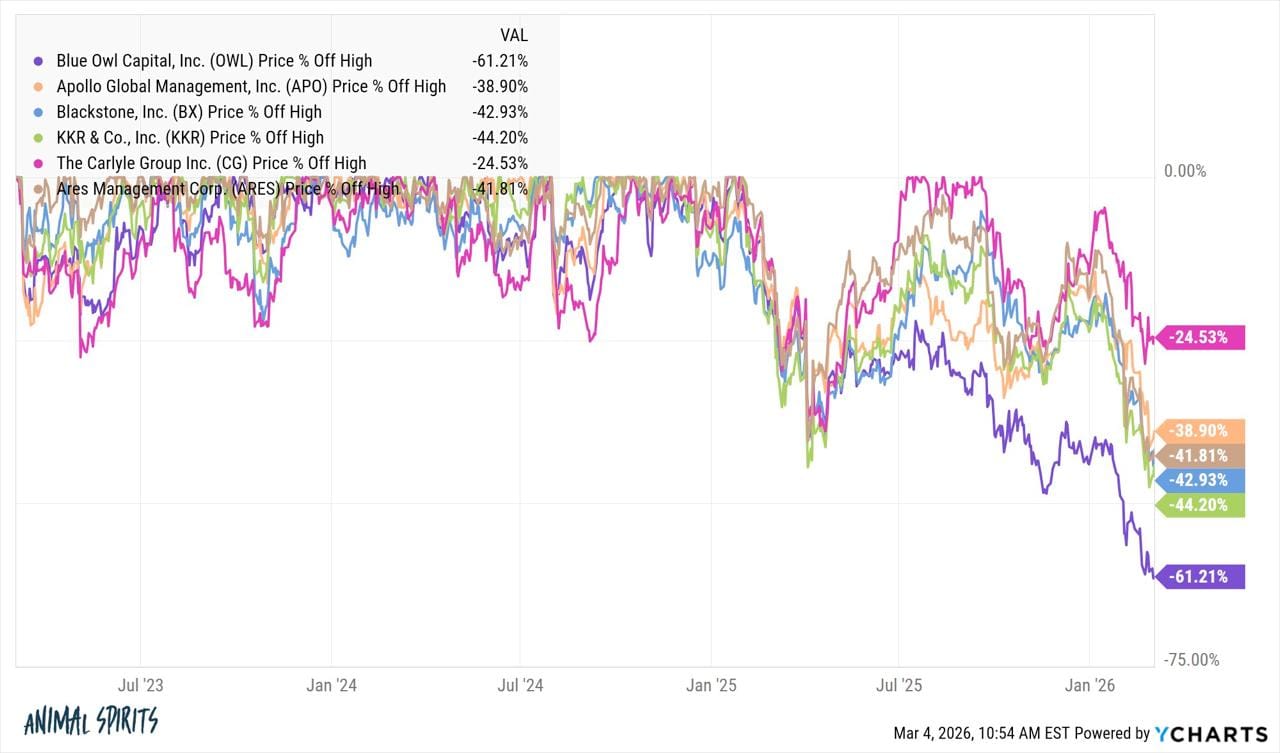
It's not noise. It's the sound of a $3 trillion market discovering that getting in was easy, but getting out is a different story entirely. As Contrarian Unicus detailed, the 777 Partners fraud, enabled by opaque ties to U.S. insurance companies, was just the canary. The UK mortgage lender Market Financial Solutions collapsed last week, rattling Wall Street lenders. Reuters cited that collapse directly in its reporting on Blackstone's redemptions. This is spreading across borders and asset classes.
The lesson for freaks: these are the same institutions that tell you Bitcoin is "too risky." The same firms that manage your 401(k), your pension, your life insurance. They've been loading up on illiquid, opaque, leveraged bets during the cheap money era, and now the refinancing wave is coming due. Bitcoin sits outside this system entirely. No counterparty risk. No redemption gates. No Jon Gray telling you the fire alarm is just noise. Self-custody is the ultimate exit from a system that won't let you leave when you need to most.
|
|
|
SIGNAL
|
Children Are Disappearing From the Population
Why it matters: The fiat economy has made family formation a luxury most can't afford.
As a percentage of the global population, children aged 0-14 are about half of what they used to be. This isn't just a developed-world phenomenon. Birth rates are collapsing everywhere, and the root cause is economic. The high-velocity fiat economy has driven both parents into the workforce, inflated the cost of housing, childcare, and education beyond what a single income can support, and created a culture where financial insecurity makes starting a family feel like a reckless gamble rather than a natural progression. Add the downstream effects of gambling apps, social media addiction, pornography, and a culture that celebrates careerism over parenthood, and you get a civilization that is quietly choosing extinction. This is an existential problem that a sound money standard would begin to address by restoring the purchasing power of labor over time rather than eroding it.
|
|
The Beef Initiative Acquires Beef.com
Why it matters: Building the digital infrastructure for a decentralized food supply chain.
Texas Slim and the Beef Initiative just acquired beef.com, and it's being built as the digital infrastructure connecting American ranchers directly to consumers. For decades, the beef supply chain has been controlled by a handful of packing conglomerates that squeeze ranchers on price while consumers pay more at the register. The Beef Initiative is working to cut out the middlemen and give ranchers transparency into where their cattle go and how the money moves. In a world where food supply chains are increasingly fragile and corporate consolidation is the norm, building parallel systems for quality beef is as important as building parallel financial rails. Fortifying our food supply starts with knowing your rancher.
|
|
White Noise Adds CLI for End-to-End Encrypted Messaging Over Nostr
Why it matters: Distributed, encrypted communications without centralized servers are now accessible from the command line.
White Noise just shipped a command line interface for fully end-to-end encrypted private messaging built on the Marmot protocol, which combines the MLS (Messaging Layer Security) group messaging standard with Nostr's decentralized relay network. This is significant because it provides a distributed alternative to centralized encrypted services like Signal or WhatsApp, meaning there's no single company that can be compelled to hand over metadata or shut down access. The Marmot protocol runs via Nostr relays, so there's no central server to subpoena. As we accelerate into an age of AI-powered surveillance and centralized control, building tools like this on distributed protocols isn't just nice to have. It's imperative for preserving privacy and free communication.
|
|
Saudi Arabia, UAE, and Qatar Consider Pulling Back From U.S. Investments
Why it matters: The petrodollar recycling loop that has underpinned the U.S. financial system for decades may be fraying.
Reports are circulating that Saudi Arabia, the UAE, Kuwait, and Qatar are discussing withdrawing from contracts with the U.S. and canceling future investment commitments as economic strain from the Iran war mounts. Foreign Policy reports that vessel traffic through the Strait of Hormuz dropped to one-fifth of normal levels, over 70% of all flights to the UAE, Qatar, and Bahrain remain canceled, and production at key energy facilities has been disrupted. The economic strain is real. For decades, Gulf sovereign wealth funds have recycled oil revenues into U.S. Treasuries, real estate, and tech investments. If that flow reverses, it would put pressure on the dollar, U.S. asset prices, and the entire financial architecture that depends on foreign capital flows. As demand for U.S. Treasuries and capital markets wanes, a neutral reserve asset controlled by no central bank, no corporation, and no government becomes enormously valuable. Bitcoin doesn't care about geopolitical alliances or trade disputes. It settles without counterparties, can't be frozen by an angry trading partner, and moves across borders without asking permission. That's not a theoretical future use case. It's the value proposition playing out in real time.
|
|
U.S. Eases Oil Sanctions on Russia as Iran Conflict Squeezes Supply
Why it matters: Geopolitical chess moves are reshaping global energy flows in real time.
Javier Blas reports that U.S. Treasury has eased oil sanctions on the Kremlin, allowing Indian refineries to buy the millions of barrels of Russian crude sitting on floating storage, with the new rules covering all oil already loaded in a tanker by March 5. This is a massive win for Putin and a clear signal that the Iran conflict has forced Washington to make uncomfortable compromises. With Hormuz traffic decimated and oil prices surging, the administration needs every barrel it can get flowing. Meanwhile, Putin is threatening to halt gas supplies to Europe entirely, weaponizing energy supply as leverage. The global energy order is being rewritten in real time, and it's not going in the direction Washington planned.
|
|
Iran War Threatens Gulf AI Infrastructure
Why it matters: The physical layer of the AI revolution runs through a war zone.
Rest of World reports that both the Strait of Hormuz and Red Sea chokepoints are now effectively closed to submarine cable maintenance vessels. The UAE and Qatar data centers that are central to the U.S.-led Pax Silica initiative, designed to keep advanced semiconductors away from China, are at risk. The January 2026 Pax Silica agreement brought the Gulf states into a U.S.-led effort to control AI chip flows, but the security architecture was designed for a different threat entirely. Nobody planned for the U.S. itself to destabilize the region where the physical infrastructure sits. The AI revolution's dependency on Middle Eastern data centers and undersea cables is a vulnerability that is now being stress-tested in the worst possible way.
|
|
|
Why it matters: Energy weaponization is escalating while the world's attention is on Iran.
While Iran dominates the headlines, Putin quietly told state media that it might be "more beneficial for Russia to stop selling gas right now" to European markets. Reuters reports that European gas prices are already surging as customers scramble to secure supply amid the Hormuz disruption and the threat of further Russian cuts. The EU had planned to impose a total ban on Russian pipeline gas imports by late 2027, but Putin is calling their bluff. If Russia cuts supply now, Europe faces an immediate energy crisis on top of the Iran-driven oil shock. The downstream effects hit everything: manufacturing, heating costs, food prices, and political stability. Every energy crisis strengthens the case for neutral, borderless stores of value that can't be weaponized by any government.
|
|
Chamath and Dalio Both Attack Bitcoin's "Privacy" Within 48 Hours
Why it matters: The coordinated framing reveals what the financial elite actually fear about Bitcoin.
Within two days, both Chamath Palihapitiya (speaking at the World Government Summit) and Ray Dalio (on the All-In Podcast) argued that Bitcoin has "privacy issues" and that central banks won't adopt it as a reserve asset because transactions can be monitored. Dalio added quantum computing fears and correlation with tech stocks for good measure. Parker Lewis nailed the response: "Bitcoin obsoletes the central bank. The central bank is the problem!" The framing tells you everything. They're evaluating Bitcoin through the lens of whether it serves the existing power structure. That's like asking whether the printing press was good for the scribes' guild. Bitcoin wasn't built to be a central bank reserve asset. It was built to make central banks irrelevant. The fact that two billionaires who swim in the waters of Davos and government summits are both surfacing the same "privacy" talking point within 48 hours should make you more bullish, not less. They see the threat.
|
|
|
PRESENTED BY
|
|
|
|
DATA SNAPSHOT
|
| Bitcoin Price | $69,738 | | Sats per Dollar | 1,434 | | Block Height | 939,584 | | Network Hashrate | 1.19 ZH/s | | Total Fees (24h) | $198,541 |
| | On-Chain Metrics | | MVRV Ratio | 1.31 — Modest premium over fair value | | SOPR | 0.991 — Coins moving at slight loss on average | | STH Realized Price | $87,299 — Short-term holders deeply underwater | | NUPL | 0.234 — Hope/Fear zone | | Realized Cap | $1.09T — Aggregate cost basis of all BTC |
|
|
|
|
|
|
If this landed, forward it to someone who could use more signal and less noise. The Bitcoin Brief is free, always will be.
See you tomorrow,
Marty Bent
|
|
|
Follow: @MartyBent · @TFTC21
Nostr: primal.net/marty
YouTube: TFTC · Podcast: tftc.io/podcast
|