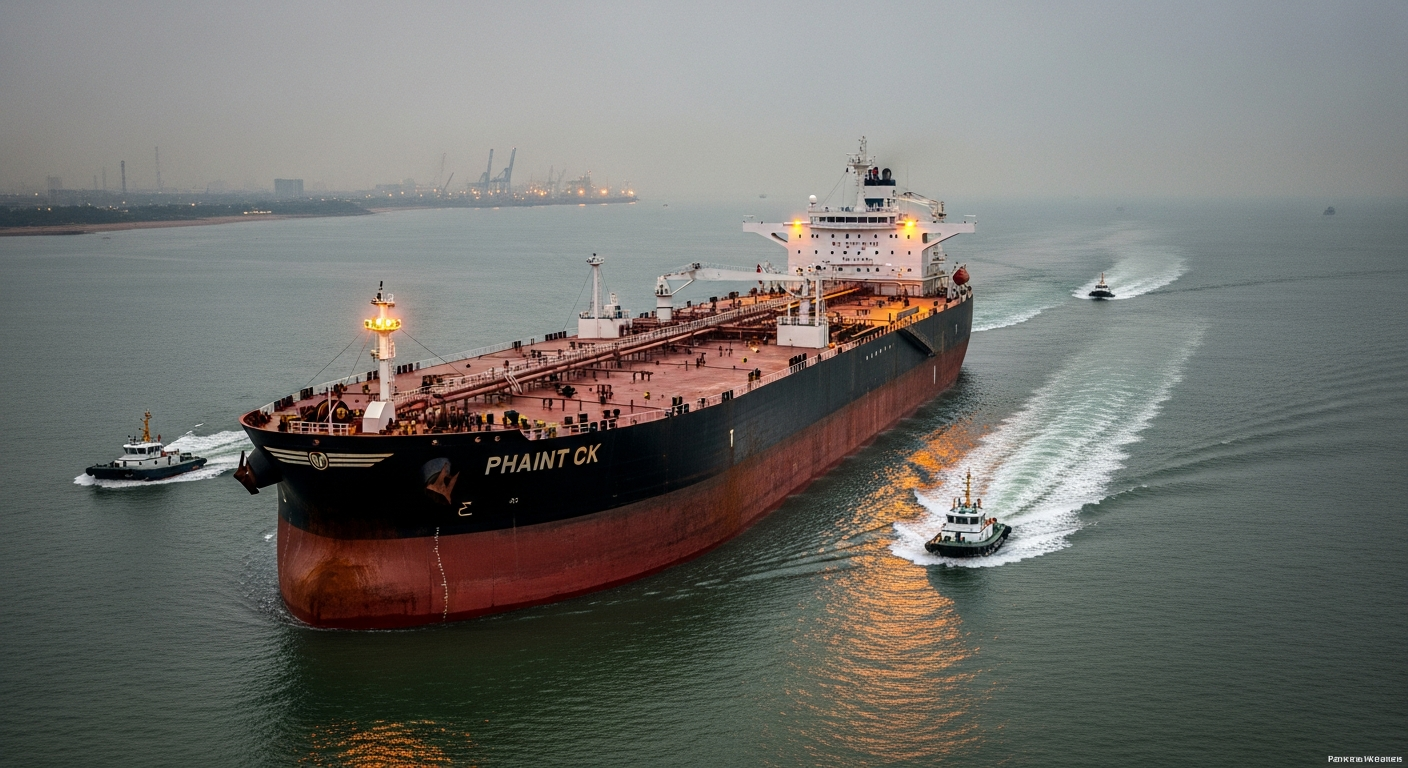
India is on track to import a record 2.35 million bpd of Russian crude in June 2026, with Russia accounting for 53.5% of all Indian oil imports. The U.S. sanctions waiver on Russian seaborne oil quietly expired. Indian refiners kept buying.
Russia now supplies more than half of India's crude oil, and the U.S. looked the other way.
Key takeaways
India imported 2.6 million barrels per day of Russian crude between June 1 and June 19, according to preliminary vessel-tracking data from Kpler cited by OilPrice.com. Kpler projects the full-month June average at 2.35 million bpd, which would be an all-time monthly record and would exceed the previous high of 2.2 million bpd from May 2023.
The Strait of Hormuz crisis is the proximate cause. The strait has been disrupted since late February 2026, and roughly 40% of India's crude imports normally transit it. Iraq, ordinarily India's second-largest supplier, has exported virtually nothing to India for approximately four months as a result. With Gulf supply offline, Indian refiners turned hard to Russia.
Russian crude is currently available at a discount of around $4 to $5 per barrel versus Brent, per Indian Defence News, making it attractive on pure economics. "India's imports remained strong through June, supported by continued discounts and steady refinery demand," said Sumit Ritolia, manager of modelling and refining at Kpler.
The timing of the waiver expiration sharpens the picture. The U.S. Treasury did not renew its sanctions waiver on Russian seaborne oil sales, with the lapse occurring around June 17, the same week Washington announced a memorandum of understanding with Iran on the Hormuz situation. The legal cover quietly disappeared. Indian refiners kept buying. Ritolia's second observation makes the forward trajectory plain: "Regardless of whether the US waiver is extended, we expect India's imports of Russian crude to remain robust, even if not at record-high levels."
A separate dataset cited by OilPrice.com shows Russian crude exports to India fell sharply in the final week of the tracking window, to levels inconsistent with the 2.6 million bpd import figure. OilPrice.com noted the disconnect without resolving it. The full-month Kpler projection of 2.35 million bpd is a forward estimate as of publication, not a settled final figure.
This is not a story about an emergency workaround. India has been buying Russian crude at scale since 2022, when Western sanctions followed the invasion of Ukraine. Four years later, Russia is India's single-largest oil supplier, and the world's third-largest crude importer is sourcing more than half its oil from a sanctioned country.
The Hormuz crisis accelerated a realignment that was already structural. That distinction matters. If this were pure crisis substitution, Indian refiners would snap back to Gulf suppliers once the strait fully reopens.
The energy shock has been severe enough to test every supply relationship, and Russia has held up as reliable and cheap. Contracts, refinery configurations, and payment infrastructure have all been rebuilt around that reality over four years.
The petrodollar architecture erodes in the background of this story. India's payments for Russian crude have run through a mix of rupees, rubles, and dirhams since 2022, with the infrastructure to move oil outside dollar rails operational at this scale. At 2.35 million bpd, this is a multi-billion dollar monthly flow that runs largely outside dollar settlement rails.
That is not theoretical de-dollarization. It is operational.
The enforcement ceiling is also now visible. When the sanctioning power quietly allows a waiver to lapse rather than confronting a non-compliant buyer of 2.35 million bpd, the message is that dollar-denominated financial coercion has a hard limit. Energy dependency is that limit.
Every country calibrating its own sanctions exposure just got a real-world data point. The Hormuz blockade has been the stress test, and the dollar-based energy order is showing the cracks.
The falsifiable version of this thesis: if India's Russian crude volumes fall back below 1.5 million bpd within 60 days of Hormuz fully reopening, and Indian refiners resume normal Gulf contractual volumes, the record imports were a crisis substitution play, not a durable shift. July and August Kpler data will answer that question. The U.S.-Iran MOU reportedly includes a finalization window of roughly 60 days, so the reopening timeline and the import data will converge around the same moment. Watch both.
Two forces combined. The Strait of Hormuz has been disrupted since late February 2026, cutting off India's normal Middle Eastern supply, including virtually all Iraqi exports for roughly four months. Simultaneously, Russian crude is available at a $4 to $5 per barrel discount to Brent, and Indian refiners have spent four years building the logistics, payment infrastructure, and refinery configurations to run Russian grades at scale. The result is a record share.
Kpler's Sumit Ritolia said plainly that Indian imports are expected to stay robust regardless of the waiver. The waiver was legal cover for transactions that were already happening. Without it, Indian refiners face theoretical sanctions exposure, but the U.S. has shown no appetite to enforce against the world's third-largest oil importer. The structural buying relationship predates the waiver and will likely outlast its expiration.
Not primarily. India's payments for Russian crude have been routed through a mix of rupees, rubles, and dirhams since 2022, with some trade also settled via other non-dollar mechanisms. The infrastructure to move oil outside dollar rails has been operational for four years at this scale, which is part of why the sanctions waiver expiration is unlikely to change the flow materially.