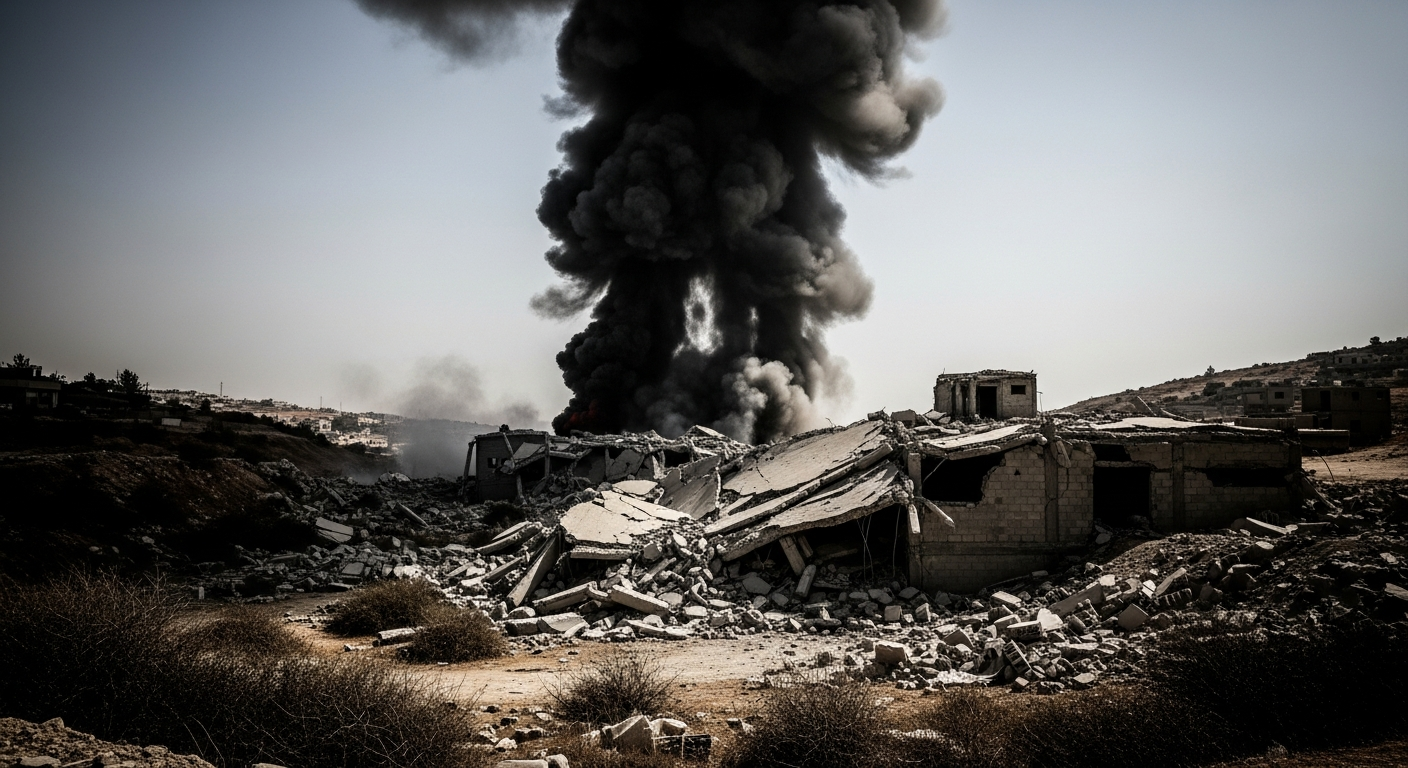
The IDF demolished a 200-meter-long, 25-meter-deep Hezbollah drone complex under the Lebanese village of Majdal Zoun on June 28, two days after signing a US-brokered trilateral security framework that Hezbollah has already rejected.
Israel destroyed a hardened Hezbollah drone base it couldn't reach from the air, and notified Washington rather than asking permission.
Key takeaways
The IDF destroyed a massive Hezbollah underground drone assembly and launch complex buried beneath the southern Lebanese village of Majdal Zoun on June 28, 2026, in an operation called "Sof Pasuk", Hebrew for "Closing Verse." The facility sat approximately ten kilometers from the Israeli border inside the IDF-controlled security zone, and it survived previous airstrikes specifically because it was engineered to do so.
Prime Minister Benjamin Netanyahu and Defense Minister Israel Katz confirmed the operation in a joint statement: "The tunnel, which is over 200 meters long and more than 25 meters deep, contained hundreds of weapons and several launch silos intended to target the territory of the State of Israel and its citizens."
The IDF's official announcement described a complex spanning 200-plus meters horizontally and plunging more than 25 meters below the surface, containing 12 rooms, living quarters, weapons storage, and four launch shafts oriented toward Israeli territory. The IDF Spokesperson's Unit stated: "The underground complex was constructed using technology and expertise provided by the Iranian terror regime."
https://x.com/IDF/status/2071344751434244500
Troops from the 551st Brigade Combat Team and Yahalom combat engineering unit, operating under the 91st Division, executed the demolition. The blast was large enough that the IDF pre-warned residents across northern Israel to expect it.
The tunnel had previously survived airstrikes. Yahalom engineers had to physically seize the complex and demolish it from the inside. The IDF escorted journalists on a media tour of the facility earlier in June, roughly ten days before the demolition. During the earlier ground seizure, more than 20 Hezbollah fighters were killed, including members of the Radwan Force.
Hezbollah has not publicly commented on the tunnel's destruction.
The timing is the story. On June 26, 2026, the US, Israel, and Lebanon signed a trilateral security framework at the State Department. Two days later, Israel demolished a village and notified Washington rather than halting. The Netanyahu-Katz joint statement was explicit: "Israel updated the United States and the American representative in Lebanon in advance regarding the destruction of the infrastructure."
Pre-notification is not permission-seeking. The gap between those two things is the gap between a real ceasefire and a diplomatic document.
Hezbollah lawmaker Hassan Fadlallah has already warned of "internal conflict" in Lebanon over the agreement. Hezbollah itself has rejected the framework's disarmament terms. The Lebanese state may have accepted the paper; the armed group holding southern Lebanon did not.
That fragility connects directly to the energy shock already repricing global markets. The tunnel was built with Iranian technology and engineering as part of the same broader Iranian drone proxy architecture that is also implicated in attacks on Strait of Hormuz shipping, though the IDF's own primary statements describe the facility as constructed with Iranian technology and expertise without specifying an operational link to confirmed Hormuz strikes. These are two forward nodes of the same Iranian proxy architecture, and destroying one tunnel in Lebanon does not close the supply route, it moves the queue.
The OPEC defection and Hormuz disruption were already tightening the energy risk premium before this operation. Persistent instability in both theaters keeps that premium elevated. Elevated energy prices feed inflation expectations. Inflation expectations running hot while the US rolls over sovereign debt at elevated rates is the monetary disorder environment that makes Bitcoin's fixed-supply argument land with people who weren't listening before.
The falsifiable version of this thesis: if Hezbollah formally accepts the trilateral disarmament terms, verifiably withdraws from southern Lebanon, and Iran ceases drone transfers to Lebanese proxies within the next 90 days, the ceasefire holds as a genuine constraint and the geopolitical tail risk recedes. That sequence is not currently in motion.
Hezbollah's formal response to the demolition will matter. Silence is not acceptance, it may simply be operational cover. The next signal is whether the trilateral framework produces any verifiable Hezbollah withdrawal from the security zone, or whether Israel continues kinetic operations inside it on its own timeline. Iran's capacity to reconstitute drone production and transfer that capability through Lebanon is the variable that determines whether "Closing Verse" is a conclusion or just a chapter break. On the FPV drone and asymmetric warfare curve, the cost to reconstitute is falling, not rising.
The complex was engineered at 25-plus meters of depth specifically to defeat air-delivered munitions. It survived previous Israeli airstrikes. Destroying it required a ground seizure by Yahalom combat engineers, who then demolished the structure from the inside. Depth is the countermeasure; the same design logic governs hardened facilities across the Iranian proxy network.
The framework was signed at the US State Department on June 26, 2026, by representatives of the US, Israel, and the Lebanese state. It conditions implementation on Hezbollah disarmament and withdrawal from southern Lebanon. Hezbollah rejected it. The Lebanese government's signature does not bind a non-state armed group that controls the territory in question. That gap between signatory and armed actor is why Israel treated the agreement as a notification obligation, not an operational constraint.
"Sof Pasuk" translates from Hebrew as "closing verse" or "end of sentence." The Israeli government framed the operation as a concluding action in a phase of operations against Hezbollah's underground infrastructure in the southern Lebanon security zone. Whether it represents a genuine operational conclusion or an interim strike depends on what Hezbollah and Iran do next.