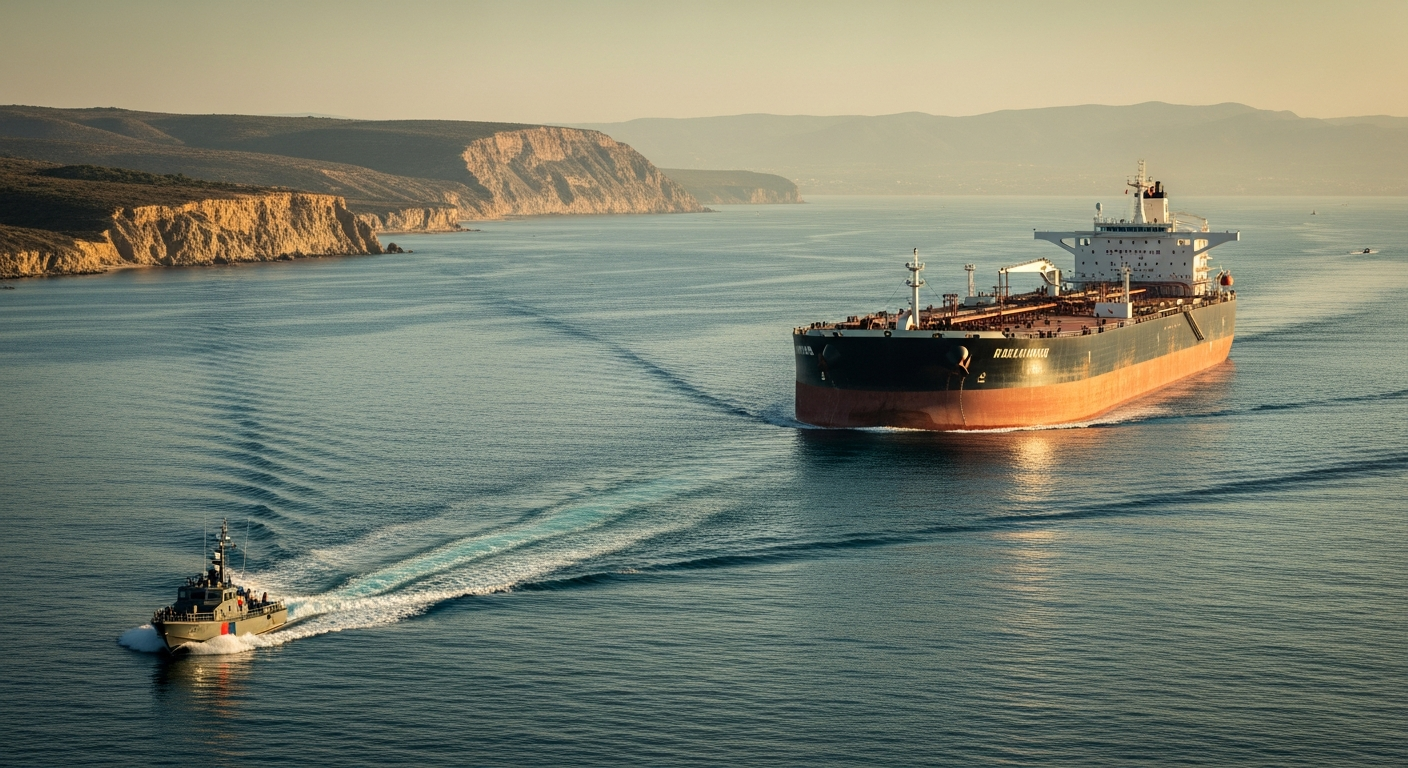
NYK Line CEO Takaya Soga told the Financial Times that Hormuz shipping will remain well below prewar levels for months. With 80 naval mines sitting in the main traffic lane, the U.S.-Iran MOU can't fix what minesweepers haven't cleared.
The U.S.-Iran MOU is a paper agreement. The mines are steel, and they're still in the water.
Key takeaways
Takaya Soga, CEO of NYK Line, one of the world's largest shipping operators, told the Financial Times in an exclusive weekend interview that the Strait of Hormuz is nowhere close to functional. Shipping volumes will stay well below prewar levels for months, even if the U.S.-Iran memorandum of understanding signed June 17 holds, because the physical obstruction is independent of political agreements.
"The routes available for navigation are extremely limited, they're very narrow corridors," Soga said. "We're still nowhere near returning to conditions before the closure of the Strait of Hormuz."
The story was first reported by the Financial Times.
https://x.com/FT/status/2071088730073444437
The operational picture underneath the diplomatic headline is stark. IMO Secretary-General Arsenio Dominguez confirmed at a June 27 press briefing that approximately 80 naval mines are sitting across the Strait's Traffic Separation Scheme, the designated main shipping corridor. Bloomberg reported the IMO's estimate directly from the Secretary-General's statement.
With the TSS mined, vessels are routed through two narrow workaround corridors: one northern lane under Iranian-controlled waters, one southern lane coordinated by Oman and U.S. forces. Neither replaces the throughput capacity of the main channel. That's the physical constraint Soga is describing, and no MOU changes it until minesweepers clear it.
Dominguez paused the IMO's coordinated evacuation plan, citing the need to "reconfirm that the necessary safety guarantees continue to be in place." The pause came after the Evergreen-operated container ship Ever Lovely (Singapore-flagged) was attacked on June 25, followed by U.S. retaliatory strikes against Iran, Iranian strikes targeting Bahrain and Kuwait, and an IRGC drone strike on the Panama-flagged tanker Kiku on June 27. UK maritime authorities separately confirmed a vessel was struck on its starboard side roughly 7.5 nautical miles southeast of Dahit, Oman.
The conflict began when U.S. and Israeli forces launched airstrikes on Iran on February 28, 2026.
This is being covered as a shipping story. It's an inflation story.
Hormuz carries roughly 20% of the world's traded oil. With the TSS mined and two narrow corridors replacing it, effective throughput is locked below half of prewar levels by the operational assessment of a company running one of the world's largest commercial fleets. That constraint doesn't resolve with a press release. It resolves when minesweepers physically clear 80 mines from an active conflict zone, a process that takes months under ideal conditions and considerably longer under hostile ones.
Container freight was already pricing in dislocation. Drewry's World Container Index registered $4,166 per 40-foot container for the week of June 25, a 22-month high. Xeneta has forecast no supply-chain normalization before mid-September. Every month the mines stay in the TSS is another month of cost-push pressure passed through to manufacturing, food, and transport, feeding CPI and complicating Fed decision-making.
The "normalization" narrative priced into markets after the June 17 MOU was a mispricing of physical reality. The energy shock isn't a spike resolving on a diplomat's timeline. The weekend's kinetic activity, three attacks on commercial vessels and an IMO evacuation pause, confirms the deal isn't holding on the water regardless of what it says on paper.
TFTC has been tracking the petrodollar fractures, multipolar energy flow rerouting, and the inflation implications of the Hormuz closure since the conflict began.
The thesis breaks if U.S. Navy and allied minesweepers complete verified clearance of the TSS and tanker-transit data tracked by Kpler or Bloomberg returns to within 20% of prewar daily averages (the baseline is roughly 20 million barrels per day through the strait). Until that data moves, the market is underpricing the duration of disruption, and the sustained energy-input premium is a persistent tailwind for hard-money demand. Watch the Kpler weekly transit count and any UKMTO threat-level change as the leading indicators.
Mine clearance timelines depend on mine density, water depth, current conditions, and whether the operating environment is permissive or actively hostile. In a best-case, fully cooperative scenario, clearing 80 mines from a busy commercial shipping lane typically takes several months. In an environment where kinetic attacks on commercial vessels continued through the weekend of June 27-28, 2026, operational clearance timelines extend considerably beyond that.
The U.S. Energy Information Administration estimates that approximately 20% of the world's traded petroleum and liquefied natural gas transits the Strait of Hormuz, making it the world's most critical oil chokepoint. At below 50% of normal throughput, the effective supply reduction is roughly 10% of global traded oil, a sustained shock with no near-term physical fix.
The IMO developed a coordinated framework to safely passage commercial vessels and their crews that were stranded in the Persian Gulf following the strait's closure. IMO Secretary-General Arsenio Dominguez announced on June 27 that he was temporarily pausing the plan's implementation to reconfirm safety guarantees, following renewed attacks on commercial shipping. The pause leaves an unknown number of vessels and crew members awaiting passage through the strait.