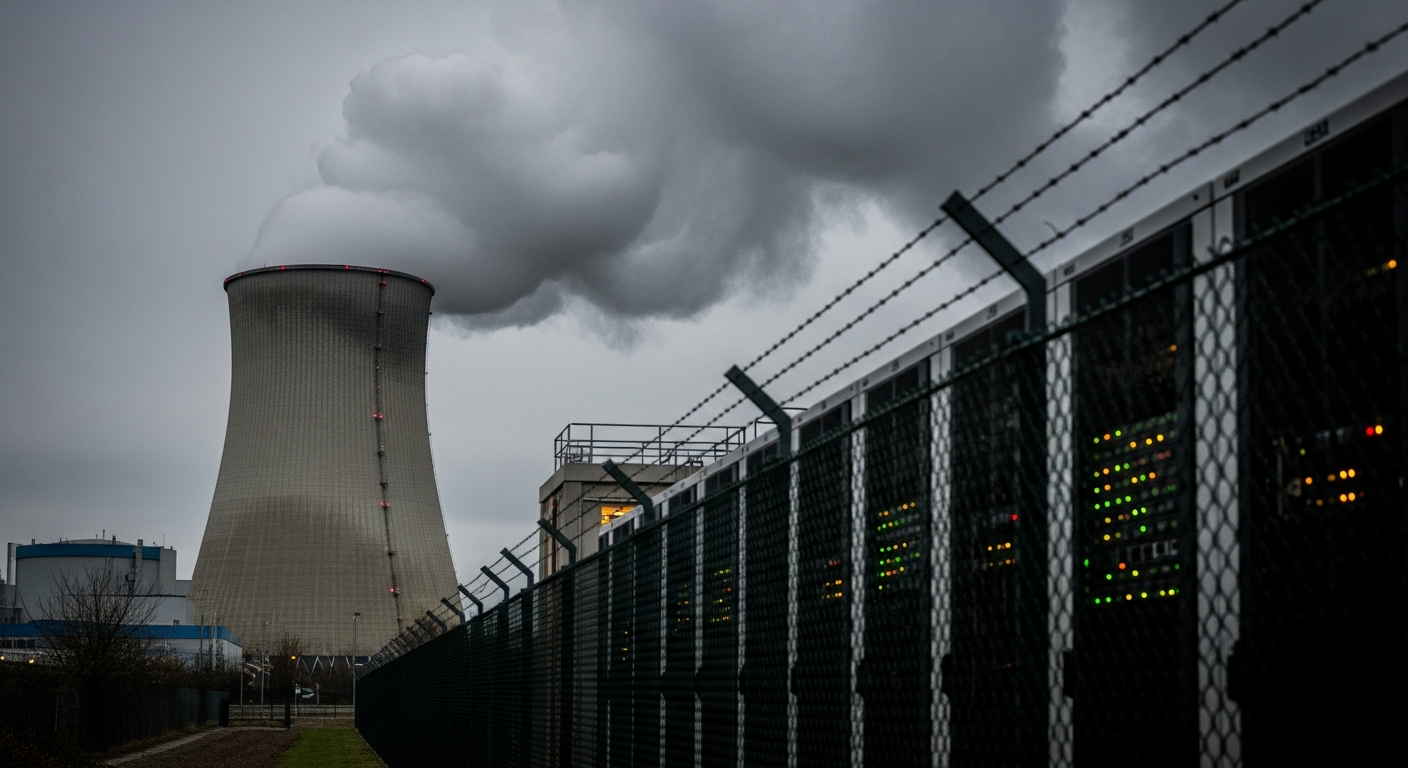
The federal government just put its balance sheet behind nuclear power. Whether the program delivers reactors or another cost explosion is the only question that matters.
Key takeaways
The Department of Energy's Office of Energy Dominance Financing announced on June 23, 2026, that it would make up to five conditional loans available under the American Nuclear Supply Chain Loans program, each backing a two-reactor Westinghouse AP1000 project for a combined 10 reactors. Each reactor generates 1.1 GW, with the combined output from all 10 enough to power nearly 10 million American households, per the DOE press release. First reported by the Wall Street Journal, the announcement arrived just over one year after Trump signed Executive Order 14302, "Reinvigorating the Nuclear Industrial Base," which set a target of 10 reactors under construction by 2030.
Energy Secretary Chris Wright framed the commitment in direct terms: "To accomplish that mission, these conditional loans will play an important role in reviving the supply chain needed for America to once again build large-scale commercial reactors. They will also help accelerate the timeline of building those large-scale reactors by up to three years, lowering construction costs and ensuring the United States is able to deliver on President Trump's bold and ambitious energy addition agenda."
The structure is worth understanding precisely, because it is not a blank check.
Loans are administered through a Westinghouse special purpose vehicle, with each project funded through a vehicle jointly owned by Westinghouse and the utility partner. Before either party touches a dollar of DOE money, Westinghouse and the partner utility must each commit $500M in equity, totaling $1B per project up front. The DOE's conditional commitment covers the long-lead procurement that determines the schedule: reactor pressure vessels, steam generators, and structural modules that take years to manufacture. Buying that equipment in bulk, at fixed prices, before full project finance is committed is the mechanism designed to compress timelines and lock costs.
Seven utilities have signed formal letters of intent for the five project slots. The DOE declined to name any of them. Per EDF Director Greg Beard, the Trump administration expects major technology companies to sign long-term power purchase agreements to backstop these projects. Microsoft and Google already have existing nuclear PPAs (Three Mile Island and Duane Arnold, respectively), so the template exists.
The program's credibility lives and dies against one data point. Vogtle Units 3 and 4 in Georgia are the only AP1000s ever completed in the United States. They were budgeted at roughly $14B and finished at over $30B, per EIA data. Construction took approximately a decade. The abandoned VC Summer AP1000 project in South Carolina burned through roughly $9B before it was cancelled entirely.
The DOE's answer to Vogtle is the supply-chain-first approach: bulk procurement at fixed prices before construction begins, rather than the sequential, one-off contracting that turned Vogtle into a change-order machine. That logic is sound in theory. Whether it holds at fleet scale across five simultaneous projects, with seven unnamed utilities still only at the letter-of-intent stage, is the unanswered question.
Cameco CEO Tim Gitzel, whose company co-owns Westinghouse, called the commitment "an additional commitment to expanding nuclear power capacity using the proven AP1000 reactor technology." Supportive, but measured. That is the appropriate register given the track record.
The energy shock playing out across global markets makes the stakes here higher than a normal infrastructure announcement. Firm, dispatchable baseload is the scarce commodity. Getting the procurement structure right is not academic.
The second-order read matters here, and it runs in two directions.
Hyperscalers are expected to sign long-term PPAs to backstop these reactors, meaning AI data centers are locking up baseload capacity before it physically exists. That is rational for an inflexible, always-on load that cannot tolerate curtailment. Bitcoin miners sit structurally on the other side of that equation. Mining is price-responsive and interruptible by design. As always-on loads lock up firm capacity through long-term contracts, demand-responsive miners become the marginal, flexible load that fills gaps when power is cheap and steps back when it is scarce. More nuclear baseload strengthens that dynamic, it does not threaten it. The AI capex buildout and nuclear expansion are happening in parallel, and miners who understand their structural role in that grid are positioned to benefit from the tighter, more contested power market that results.
The policy backdrop also matters. The U.S. grid is now explicitly betting on dispatchable baseload over intermittent generation. That is the macro environment Bitcoin mining needs: stable, firm, abundant power priced at cost of production, not subsidized renewables that distort the dispatch stack.
The gap between letter of intent and equity check is where nuclear programs die in the United States. The falsifiable version of this thesis: if the five project SPVs fail to secure final partner equity commitments by 2027, or if no reactor breaks ground by 2030 as EO 14302 requires, this program is a press release with a price tag attached to it.
The signal to watch is the first named utility committing actual equity. That is when the announcement becomes a project.
Long-lead items are the major components that take years to manufacture and can only come from a handful of specialized suppliers: reactor pressure vessels, steam generators, large forgings, and pre-fabricated structural modules. In the Vogtle construction, these were ordered project-by-project under sequential contracts, which created schedule dependencies and cost escalation when any single component was delayed. The DOE program is designed to place bulk, fixed-price orders for all 10 reactors before construction on any individual project begins. If a supplier delivers on fixed-price contracts across a fleet order, the cost discipline that eluded Vogtle becomes achievable. If suppliers cannot hold those prices at scale, the problem recurs.
New firm baseload changes the supply side of the power market. More always-on, dispatchable generation means more hours where supply exceeds inflexible demand, creating the surplus windows where behind-the-meter and grid-interactive miners operate at their best economics. It also reinforces the structural case for mining as a flexible load resource: as data centers lock up capacity through long-term PPAs, miners fill the role of demand that can absorb surplus and curtail during scarcity. That is a feature, not a vulnerability.
Letters of intent are not binding commitments. The DOE's conditional loan does not disburse until each partner commits $500M in equity. History is not encouraging: the VC Summer project in South Carolina had regulatory approvals, partial construction, and billions already spent before its utility partners abandoned it in 2017. The unnamed status of the seven LOI signatories at this stage means there is no public accountability mechanism yet. Until a utility puts equity on the table and allows its name to be attached to a specific project, the program remains a framework, not a construction schedule.