TFTC – Truth for the Commoner
Bitcoin Brief
|
|
Sup, freaks.
Security researchers just exposed a secret AI surveillance machine that's been watching millions of OpenAI users behind the scenes for over two years. A KYC provider called Persona has been running 269 different verification checks on your face, comparing your selfie to every politician on Earth, and filing reports directly with government agencies. This isn't some conspiracy theory, it's 53MB of unprotected source code sitting on a FedRAMP government endpoint. When you hand over your passport to use a chatbot, your biometrics end up in permanent government watchlist databases. This is the digital panopticon in action, and it's exactly what Bitcoin skeptics of KYC have been warning about for years.
|
|
LEAD STORY
|
Researchers Uncover Secret AI Surveillance Machine Linking KYC Provider Persona and OpenAI
This is the smoking gun that privacy advocates have been looking for. Security researchers vmfunc, MDL, and Dziurwa discovered 53MB of unprotected source maps on a FedRAMP government endpoint that expose the full architecture of a mass surveillance system disguised as identity verification. The domain `openai-watchlistdb.withpersona.com` has been running since November 2023, a full 18 months before OpenAI ever disclosed any ID verification requirements to the public.
Persona, the KYC provider, screens "millions monthly" for OpenAI and "automatically screens over 99% of users behind the scenes in seconds." But this isn't simple age verification. The system runs 269 individual checks, including SelfieSuspiciousEntityDetection and SelfiePublicFigureDetection, which compares your face to every politician on Earth with similarity scoring categorized as low, medium, or high. There's a literal "Send to FinCEN" button for filing Suspicious Activity Reports directly with the Treasury Department, and STR filing to FINTRAC in Canada tagged with intelligence program codenames: Project SHADOW, Project LEGION, Project GUARDIAN, Project PROTECT, Project ATHENA, Project ANTON, and Project CHAMELEON.
The system maintains 13 types of tracking lists including biometric face databases with 3-year retention, Chainalysis crypto address surveillance with persistent monitoring on a cron job, and PEP (Politically Exposed Person) facial recognition that compares your selfie to every politician's face with similarity scoring using Wikidata photos. A new "ONYX" deployment appeared February 4, 2026, matching ICE's $4.2M surveillance tool Fivecast ONYX. Even more disturbing, OpenAI blocks Ukraine alongside sanctioned nations despite Ukraine NOT being OFAC-sanctioned.
The researchers confirmed that the government platform (withpersona-gov.com) runs the SAME codebase as the commercial platform, verified through matching git commits. When the findings were published, Persona CEO Rick Song entered correspondence with the researchers, but the core findings remain unaddressed. All of this was discovered through passive reconnaissance using Shodan, certificate transparency logs, DNS records, and public source maps, no systems were breached.
This is exactly what KYC skeptics have warned about for years. You hand over your passport to use a chatbot, and your biometrics end up in permanent government watchlist databases. The Bank Secrecy Act enables this surveillance infrastructure, and companies like Persona profit from building digital panopticons that would make Orwell blush. Bitcoin is the antidote: permissionless, no KYC at the protocol level, and no central point of failure that can be co-opted by surveillance agencies. Every sat you stack outside the traditional financial system is a vote for financial privacy and human dignity.
|
|
|
SIGNAL
|
FOMC Minutes: Rate Hikes Back on the Table
Why it matters: Fed officials upgraded growth to "solid" while flagging private credit vulnerabilities.
The January 27-28 FOMC minutes released February 18 show a 10-2 vote, with Waller and Miran dissenting because they wanted a 25 basis point cut. The Committee upgraded economic growth from "modest" to "solid" while describing inflation progress as "uneven." They specifically flagged "vulnerabilities" in private credit markets. Bitcoin dropped below $66,000 after the release as markets repriced the probability of rate cuts. When the Fed starts talking about solid growth and uneven inflation in the same breath, they're setting up the narrative for keeping rates higher for longer.
|
|
Bitcoin as a Liquidity Alarm Bell
Why it matters: The only truly free market may be detecting what centrally planned markets cannot.
Jack Mallers made an observation worth sitting with: Bitcoin has been labeled "weak" since it diverged from the Nasdaq, but what if it's the smoke alarm? Bitcoin trades 24/7/365. It can be sold instantly for cash anywhere on Earth. There is no circuit breaker, no market maker propping up the bid, no Fed put. When liquidity gets tight, Bitcoin feels it first because it's the only asset that trades in a truly free market. The divergence from equities isn't a failure of the thesis. It may be Bitcoin doing exactly what a free market is supposed to do: telling you the truth before the managed markets are allowed to.
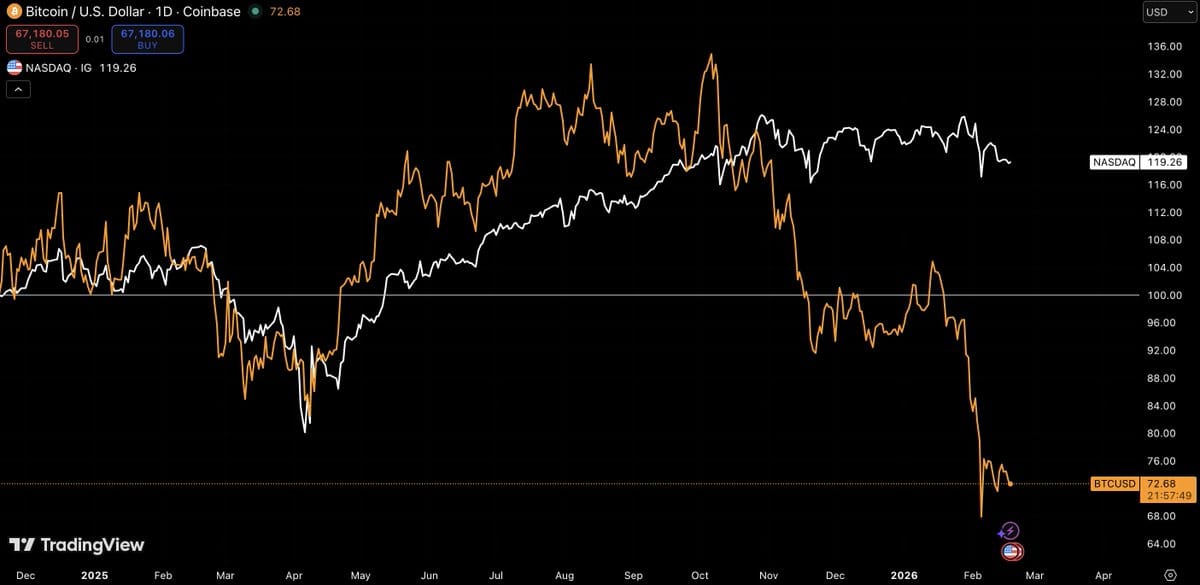
Chart via @jackmallers
|
|
Arkade's MCP: Agents Accept Stablecoins, Settle in Bitcoin
Why it matters: Another mechanism for Bitcoin to become the settlement layer of the agentic economy.
Alex Berg from Ark Labs shipped Claw Cash, an MCP (Model Context Protocol) integration that lets AI agents accept stablecoin payments from humans and immediately convert to Bitcoin. The flow: a human pays in USDC or USDT on Polygon, Arbitrum, or Ethereum. The agent auto-swaps to sats and settles on Arkade using VTXOs, virtual transaction outputs from the Ark protocol that enable instant transfers with minimal fees. No block confirmations needed for agent-to-agent payments. This is Bitcoin as verifiable money for machines: 21 million cap enforced by math, every block header cryptographically linked, no trust required. Agents can verify the chain with code. Fiat can't offer that. Between this and NUT-24 (Cashu ecash over HTTP 402), agents will have many Bitcoin tools at their disposal to conduct commerce in the agentic economy.
|
|
Global Liquidity Hits All-Time High: $188.8 Trillion
Why it matters: 3-month lag to risk assets suggests April/May bullish inflection.
Michael Howell's Capital Wars data shows global liquidity hit a record $188.8 trillion with a 3-month annualized growth rate of 3.6%. The dollar appears to be peaking while China expands stimulus. Howell's research consistently shows approximately a 3-month lag between liquidity expansion and risk asset performance, which points to a potential bullish inflection for Bitcoin and other risk assets in April or May. When central banks coordinate to flood the system with liquidity, scarce assets like Bitcoin benefit disproportionately.
|
|
20-Year Treasury Auction: Lowest Foreign Demand Since 2021
Why it matters: Foreign buyers pulling back raises fiscal sustainability concerns.
The 20-year Treasury auction on February 18 showed ugly demand metrics with yields jumping immediately after. Foreign buyers, traditionally the marginal purchaser of long-term US debt, are pulling back to levels not seen since 2021. This comes as the US Treasury needs to issue record amounts of debt to fund government operations. When foreign central banks and sovereign wealth funds lose appetite for US paper, the Fed becomes the buyer of last resort, which is just money printing with extra steps. Bitcoin looks more attractive when the fiscal sustainability of the world's reserve currency comes into question.
|
|
Crypto Is the Tower of Babel
Why it matters: Bitcoin's sound foundation becomes more valuable as crypto pivots endlessly.
Base announced they're leaving the Optimism Superchain to build their own stack, prompting Marty to observe: "Crypto is a tower of babble with no sound foundations. Things are built, they don't work optimally. A new shiny thing catches the eye of the builders. They pivot and work on more on sound foundation. The end result is a never-ending stream of pivots and hard forks that degrade reliability. This is why we are Bitcoin only. It's the only sound foundation to build on." While crypto projects chase the latest trend, Bitcoin's stable and robust protocol becomes more valuable precisely because it resists constant change.
|
|
Israeli Government Installed Surveillance at Epstein's Manhattan Apartment
Why it matters: Foreign intelligence operations on US soil targeting prominent Americans.
A Drop Site News investigation revealed that DOJ emails show the Israeli government installed security equipment at Jeffrey Epstein's 301 E. 66th Street apartment starting in early 2016. Rafi Shlomo from the Israeli mission to the UN controlled access and conducted background checks. Former Prime Minister Ehud Barak frequently stayed there. The building housed underage models, and Epstein personally approved the installation of window sensors and remote access control equipment. The fact that Israeli security agencies set up surveillance systems in that location on American soil suggests they were definitely monitoring prominent visitors, potentially to gather blackmail material to influence American politics and business. This is the kind of intelligence operation that makes Bitcoin's censorship resistance even more valuable.
|
|
Blue Owl Permanently Halts Redemptions at Retail Private Credit Fund
Why it matters: The "democratization of private credit" is showing its true colors. You can get in, but you can't get out.
Per the Financial Times, Blue Owl Capital has permanently halted redemptions at a private credit fund aimed at retail investors, backtracking from an earlier promise to reopen withdrawals. This is the culmination of a slow-motion bank run that started in mid-2025.
Blue Owl manages five BDCs (business development companies), two public and three private. The private funds promise quarterly liquidity at net asset value, subject to a 5% gate. The problem: public BDCs started trading at 20%+ discounts to NAV, creating an obvious arbitrage. Why hold the private fund at 100 cents when you can redeem and buy the exact same portfolio on the public market at 80 cents? Through the first nine months of 2025, investors in the non-traded OBDC II pulled roughly $150 million, about 15% of NAV, running near the quarterly gate limit.
In November, Blue Owl tried to solve the problem by merging the private fund into the public one. The catch: investors couldn't redeem until the merger closed, and they'd take a ~20% haircut converting to public shares. The market revolted. OWL stock tanked. Blue Owl called off the merger the next day and promised to reopen redemptions in Q1 2026. In January, when they raised the gate on another fund (Blue Owl Technology Income Corp) from 5% to 17%, investors immediately yanked 15.4% of assets. Now, instead of reopening as promised, they've permanently locked the door.
This is the private credit version of Blackstone's REIT gating in 2022. Wall Street sold retail investors "access" to institutional-grade private credit with the promise of quarterly liquidity. That promise was always backed by gates and fine print. When too many people wanted out at the same time, the exit disappeared entirely. Remember, the FOMC minutes released yesterday specifically flagged "vulnerabilities in private credit." This is what they were talking about.
Bitcoin trades 24/7/365. Real-time price discovery. Instant settlement. No gates, no redemption windows, no merger tricks, no 20% haircuts to exit. The liquidity is real because it was never a promise from a fund manager. It's a property of the protocol. When the next wave of private credit stress hits, and the FOMC minutes suggest it will, the contrast between fake liquidity and real liquidity will become impossible to ignore.
|
|
|
DATA SNAPSHOT
|
| Bitcoin Price | $66,465 | | Sats per Dollar | 1,505 | | Block Height | 937,396 | | Network Hashrate | 1,078 EH/s | | Priority Fee | 2 sat/vB |
| | On-Chain Metrics | | MVRV Ratio | 1.21 , Fair value range, not overheated | | SOPR | 0.97 , Coins moving at a loss on average | | STH Realized Price | $89,968 , Short-term holders deeply underwater | | NUPL | 0.17 , Hope/Fear zone, capitulation fading | | Supply in Profit | 50.5% , Half of all coins are green | | Realized Cap | $1.10T , Aggregate cost basis of all coins |
|
|
|
|
If today's issue gave you signal, forward it to a friend who deserves better information. Know someone who should be reading this? Send them to tftc.io/bitcoin-brief to subscribe. The Bitcoin Brief is free, always will be.
See you tomorrow,
Marty Bent
|
|
|
Follow: @MartyBent · @TFTC21
Nostr: primal.net/marty
YouTube: TFTC · Podcast: tftc.io/podcast
|